
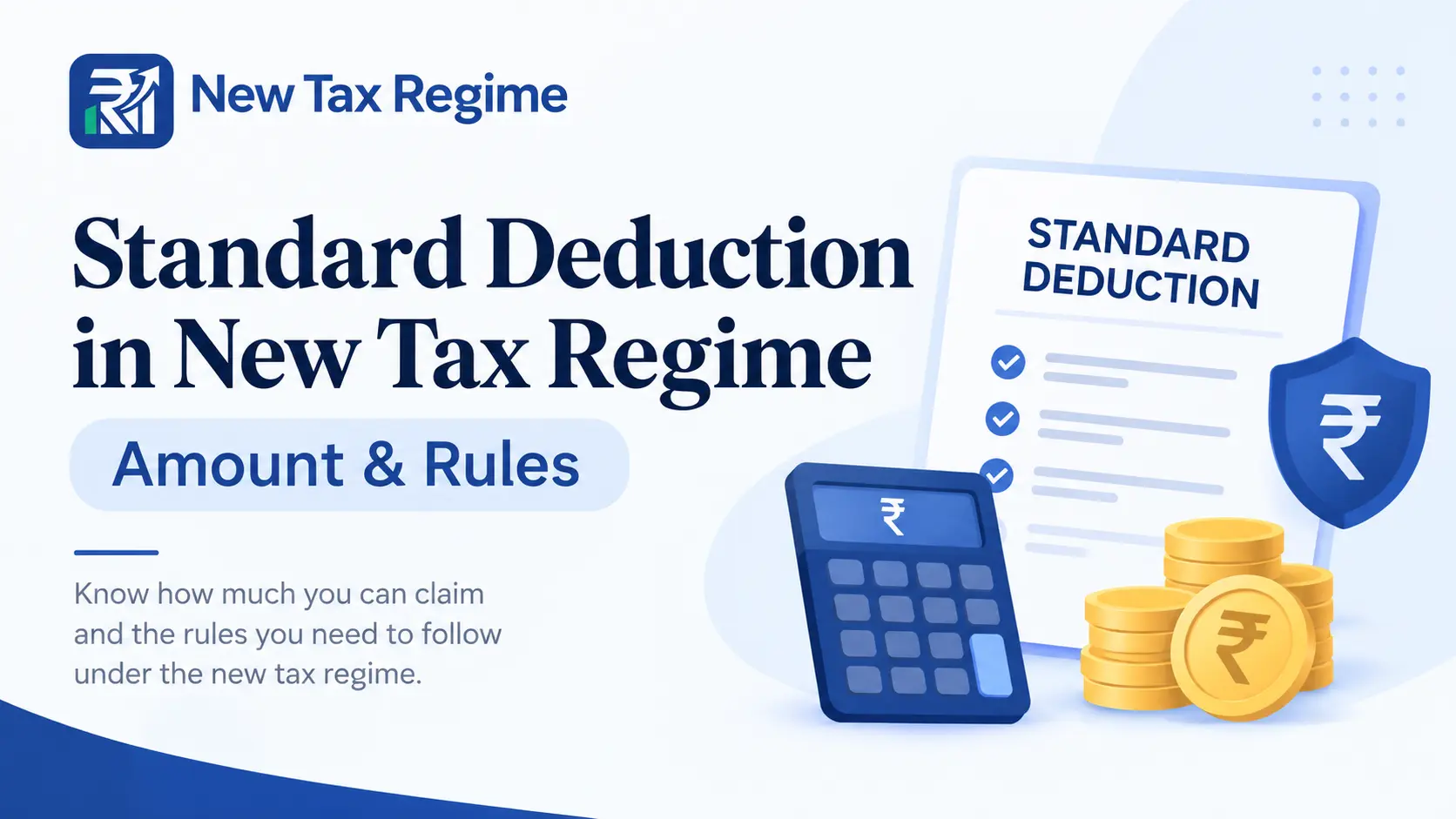
Yes, the standard deduction in new tax regime is available for eligible salaried taxpayers and pensioners for FY 2025-26 (AY 2026-27).
Under the new regime, the deduction is ₹75,000, which is subtracted from eligible salary or pension income before taxable income is calculated. The provision was increased from ₹50,000 to ₹75,000 and applies from AY 2025-26 onward.
This deduction does not require the taxpayer to prove actual expenses. The main benefit is straightforward: a qualifying employee with ₹15 lakh of salary, for example, can reduce salary income by ₹75,000 before moving to the next stage of the tax calculation.
Discover More About:👇
What Is Standard Deduction in New Tax Regime?
The standard deduction is a fixed deduction available against eligible income from salary or pension.
Instead of asking an employee to calculate work-related expenses individually, the tax rules provide a prescribed deduction that can be applied while computing income under the head “Salaries.”
For FY 2025-26, the maximum standard deduction under the new regime is ₹75,000. The relevant provision was changed to substitute ₹75,000 for the earlier ₹50,000 amount.
The deduction reduces taxable income, not the tax bill by an equal amount. For example, a ₹75,000 deduction does not mean the taxpayer receives ₹75,000 back.
It means ₹75,000 of eligible salary income is removed before the applicable tax calculation.
You May Also Like To Read These Posts 👇
Complete List of Deductions & Exemptions Allowed in New Tax Regime
NPS Deduction (80CCD(2)) Under New Tax Regime – Full Guide for FY 2025-26
Section 87A Rebate in New Tax Regime – Eligibility & Limit FY 2025-26
HRA Exemption in New Tax Regime – Can You Still Claim It?
How the Deduction Works
Suppose an employee has eligible salary income of ₹15,00,000 during the year.
Gross salary: ₹15,00,000
Less: Standard deduction: ₹75,000
Salary income after deduction: ₹14,25,000
The resulting amount then moves into the broader income-tax calculation, which can include other income, permitted deductions, and the applicable tax rates.
The standard deduction is therefore different from a tax rebate. A deduction lowers the income considered for tax, while a rebate reduces tax payable after the tax calculation.
Standard Deduction Under New Tax Regime for FY 2025-26
For FY 2025-26, the standard deduction for eligible taxpayers under the new regime is ₹75,000. The Budget proposal that increased the deduction became effective from 1 April 2025 and applies from AY 2025-26 onward.
| Particular | New Tax Regime |
|---|---|
| Standard deduction | ₹75,000 |
| Applicable income | Eligible salary/pension income |
| Expense bills required | No |
| Investment proof required for this deduction | No |
| Applicable from | AY 2025-26 onward |
| FY covered in this article | FY 2025-26 |
The deduction is subject to the applicable provisions governing salary income. It should not be treated as a separate deduction that can be claimed against every type of income.
Standard Deduction for Salaried Taxpayers
An eligible employee receiving taxable salary can generally claim the standard deduction while computing income from salary under the new regime.
The deduction is a fixed statutory amount rather than a reimbursement linked to the employee’s actual spending.
Employers may consider the standard deduction while calculating TDS on salary based on the tax-regime information and declarations available to them.
The final deduction is reflected in the salary-tax documentation and can be considered when filing the income-tax return.
The standard deduction is separate from benefits such as employer contributions to NPS under Section 80CCD(2). A taxpayer should not treat those two provisions as the same deduction.
Standard Deduction for Pensioners
Eligible pension received from a former employer is generally taxable under the head “Salaries.”
Such pension income can therefore qualify for the standard deduction applicable to salary income. The new-regime limit for FY 2025-26 is ₹75,000.
This should not be confused with family pension. Family pension received by a legal heir is generally taxable under “Income from Other Sources,” so the salary standard deduction does not apply to it.
Family pension may instead qualify for a separate deduction under Section 57(iia). Under the new regime, the deduction can be up to one-third of family pension or ₹25,000, whichever is lower.
How Does the Standard Deduction Reduce Taxable Income?
The easiest way to understand the new tax regime standard deduction is to separate income from tax.
A deduction is taken into account before the applicable tax rates are applied. It therefore reduces the amount of income that enters the subsequent tax calculation.
Consider an employee with ₹15,00,000 of eligible salary income:
- Gross salary: ₹15,00,000
- Standard deduction: ₹75,000
- Salary after standard deduction: ₹14,25,000
- Next step: Apply the applicable income-tax rules to the resulting income, after considering other relevant income and permitted deductions.
The deduction itself does not guarantee a particular tax saving. The actual tax benefit depends on the taxpayer’s total income, applicable slab rates, rebate eligibility, and other relevant provisions.
You May Also Like To Read These Posts 👇
80TTA & 80TTB Deduction – Are They Allowed in New Tax Regime?
Meal Card, Food Coupons & Conveyance Allowance in New Tax Regime
LTA (Leave Travel Allowance) in New Tax Regime – Rules Explained
Marginal Relief in New Tax Regime – Explained With Examples
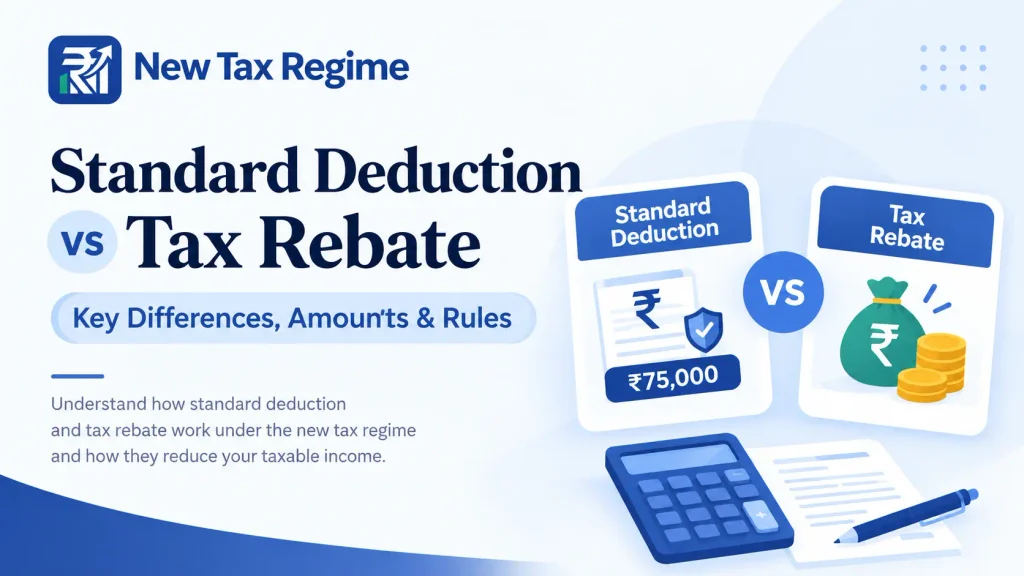
Standard Deduction vs Tax Rebate
These two terms are often confused.
A standard deduction reduces taxable income. A Section 87A rebate, where applicable, reduces the income tax calculated for an eligible resident individual.
For AY 2026-27, the Section 87A rebate under the new regime has been increased to ₹60,000 for eligible resident individuals with total income up to ₹12 lakh, subject to the applicable conditions.
Therefore, an employee should not assume that receiving a ₹75,000 standard deduction automatically creates a ₹75,000 tax saving or refund.
What Is the Standard Deduction in New Tax Regime Compared With the Old Regime?
The standard deduction is available under both tax regimes, but the amount differs.
For FY 2025-26, the new regime provides a standard deduction of ₹75,000, while the standard deduction under the old regime remains ₹50,000.
The increase to ₹75,000 under the new regime was introduced through the 2024 Budget and took effect from AY 2025-26.
| Particular | New Tax Regime | Old Tax Regime |
|---|---|---|
| Standard deduction | ₹75,000 | ₹50,000 |
| Basic effect | Reduces eligible salary/pension income | Reduces eligible salary/pension income |
| Actual expense proof | Generally not required | Generally not required |
| Main difference | Higher standard deduction | Lower standard deduction |
The standard deduction alone should not be used to decide which tax regime is better. The old regime allows a wider range of deductions and exemptions, while the new regime generally has fewer deductions but uses its own slab structure and benefits.
A taxpayer should compare the complete tax calculation rather than comparing only the ₹25,000 difference in standard deduction.
Who Can Claim the Standard Deduction?
The standard deduction for new tax regime is primarily relevant to individuals receiving eligible income taxable under the head “Salaries.”
Common qualifying categories include:
- Salaried employees receiving taxable salary income.
- Eligible pensioners receiving pension taxable as salary.
- Individuals whose income from salary is sufficient to use the prescribed deduction.
The deduction is not a general-purpose deduction against all income.
For example, a freelancer earning only professional income cannot simply subtract ₹75,000 as a salary standard deduction.
Similarly, a person earning only interest, rental income, or capital gains does not receive the salary standard deduction against those income heads.
The treatment of pension also matters. Pension from a former employer can fall under salary, whereas family pension has a different tax treatment.
Common Mistakes About Standard Deduction
Standard Deduction Is Not Section 80C
Standard deduction and Section 80C are separate provisions.
Section 80C covers specified investments and payments subject to its conditions and limits. The standard deduction does not depend on making an investment or spending money on a qualifying product.
This distinction is particularly useful under the new regime because many popular Chapter VI-A deductions are restricted, while the standard deduction continues to be available to eligible salary taxpayers.
₹75,000 Is Not a ₹75,000 Tax Refund
If the standard deduction is ₹75,000, the taxpayer does not receive ₹75,000 as a refund.
The deduction reduces taxable income. The actual reduction in tax depends on the applicable tax calculation.
For illustration, if ₹75,000 of income would otherwise have been taxed at a 30% marginal rate, the tax effect on that portion would be ₹22,500 before considering cess and other applicable factors.
This is an illustration of the calculation, not a guaranteed tax saving for every taxpayer.
No Expense Bills Are Needed for the Standard Deduction
The standard deduction is a prescribed deduction rather than reimbursement for specific expenses.
An employee does not generally need to submit rent receipts, medical bills, or investment documents to establish the standard deduction itself.
Other deductions or exemptions, where available, can have their own documentation requirements.
Do Not Treat Every Salary Benefit as the Standard Deduction
Salary can contain several components, including allowances, employer contributions, and other benefits. These items can have different tax treatments.
The standard deduction is a specific deduction from eligible salary income. It should not be added to or substituted for other deductions simply because both appear in the overall salary-tax calculation.
How to Calculate Taxable Salary After Standard Deduction
The calculation can be approached in a few simple steps.
Step 1: Identify eligible salary income
Start with the relevant salary income for the financial year.
Step 2: Apply the standard deduction
For an eligible taxpayer under the new regime for FY 2025-26, the standard deduction is ₹75,000, subject to the applicable rules.
Step 3: Subtract the deduction
For example:
₹15,00,000 salary − ₹75,000 standard deduction = ₹14,25,000
Step 4: Consider other income
If the taxpayer also earns interest, rental income, or other taxable income, those amounts may form part of the overall income-tax computation under their respective heads.
Step 5: Apply permitted deductions and adjustments
The new tax regime permits only specified deductions. For example, eligible employer contributions to NPS under Section 80CCD(2) can receive separate treatment.
Step 6: Calculate tax
The resulting total income is then considered under the applicable tax slabs, rebate provisions, and other rules for FY 2025-26/AY 2026-27.
This is why the standard deduction should be viewed as one part of the tax calculation rather than the complete tax-saving process.
You May Also Like To Read These Posts 👇
Home Loan in New Tax Regime: Deduction & Interest Benefit for FY 2025-26
Surcharge in New Tax Regime: Rates, Calculation & Marginal Relief for FY 2025-26
Gratuity & Leave Encashment Exemption in New Tax Regime
80G Deduction (Donations) in New Tax Regime – Is It Allowed?
Key Takeaways
- The standard deduction under the new tax regime for FY 2025-26 is ₹75,000 for eligible salary/pension income.
- It reduces taxable income, not the tax payable by the same ₹75,000.
- Eligible pension received from a former employer can generally qualify because it is taxed under the salary head.
- Family pension is different and can instead qualify for the separate Section 57(iia) deduction, subject to its limit.
- The standard deduction does not require taxpayers to prove actual expenses.
- The ₹75,000 new-regime deduction should not be used alone to decide between the old and new tax regimes.
Frequently Asked Questions
Is standard deduction available in the new tax regime for FY 2025-26?
Yes. Eligible salaried taxpayers and pensioners can claim a standard deduction of up to ₹75,000 under the new tax regime for FY 2025-26. The increase from ₹50,000 to ₹75,000 was introduced with effect from AY 2025-26.
What is the standard deduction amount under the new tax regime?
For FY 2025-26, the standard deduction under the new regime is ₹75,000 for eligible salary or pension income. It is a deduction from taxable income rather than a direct tax rebate or refund.
Can salaried employees claim standard deduction under the new tax regime?
Yes. An eligible salaried individual can generally claim the prescribed standard deduction while computing income taxable under the salary head.
For FY 2025-26, the applicable new-regime amount is ₹75,000, subject to the relevant provisions.
Can pensioners claim standard deduction under the new tax regime?
Yes. Pension received from a former employer is generally taxable under the head “Salaries,” so an eligible pensioner can generally claim the applicable salary standard deduction.
Family pension is treated differently and is generally taxed under “Income from Other Sources.”
Does standard deduction reduce taxable income or tax payable?
The standard deduction reduces taxable income. For example, ₹15 lakh of eligible salary becomes ₹14.25 lakh after a ₹75,000 standard deduction, before the remaining applicable tax calculation is performed. It is not itself a tax rebate or a ₹75,000 refund.
Disclaimer: This article is intended for general informational purposes and should not be treated as professional tax or financial advice. Tax treatment can vary based on individual circumstances and applicable law.

5 Comments
Pingback: New Tax Regime Deductions & Exemptions FY 2025-26
Pingback: 87A Rebate in New Tax Regime: Limit & Eligibility
Pingback: Meal Card & Conveyance in New Tax Regime
Pingback: No LTA Exemption in New Tax Regime FY 2026-27
Pingback: No HRA Exemption in New Tax Regime FY 2026-27