

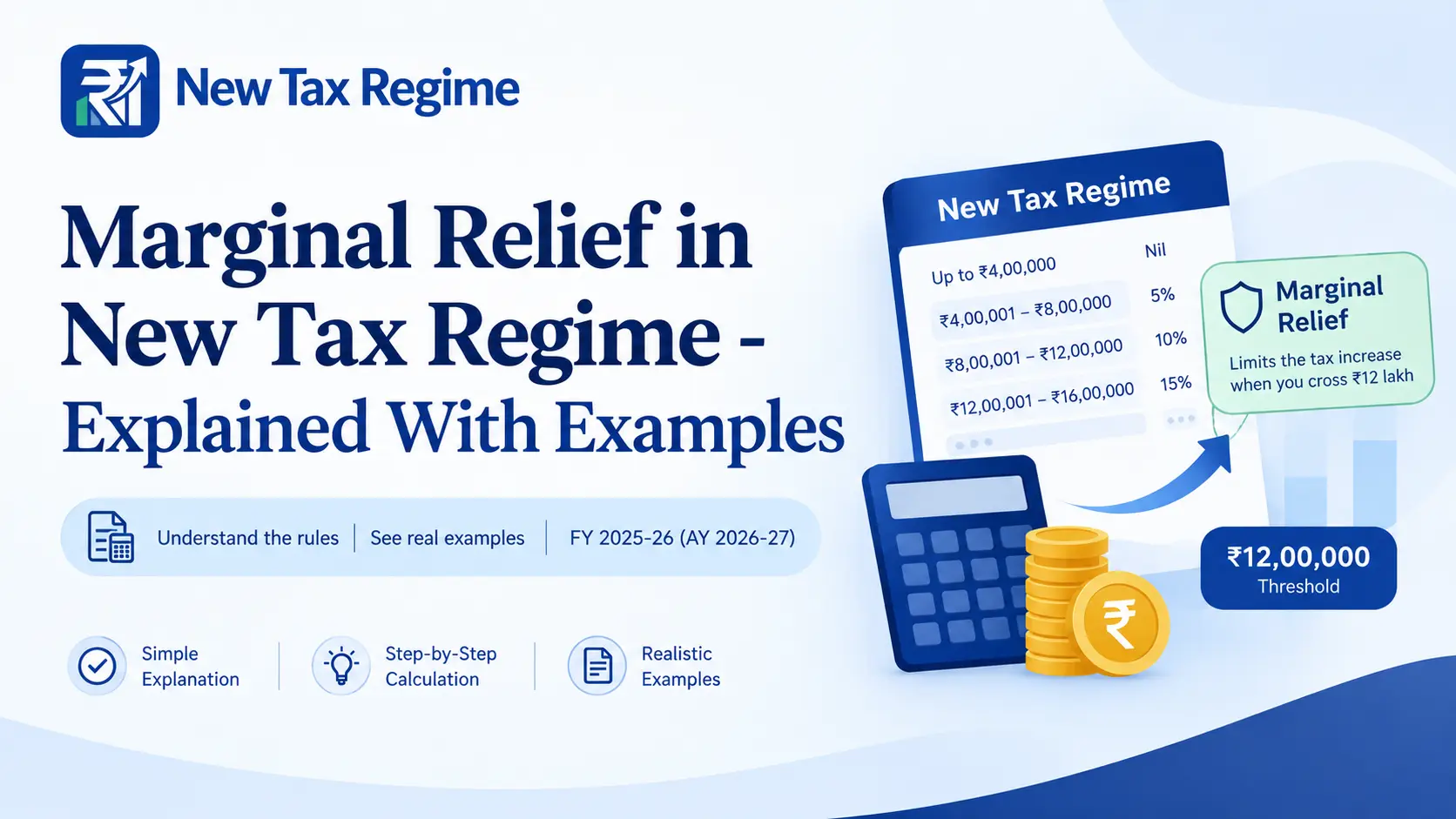
Marginal relief in new tax regime protects eligible resident individuals from a disproportionate increase in tax when their taxable income crosses the ₹12 lakh Section 87A rebate threshold by a relatively small amount.
For FY 2025-26, the new tax regime provides a Section 87A rebate of up to ₹60,000 when total income does not exceed ₹12 lakh.
When eligible income goes above that limit, marginal relief can reduce the tax so that the additional tax does not exceed the additional income over the threshold, subject to the applicable rules.
The relief is particularly relevant around the ₹12 lakh to ₹12.71 lakh range. The calculation becomes easier to understand when the slab rates, Section 87A rebate and marginal-relief mechanism are considered together.
Discover More About:👇
Marginal Relief in New Tax Regime
What Is Marginal Relief in New Tax Regime?
Marginal relief is a tax-relief mechanism that addresses the sharp increase that can otherwise occur when taxable income moves just above a threshold at which a tax benefit is available.
For FY 2025-26, the new tax regime allows eligible resident individuals with total income up to ₹12 lakh to claim a Section 87A rebate of up to ₹60,000.
The Budget 2025 changes increased both the income limit and maximum rebate from the earlier new-regime limits.
The problem becomes visible when income crosses ₹12 lakh by only a small amount. For example, a person with taxable income of ₹12,10,000 has ₹10,000 of income above the threshold.
The normal slab calculation produces tax of ₹61,500 before cess. Without marginal relief, that tax would be much higher than the additional ₹10,000 income.
Marginal relief reduces the tax in such a case. For eligible income, the relief effectively limits the tax on the amount around the threshold so that the additional tax does not exceed the income exceeding ₹12 lakh.
Marginal relief is different from a rebate. A Section 87A rebate reduces eligible income-tax liability when the taxpayer falls within the prescribed income limit.
Marginal relief instead addresses the tax increase when the taxpayer moves just beyond that limit.
Who Is Eligible for Marginal Relief Under New Tax Regime?
The marginal-relief provision associated with the ₹12 lakh Section 87A threshold applies to an eligible resident individual whose income is taxed under the new tax regime.
The Finance Bill 2025 specifically increased the Section 87A income limit for eligible resident individuals under the new regime from ₹7 lakh to ₹12 lakh and increased the maximum rebate from ₹25,000 to ₹60,000, applicable from AY 2026-27 .
A taxpayer should therefore distinguish between three separate questions:
- Is the taxpayer a resident individual eligible for Section 87A?
- Is total income within or just above the ₹12 lakh threshold?
- Is the relevant income being taxed at normal new-regime slab rates or at a special tax rate?
The third point matters because the Section 87A rebate does not apply to tax on income chargeable at specified special rates.
The Budget memorandum specifically identifies examples such as income taxed under sections 111A and 112 among the special-rate income excluded from the rebate.
Therefore, taxpayers with capital gains or other special-rate income should not apply the simple salary-income example mechanically to their entire tax calculation.
How Is Marginal Relief Calculated?
The marginal relief calculation starts with taxable income and the tax produced by the applicable new-regime slabs.
For AY 2026-27, the Income Tax Department lists these new-regime slab rates:
Nil up to ₹4 lakh, 5% from ₹4 lakh to ₹8 lakh, 10% from ₹8 lakh to ₹12 lakh, 15% from ₹12 lakh to ₹16 lakh, 20% from ₹16 lakh to ₹20 lakh, 25% from ₹20 lakh to ₹24 lakh, and 30% above ₹24 lakh .
Step-by-Step Calculation
For an eligible taxpayer with ordinary slab-rate income:
- Calculate total taxable income after applicable deductions.
- Check whether taxable income exceeds ₹12 lakh.
- Calculate income-tax using the applicable income tax slabs.
- Calculate the amount by which income exceeds ₹12 lakh.
- Compare the slab-based tax with that excess amount.
- Where the tax exceeds the excess income and the taxpayer qualifies, calculate the marginal relief as the difference.
- Add 4% Health and Education Cess after determining the applicable income-tax liability. The Income Tax Department confirms that the 4% cess applies to income tax plus surcharge, where applicable .
For the basic marginal-relief calculation around ₹12 lakh, the important comparison is therefore:
Excess income = Taxable income − ₹12,00,000
Marginal relief = Tax before cess − Excess income, where the applicable marginal-relief conditions are satisfied.
The final tax before cess after relief is therefore limited to the relevant excess income in these basic examples.
Marginal Relief New Tax Regime Example
The following examples use taxable income consisting of income taxed at the normal new-regime slab rates. They illustrate the mechanism rather than replacing an individual’s complete tax computation.
Example 1 — Taxable Income of ₹12.10 Lakh
Suppose an eligible resident individual has taxable income of ₹12,10,000.
The income above ₹12 lakh is:
₹12,10,000 − ₹12,00,000 = ₹10,000
The slab-based tax is:
- ₹0 to ₹4 lakh: Nil
- ₹4 lakh to ₹8 lakh at 5%: ₹20,000
- ₹8 lakh to ₹12 lakh at 10%: ₹40,000
- ₹10,000 above ₹12 lakh at 15%: ₹1,500
Total tax before marginal relief:
₹20,000 + ₹40,000 + ₹1,500 = ₹61,500
Because ₹61,500 is greater than the ₹10,000 excess income, marginal relief is:
₹61,500 − ₹10,000 = ₹51,500
Tax after marginal relief, before cess:
₹10,000
At 4% Health and Education Cess, the amount becomes:
₹10,400
This illustrates why marginal relief matters when income is only slightly above the Section 87A threshold.
Example 2 — Taxable Income of ₹12.50 Lakh
Now assume taxable income is ₹12,50,000.
The excess over ₹12 lakh is:
₹50,000
Tax under the new-regime slabs is:
- ₹4 lakh to ₹8 lakh at 5%: ₹20,000
- ₹8 lakh to ₹12 lakh at 10%: ₹40,000
- ₹50,000 above ₹12 lakh at 15%: ₹7,500
Total tax before marginal relief:
₹67,500
Since this exceeds the ₹50,000 excess income, marginal relief is:
₹67,500 − ₹50,000 = ₹17,500
Tax after marginal relief, before cess:
₹50,000
After 4% Health and Education Cess:
₹52,000
The example also shows that the benefit decreases as taxable income moves further above ₹12 lakh.
At approximately ₹12,70,588, the slab-based tax reaches the point where it equals the excess income over ₹12 lakh.
Beyond that point, this specific marginal-relief benefit no longer reduces the normal slab-based tax.
Marginal Relief for New Tax Regime vs Section 87A Rebate
Marginal relief and the Section 87A rebate are related but serve different purposes.
| Feature | Marginal Relief | Section 87A Rebate |
|---|---|---|
| Main purpose | Prevents a disproportionate tax increase around the applicable threshold | Reduces eligible income-tax liability |
| Relevant FY 2025-26 threshold | Applies around income just above ₹12 lakh, subject to the rules | Available where total income does not exceed ₹12 lakh |
| Maximum Section 87A rebate | Not a fixed rebate amount | Up to ₹60,000 |
| Basic calculation | Compares tax with the income exceeding the threshold | Reduces eligible income tax |
| Typical relevance | Income slightly above ₹12 lakh | Income at or below ₹12 lakh |
| Tax on special-rate income | Requires careful computation where special-rate income exists | Section 87A does not apply to tax on specified special-rate income |
The Income Tax Department confirms the ₹60,000 rebate limit and ₹12 lakh income condition for AY 2026-27 .
A taxpayer should not assume that receiving marginal relief means that the Section 87A rebate continues after income crosses ₹12 lakh. They are different parts of the tax computation.

When Marginal Relief May Not Apply
Marginal relief at the ₹12 lakh threshold is not a universal reduction available to every taxpayer.
Income Is Significantly Above the Threshold
The benefit is designed for the transition around the rebate threshold. Under the normal slab-rate calculation, marginal relief phases out as income rises.
Using the FY 2025-26 slabs, the crossover occurs at approximately ₹12,70,588. Above that level, the normal slab-based tax is no longer greater than the excess income by the amount required for this marginal-relief calculation .
Special-Rate Income Is Included
Special-rate income needs separate attention.
The Budget 2025 explanatory memorandum states that the Section 87A rebate is not available against tax on income chargeable at specified special rates, including certain capital gains .
Therefore, a taxpayer with salary income plus capital gains should not simply add all income together and apply the basic ₹12 lakh marginal-relief example.
The tax on each applicable category needs to be considered under the relevant provisions.
Surcharge-Related Marginal Relief Is Different
There is another form of marginal relief associated with surcharge at higher income levels.
For AY 2026-27, the Income Tax Department lists surcharge thresholds beginning at ₹50 lakh, followed by ₹1 crore and ₹2 crore under the new tax regime .
Separate marginal-relief rules can apply to prevent surcharge from creating an excessive increase in tax liability around those thresholds.
This surcharge-related relief should not be confused with the marginal relief associated with the ₹12 lakh Section 87A threshold.
How to Check Marginal Relief in Your Tax Calculation
A taxpayer can review the calculation in a few steps:
- Find total taxable income after applicable deductions and exemptions.
- Check whether the taxable income is at or below ₹12 lakh or slightly above it.
- Identify whether the income is taxed under normal slab rates or whether some income is subject to a special tax rate.
- Calculate the normal new-regime tax before cess.
- If income is just above ₹12 lakh, calculate the excess over ₹12 lakh.
- Compare the slab-based tax with that excess to determine whether marginal relief applies.
- Add the applicable 4% Health and Education Cess after the income-tax calculation.
For a complete return, the taxpayer should also check whether surcharge, capital gains, business income or other special provisions affect the computation.
The Income Tax Department’s applicable tax-return utilities and calculators should be used for the final computation, particularly where more than one type of income is involved.
Key Takeaways
- Marginal relief helps eligible resident individuals when taxable income moves slightly above the ₹12 lakh Section 87A threshold under the FY 2025-26 new tax regime.
- The Section 87A rebate is up to ₹60,000 where eligible total income does not exceed ₹12 lakh.
- For ordinary slab-rate income, the basic marginal-relief calculation compares the tax with the amount by which income exceeds ₹12 lakh.
- At approximately ₹12,70,588, the normal slab tax reaches the excess-income amount, so this specific marginal-relief benefit phases out.
- Marginal relief is not the same as the Section 87A rebate.
- Special-rate income, capital gains and surcharge can change the tax computation and should be checked separately.
Frequently Asked Questions
What is marginal relief in the new tax regime?
Marginal relief is a mechanism that can reduce tax when an eligible resident individual’s taxable income is just above ₹12 lakh and the normal slab-based tax is higher than the income exceeding that threshold.
Who is eligible for marginal relief under the new tax regime?
The marginal relief associated with the ₹12 lakh Section 87A threshold is relevant to resident individuals using the new tax regime, subject to the applicable conditions.
It should not be treated as a general benefit available to every taxpayer.
How is marginal relief calculated under the new tax regime?
First calculate tax under the applicable new-regime slabs. Then calculate the income exceeding ₹12 lakh.
Where the applicable conditions are met and the slab-based tax exceeds that excess income, the difference represents the marginal relief in the basic calculation.
Is marginal relief the same as the Section 87A rebate?
No. The Section 87A rebate can reduce eligible income tax by up to ₹60,000 where total income does not exceed ₹12 lakh. Marginal relief addresses the tax increase when income moves beyond that threshold.
Does marginal relief apply if income is significantly above ₹12 lakh?
Not indefinitely. Under the normal FY 2025-26 slab structure, the specific marginal-relief benefit around the ₹12 lakh threshold phases out at approximately ₹12,70,588.
Other factors, including special-rate income, can require a separate calculation.
This article is intended for general informational purposes and should not be treated as professional tax, legal, or financial advice.
Tax liability can vary based on the taxpayer’s income, source of income, residential status, and other applicable provisions.
