

If your annual CTC is ₹12 lakh, you will not receive ₹1 lakh in your bank account every month. Your actual in-hand salary the amount credited after income tax, employee PF, professional tax, and other deductions will be lower.
An in hand salary calculator new tax regime helps you estimate this monthly take-home amount by applying the FY 2025-26 tax slabs and common payroll deductions.
This article walks through exactly how to calculate your net salary, what components affect it, and what you can realistically expect to receive each month.
In-Hand Salary Calculator
Estimate your monthly take-home pay under the new tax regime, after income tax, PF and professional tax.
- Annual gross salary₹0
- Standard deduction− ₹75,000
- Employer NPS tax treatment− ₹0
- Taxable income₹0
- Income tax (before rebate)₹0
- Section 87A rebate− ₹0
- Marginal relief− ₹0
- Tax after rebate/marginal relief₹0
- Surcharge₹0
- Health & education cess (4%)₹0
- Total tax + cess₹0
- Employee PF contribution− ₹0
- Professional tax− ₹0
- Other deductions− ₹0
What Is In-Hand Salary Under the New Tax Regime?
In-hand salary, also called take-home salary or net salary, is the amount that actually reaches your bank account each month after all deductions. It is not the same as your CTC or your gross salary.
Here is the salary flow in simple terms:
CTC → Gross Salary → Taxable Income → Income Tax + Payroll Deductions → In-Hand Salary
Your CTC (Cost to Company) is the total amount your employer spends on you. This includes your basic salary, allowances, employer PF contribution, gratuity, insurance premiums, bonus, and other benefits.
Your gross salary is the cash component of your CTC before any deductions. Your taxable income is the portion of your gross salary that remains after applying the standard deduction and other eligible adjustments.
The final in-hand salary is what remains after subtracting:
- Income tax (calculated under the new regime slabs)
- Employee PF contribution (typically 12% of basic salary)
- Professional tax (where applicable in certain states)
- Other employer-specific deductions
Do not assume that your entire CTC is paid as monthly cash. Employer contributions to PF, gratuity, and insurance are part of your CTC but do not appear in your bank account.
Discover More About:👇
How Does a New Tax Regime Salary Calculator Work?
A salary calculator new tax regime follows these steps to estimate your in-hand salary:
- Start with your annual gross salary or the relevant cash salary components from your CTC.
- Identify exempt or non-taxable components where applicable—such as employer NPS contributions (up to 14% of basic salary) or certain allowances.
- Apply the standard deduction of ₹75,000 available to all salaried employees under the new regime.
- Calculate taxable income by subtracting the standard deduction and any other eligible adjustments from your gross salary.
- Apply the FY 2025-26 new tax regime slabs to compute the income tax amount.
- Apply the Section 87A rebate where eligible—up to ₹60,000 for resident individuals with taxable income up to ₹12 lakh.
- Add health and education cess at 4% on the tax amount.
- Account for employee-side payroll deductions such as PF (typically 12% of basic salary) and professional tax (state-dependent).
- Convert the annual net amount into monthly in-hand salary by dividing by 12.
The income-tax calculation and the payroll deduction calculation are related but not identical.
Income tax is determined by the tax department’s rules, while payroll deductions like PF and professional tax are determined by your employer and the state where you work.
New Tax Regime Salary Slabs for FY 2025-26
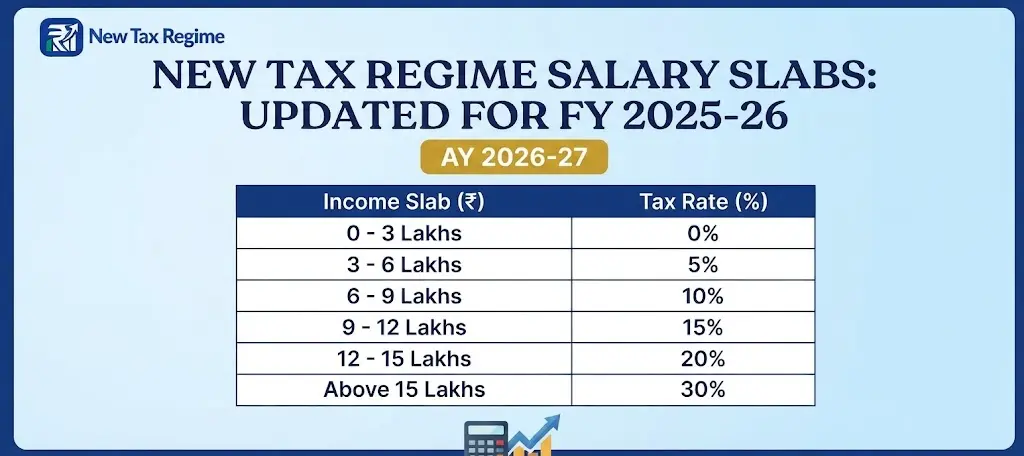
The Union Budget 2025 introduced revised tax slabs for the new tax regime applicable to FY 2025-26 (AY 2026-27). The slabs are:
| Taxable Income Range | Tax Rate |
|---|---|
| Up to ₹4,00,000 | Nil |
| ₹4,00,001 – ₹8,00,000 | 5% |
| ₹8,00,001 – ₹12,00,000 | 10% |
| ₹12,00,001 – ₹16,00,000 | 15% |
| ₹16,00,001 – ₹20,00,000 | 20% |
| ₹20,00,001 – ₹24,00,000 | 25% |
| Above ₹24,00,000 | 30% |
These slab rates apply to taxable income, not to your CTC or gross salary directly. Several provisions affect your final tax liability:
- Standard Deduction: ₹75,000 is automatically deducted from salary income for all salaried employees under the new regime.
- Section 87A Rebate: Resident individuals with taxable income up to ₹12,00,000 can claim a rebate of up to ₹60,000. This effectively makes income up to ₹12 lakh tax-free.
- For salaried employees, with the ₹75,000 standard deduction, total income up to ₹12.75 lakh can effectively attract zero tax.
- Health and Education Cess: 4% of the income tax amount is added as cess.
- Surcharge: Applies only at higher income levels (₹50 lakh and above) and is not covered in standard salary calculations.
Do not confuse the rebate threshold of ₹12 lakh with the tax slabs. Even if your taxable income is ₹15 lakh, you still pay tax according to the slab rates the rebate is not available once taxable income exceeds ₹12 lakh.
Salary Calculator New Tax Regime: Worked Examples
The following examples assume the figures represent annual gross salary (cash salary before deductions). They illustrate the tax calculation under the new regime.
The actual in-hand salary will be lower after employee PF, professional tax, and other payroll deductions are applied.
Example 1: Annual Gross Salary ₹6,00,000
| Particulars | Amount |
|---|---|
| Annual Gross Salary | ₹6,00,000 |
| Standard Deduction | ₹75,000 |
| Estimated Taxable Income | ₹5,25,000 |
| Income Tax Before Rebate | ₹6,250 |
| Section 87A Rebate | ₹6,250 |
| Income Tax After Rebate | ₹0 |
| Health & Education Cess (4%) | ₹0 |
| Estimated Annual Tax Liability | ₹0 |
Estimated monthly tax impact: ₹0
Since taxable income after standard deduction is ₹5,25,000 (below ₹12 lakh), the Section 87A rebate eliminates the entire tax liability.
Example 2: Annual Gross Salary ₹10,00,000
| Particulars | Amount |
|---|---|
| Annual Gross Salary | ₹10,00,000 |
| Standard Deduction | ₹75,000 |
| Estimated Taxable Income | ₹9,25,000 |
| Income Tax Before Rebate | ₹32,500 |
| Section 87A Rebate | ₹32,500 |
| Income Tax After Rebate | ₹0 |
| Health & Education Cess (4%) | ₹0 |
| Estimated Annual Tax Liability | ₹0 |
Estimated monthly tax impact: ₹0
Taxable income of ₹9.25 lakh remains below the ₹12 lakh threshold, so the rebate wipes out the full tax liability.
Example 3: Annual Gross Salary ₹15,00,000
| Particulars | Amount |
|---|---|
| Annual Gross Salary | ₹15,00,000 |
| Standard Deduction | ₹75,000 |
| Estimated Taxable Income | ₹14,25,000 |
| Income Tax Calculation | |
| — ₹4,00,000 @ 0% | ₹0 |
| — ₹4,00,000 @ 5% | ₹20,000 |
| — ₹4,00,000 @ 10% | ₹40,000 |
| — ₹2,25,000 @ 15% | ₹33,750 |
| Income Tax Before Rebate | ₹93,750 |
| Section 87A Rebate | Not eligible (income above ₹12 lakh) |
| Health & Education Cess (4%) | ₹3,750 |
| Estimated Annual Tax Liability | ₹97,500 |
Estimated monthly tax impact: ₹8,125
For this example, the employee’s actual in-hand salary also depends on PF and other payroll deductions. The income tax liability alone reduces the annual cash salary by ₹97,500, or about ₹8,125 per month.
CTC vs Gross Salary vs In-Hand Salary
| Salary Term | Meaning | Does It Equal Bank Credit? |
|---|---|---|
| CTC (Cost to Company) | Total employer spending, including salary, PF, gratuity, insurance, and other benefits | No—CTC includes non-cash and employer-side components |
| Gross Salary | Total cash salary before any deductions | No—gross salary is pre-deduction |
| Taxable Salary/Income | Gross salary minus standard deduction and other eligible adjustments | No—this is the figure used for tax calculation |
| In-Hand Salary | Amount credited to bank account after all deductions | Yes—this is the actual take-home pay |
The difference between CTC and in-hand salary can be substantial. Common components that create this gap include:
- Employer PF contribution: 12% of basic salary (part of CTC, not paid in cash to the employee)
- Employee PF contribution: 12% of basic salary (deducted from the employee’s salary)
- Gratuity: Employer provision, not paid monthly
- Insurance premiums: Employer-paid, not part of cash salary
- Bonus: May be paid annually or quarterly, not reflected in monthly pay
- Professional tax: State-specific deduction
- Income tax/TDS: Deducted at source by the employer
- Other payroll deductions: Meal vouchers, salary advances, voluntary deductions
Every employer’s salary structure is different. Do not assume that a particular CTC automatically results in a specific in-hand amount without reviewing the full salary breakup.
New Tax Regime In-Hand Salary Calculator: What Deductions Affect Take-Home Pay?
Understanding the difference between tax deductions and payroll deductions is essential for accurate in-hand salary estimation.
Standard Deduction
Under the new tax regime, salaried employees can claim a standard deduction of ₹75,000 from their gross salary. This deduction reduces taxable income and is automatically applied without requiring any proof of investment.
For example, if your gross salary is ₹15,00,000, your taxable salary becomes ₹14,25,000 after this deduction.
Employee Provident Fund (EPF)
Employee PF contributions typically amount to 12% of basic salary under the EPF Act. This amount is deducted from your monthly salary and credited to your EPF account.
Under the new tax regime, the employee’s PF contribution is not eligible for tax deduction unlike under the old regime where it qualified under Section 80C. This means your PF contribution reduces your take-home pay but does not reduce your tax liability.
The employer’s PF contribution remains a part of your CTC and does not reduce your monthly in-hand salary it is not paid to you in cash.
Professional Tax
Professional tax is a state-level tax levied by certain state governments on salaried individuals. It is not uniform across India some states charge it, while others do not.
Where applicable, the amount varies by state and income level, typically ranging from ₹1,500 to ₹2,500 per year. This is deducted monthly from your salary by your employer.
TDS on Salary
Tax Deducted at Source (TDS) is the mechanism through which your employer deducts income tax from your salary every month. The employer estimates your annual tax liability and deducts a proportionate amount each month.
This is why even if your annual tax liability is zero (thanks to the Section 87A rebate), your employer may still deduct TDS initially and you can claim a refund when filing your income tax return.
Other Employer-Specific Deductions
Employers may also deduct amounts for meal vouchers, insurance premiums, salary advances, voluntary contributions, or other payroll items. These vary significantly by employer and employment terms.
How to Calculate Monthly In-Hand Salary From Annual Salary
Here is a step-by-step framework you can follow to estimate your monthly in-hand salary:
Step 1: Start with annual gross salary
₹15,00,000 (example)
Step 2: Apply the standard deduction
₹15,00,000 − ₹75,000 = ₹14,25,000
Step 3: Add any other eligible exclusions
If your employer contributes to NPS, this may reduce your taxable income. For this illustration, assume no such exclusions.
Step 4: Calculate income tax
Apply the FY 2025-26 slabs to the taxable income of ₹14,25,000:
| Slab | Amount | Tax |
|---|---|---|
| Up to ₹4,00,000 | ₹4,00,000 | ₹0 |
| 5% slab | ₹4,00,000 | ₹20,000 |
| 10% slab | ₹4,00,000 | ₹40,000 |
| 15% slab | ₹2,25,000 | ₹33,750 |
| Total Tax | ₹93,750 |
Step 5: Apply rebate and cess
No rebate is available (income exceeds ₹12 lakh). Cess at 4% on ₹93,750 = ₹3,750. Total tax = ₹97,500.
Step 6: Account for employee-side payroll deductions
For illustration, assume:
- Employee PF: ₹14,400 per year (basic salary of ₹1,20,000 annually and 12% contribution)
- Professional tax: ₹2,500 (if applicable in your state)
Step 7: Calculate annual in-hand estimate
₹15,00,000 − ₹97,500 (tax) − ₹14,400 (PF) − ₹2,500 (professional tax) = ₹13,85,600
Step 8: Convert to monthly
₹13,85,600 ÷ 12 = ₹1,15,467
This is an estimate. Your actual in-hand salary depends on your precise salary structure, applicable PF rate, professional tax rules in your state, and other employer-specific deductions.
Who Should Use an In-Hand Salary Calculator?
An in-hand salary calculator is useful for:
- Comparing job offers: Understanding which offer provides better monthly take-home pay, not just a higher CTC.
- Evaluating CTC packages: Seeing through inflated CTC numbers that include non-cash benefits.
- Estimating monthly household income: Planning family budgets based on realistic income expectations.
- Checking the impact of a salary hike: Understanding how much of a raise actually lands in your bank account.
- Understanding TDS: Seeing how income tax is deducted from your salary.
- Comparing different salary structures: Evaluating how changes in basic salary, allowances, or employer contributions affect take-home pay.
- Estimating take-home pay before accepting a job: Making informed decisions based on real numbers.
Key Takeaways
- CTC and in-hand salary are different. Your CTC includes employer contributions and benefits that never reach your bank account.
- Income tax is calculated on taxable income, not directly on CTC or gross salary.
- For FY 2025-26, taxable income up to ₹12 lakh attracts no tax under the new regime due to the Section 87A rebate. For salaried employees, this effectively becomes ₹12.75 lakh after the standard deduction.
- The standard deduction of ₹75,000 applies automatically to salaried employees under the new regime.
- Employee PF contributions reduce your monthly take-home pay but do not reduce your tax liability under the new regime.
- An exact in-hand salary figure requires your actual salary breakup—different employers structure salaries differently, affecting PF, professional tax, and other deductions.
Frequently Asked Questions
1. How do I calculate in-hand salary under the new tax regime?
Start with your annual gross salary, subtract the ₹75,000 standard deduction, apply the FY 2025-26 tax slabs, subtract any Section 87A rebate if eligible, add 4% cess, then subtract employee PF and professional tax.
Divide the annual figure by 12 to get your estimated monthly in-hand salary. The exact amount depends on your salary structure.
2. Is CTC the same as in-hand salary under the new tax regime?
No. CTC includes employer contributions to PF, gratuity, insurance, and other benefits that are not paid in cash. In-hand salary is the amount credited to your bank account after all deductions.
3. What is the in-hand salary for ₹10 lakh under the new tax regime?
For a gross salary of ₹10 lakh under the new regime, the income tax liability is zero after the Section 87A rebate (taxable income of ₹9.25 lakh after standard deduction). However, the actual in-hand salary will be lower than ₹10 lakh if employee PF and professional tax are deducted.
For illustration, with a 12% PF contribution on a basic salary of ₹5 lakh and professional tax of ₹2,500, the annual in-hand estimate would be around ₹9,37,500 or ₹78,125 per month. This is an estimate and varies by salary structure.
4. Does TDS reduce monthly in-hand salary?
TDS is deducted monthly by your employer based on estimated annual tax liability. Under the new regime, if your estimated annual tax liability is zero (taxable income up to ₹12 lakh), your employer should not deduct TDS.
However, if your estimated tax exceeds the rebate limit, TDS will reduce your monthly bank credit. Any excess TDS can be claimed as a refund when filing your income tax return.
5. Can a salary calculator give the exact take-home salary?
No calculator can give an exact figure without your actual salary breakup.
While income tax can be calculated from your gross salary, payroll deductions like PF (percentage of basic salary) and professional tax depend on your employer and salary structure.
A calculator provides a close estimate, but the precise in-hand amount varies by employer.
Disclaimer: This article is for general informational purposes only and should not be treated as professional tax, financial, or legal advice.
Individual tax liability and salary deductions can vary based on personal circumstances and employer-specific payroll structures.
