

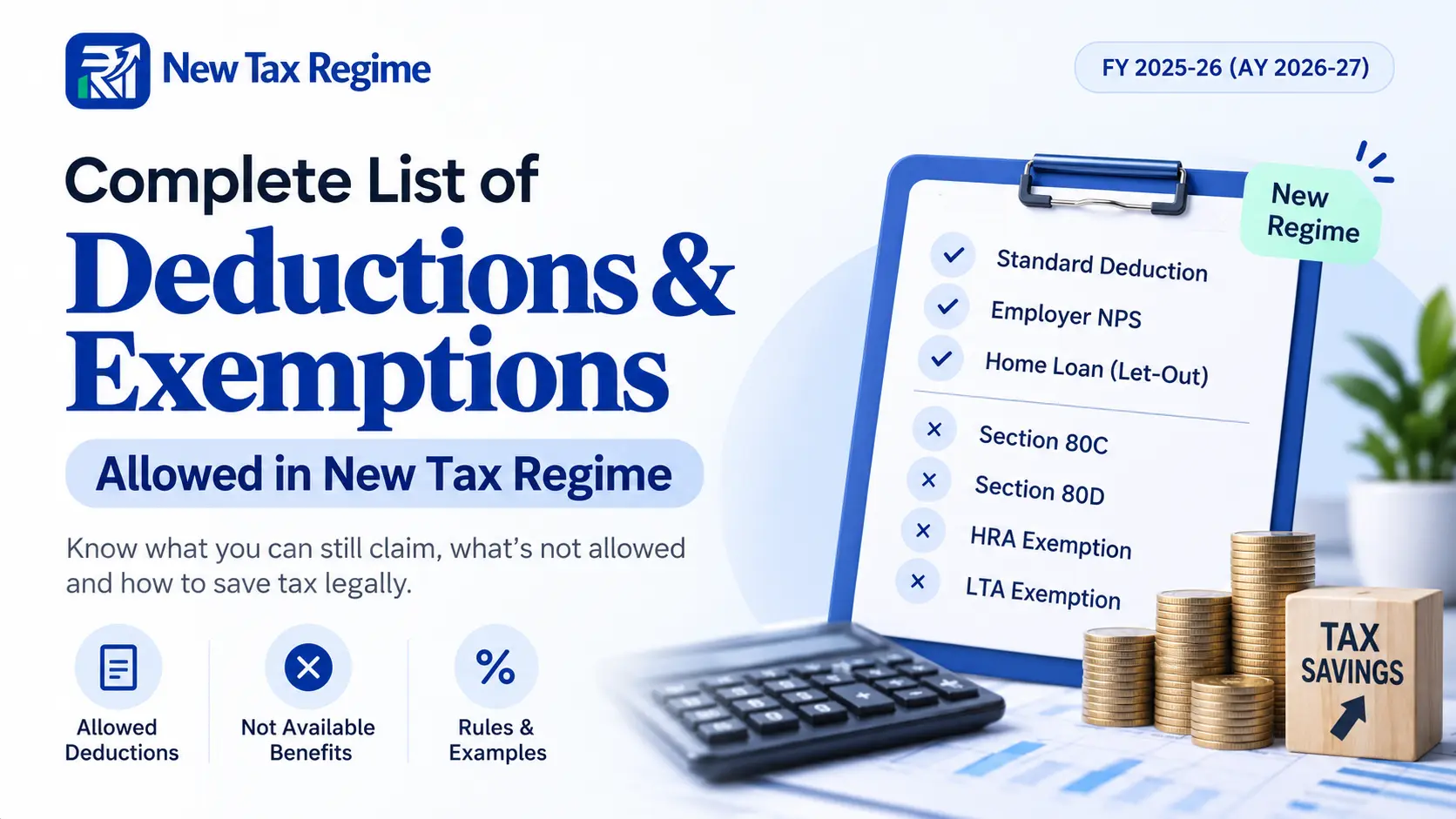
For FY 2026-27 (AY 2027-28), the new tax regime allows some important deductions, but most popular tax-saving deductions available under the old regime are excluded.
Last updated: October 2026.
For salaried taxpayers, the key benefits include the ₹75,000 standard deduction and eligible employer NPS contributions under Section 80CCD(2).
The Section 87A rebate of up to ₹60,000 is available for resident individuals with income up to ₹12 lakh, making income effectively tax-free up to that level.
This guide explains the new tax regime deductions available for FY 2026-27, the treatment of HRA and home-loan interest, common deductions that cannot be claimed, and the special provisions that taxpayers should not overlook. Check your exact liability with our new tax regime calculator.
You May Also Like To Read These Posts 👇
NPS Deduction (80CCD(2)) Under New Tax Regime – Full Guide for FY 2026-27
Section 87A Rebate in New Tax Regime – Eligibility & Limit FY 2026-27
Standard Deduction in New Tax Regime – Amount & Rules
HRA Exemption in New Tax Regime – Can You Still Claim It?
What Deductions Are Allowed in the New Tax Regime?
The new tax regime is designed around lower slab rates with fewer deductions and exemptions.
That means a taxpayer cannot simply carry over the deductions used under the old regime and subtract them from income while filing under the new regime.
For individuals, the commonly relevant deductions include the standard deduction and eligible employer contributions to NPS under Section 80CCD(2).
The Income Tax Department’s AY 2027-28 guidance expressly lists Section 24(b) interest for a let-out house property and Section 80CCD(2) among the benefits available under the new regime.
Standard Deduction of ₹75,000
Eligible salaried employees and pensioners can claim a ₹75,000 standard deduction under the new regime for FY 2026-27. This increased standard deduction (from ₹50,000 to ₹75,000) was introduced in Union Budget 2024 and continues for FY 2026-27.
This deduction is different from Section 80C or other investment-based deductions. A taxpayer does not need to invest ₹75,000 to receive the standard deduction; it is a deduction linked to eligible salary or pension income.
For example, if an eligible taxpayer has salary income of ₹15 lakh, the standard deduction reduces the salary income considered for tax computation by ₹75,000, subject to the applicable rules.
Employer NPS Contribution Under Section 80CCD(2)
An employer’s contribution to an eligible employee’s NPS account can qualify for deduction under Section 80CCD(2) under the new tax regime.
The Finance Act 2024 introduced a key change effective from April 1, 2025: the deduction limit for private sector employees was raised from 10% to 14% of salary (basic + DA), matching the limit for government employees. This means for AY 2027-28:
- Government employees: 14% of basic + DA
- Private sector employees: 14% of basic + DA (raised from 10%)
This should not be confused with the employee’s own NPS investment.
The employee’s contribution under Sections 80CCD(1) and 80CCD(1B) is not available as a deduction under the new regime. The benefit under Section 80CCD(2) relates to the eligible contribution made by the employer.
For example, on a ₹10 lakh basic salary, a 14% employer contribution (₹1.4 lakh) deductible under 80CCD(2) saves roughly ₹36,000–₹44,000 in tax depending on the slab it offsets.
You May Also Like To Read These Posts 👇
80TTA & 80TTB Deduction – Are They Allowed in New Tax Regime?
Meal Card, Food Coupons & Conveyance Allowance in New Tax Regime
LTA (Leave Travel Allowance) in New Tax Regime – Rules Explained
Marginal Relief in New Tax Regime – Explained With Examples
Section 87A Rebate (Not a Deduction)
The Section 87A rebate is a tax rebate, not a deduction or exemption. It reduces the income-tax liability after tax has been calculated.
For FY 2026-27 under the new tax regime:
- Maximum rebate of ₹60,000 is available for resident individuals
- Applicable if total income chargeable to tax under Section 115BAC(1A) is up to ₹12,00,000
- With the ₹75,000 standard deduction, salaried taxpayers may effectively have zero tax liability up to ₹12.75 lakh (assuming no income taxable at special rates)
The rebate is not available against income taxed at special rates, such as certain capital gains or lottery winnings.
New Tax Regime Exemptions Available for Salary Income
The new regime removes many of the salary exemptions commonly associated with the old regime. HRA exemption, for example, is not available under the new regime.
The distinction between an exemption and a deduction matters. An exemption generally removes qualifying income or an allowance from the taxable amount, while a deduction is subtracted from income according to the relevant provision.
Not every payment shown on a salary slip automatically becomes tax-free. The treatment depends on the specific provision governing that payment and whether the taxpayer satisfies its conditions.
For this reason, taxpayers should check the nature of an allowance or benefit rather than assuming that every old-regime salary exemption continues under the new regime.
Which Common Deductions Are Not Available Under the New Tax Regime?
A major source of confusion is the continued use of familiar tax-saving investments even after choosing the new regime. Many Chapter VI-A deductions that taxpayers commonly claim under the old regime are not available.
Section 80C
The popular Section 80C deduction is generally unavailable under the new regime.
This means eligible investments or payments such as life insurance premiums, PPF contributions, ELSS investments, certain NSC investments, eligible tuition fees and housing-loan principal repayment do not automatically create a deduction when the taxpayer uses the new regime.
Section 80D
The deduction under Section 80D for eligible health-insurance premiums and specified medical expenditure is generally not available under the new regime.
Sections 80E, 80G and Similar Deductions
The deduction for eligible education-loan interest under Section 80E and the deduction for qualifying donations under Section 80G are also among the commonly used old-regime benefits that are generally unavailable under the new regime.
The same principle applies to the employee’s own NPS contributions under Sections 80CCD(1) and 80CCD(1B). The fact that NPS itself remains relevant does not mean every NPS contribution qualifies for deduction.
Is HRA Exemption Available Under the New Tax Regime?
No, the HRA exemption under Section 10(13A) is not available under the new tax regime.
The Income Tax Department confirms that HRA exemption available under the old regime cannot be claimed under the new regime.
This means that receiving House Rent Allowance does not by itself create an HRA exemption when the new regime is selected.
A taxpayer who pays rent should therefore avoid assuming that rent receipts, rent agreements or HRA declarations will produce the same tax benefit available under the old regime.
Can Home Loan Interest Be Claimed Under the New Tax Regime?
Home-loan interest receives different treatment depending on the property.
Self-Occupied Property
For a self-occupied house property, the interest deduction under Section 24(b) is not available under the new regime.
Under the old regime, eligible taxpayers can generally claim a deduction for interest on a qualifying self-occupied property subject to the applicable limit, which can be ₹2 lakh in specified cases. The new regime does not provide the same benefit.
Let-Out Property
The position is different for a let-out property. Under the new regime, eligible interest under Section 24(b) can be deducted from income from the let-out property without a specified monetary cap.
However, there is an important restriction: if the calculation produces a loss under the head “Income from house property,” that loss cannot be set off against income under other heads such as salary.
Therefore, “home-loan interest is allowed” does not mean that every taxpayer with a housing loan gets a general deduction against total income.
You May Also Like To Read These Posts 👇
Home Loan in New Tax Regime: Deduction & Interest Benefit for FY 2026-27
Surcharge in New Tax Regime: Rates, Calculation & Marginal Relief for FY 2026-27
Gratuity & Leave Encashment Exemption in New Tax Regime
80G Deduction (Donations) in New Tax Regime – Is It Allowed?
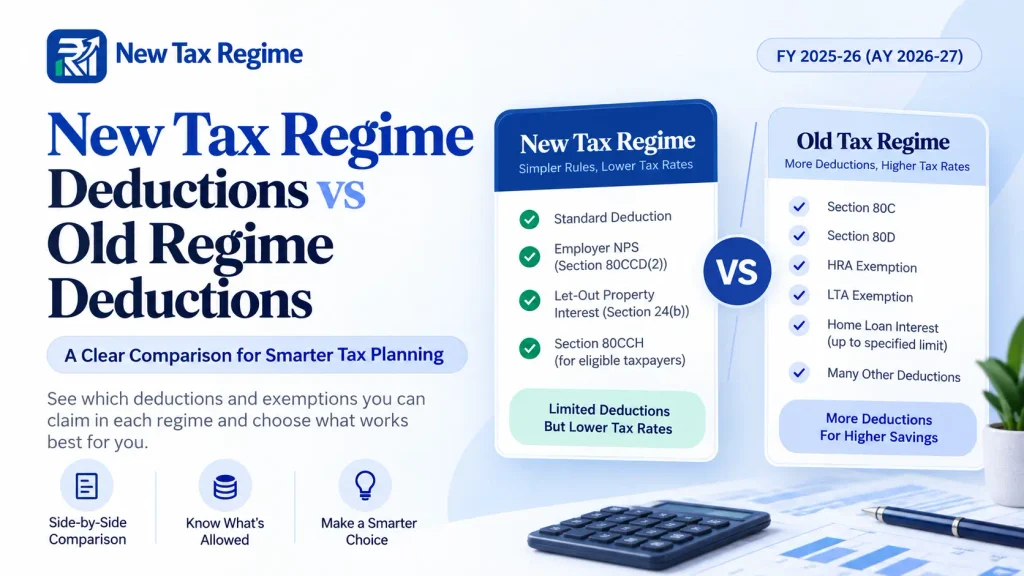
New Tax Regime Deductions vs Old Regime Deductions
The following comparison covers the deductions and exemptions most relevant to individual taxpayers:
| Deduction / Exemption | New Tax Regime | Old Tax Regime |
|---|---|---|
| Standard deduction | ₹75,000, subject to eligibility | ₹50,000, subject to eligibility |
| Section 80C | Generally not available | Available, subject to conditions |
| Section 80D | Generally not available | Available, subject to conditions |
| Employer NPS — Section 80CCD(2) | Available up to 14% of salary for all employees, subject to conditions | Available (10% for private, 14% for govt) |
| Employee’s own NPS contribution | Generally not available | Available subject to applicable limits |
| HRA exemption | Not available | Available subject to conditions |
| LTA exemption | Generally not available | Available subject to conditions |
| Self-occupied home-loan interest | Not available | Available subject to conditions |
| Let-out property interest | Available under Section 24(b), but loss cannot be set off against other income | Available subject to conditions |
| Section 87A Rebate | Up to ₹60,000 for income up to ₹12 lakh | ₹12,500 for income up to ₹5 lakh |
How Deductions in New Tax Regime Affect Taxable Income
Consider an illustrative salaried employee with the following figures:
- Gross salary: ₹18,00,000
- Eligible standard deduction: ₹75,000
- Eligible employer NPS contribution under Section 80CCD(2): ₹1,50,000
The simplified calculation of salary income would be:
- Gross salary = ₹18,00,000
- Less standard deduction = ₹75,000
- Less eligible employer NPS contribution = ₹1,50,000
- Resulting salary income for further tax computation = ₹15,75,000
This is only an illustration of how eligible deductions can affect taxable income.
It is not a complete income-tax calculation because the final liability can depend on other income, the applicable slab rates, special-rate income, rebate eligibility and other provisions.
The example also demonstrates why a taxpayer should not simply subtract Section 80C, Section 80D or an HRA exemption from salary after selecting the new regime.
New Tax Regime Exemption List: What Should Taxpayers Check?
A practical checklist for taxpayers filing under the new regime:
| Income / Payment | New Regime Treatment |
|---|---|
| Salary income | Taxable after applicable deductions |
| Standard deduction | Available at ₹75,000 for eligible salary/pension income |
| HRA exemption | Not available |
| LTA exemption | Generally not available |
| Employer NPS contribution | Available under Section 80CCD(2) up to 14% of salary, subject to conditions |
| Employee’s own NPS contribution | Generally not available |
| Section 80C investments | Generally not deductible |
| Health-insurance deduction under 80D | Generally not available |
| Education-loan interest under 80E | Generally not available |
| Qualifying donations under 80G | Generally not deductible |
| Let-out property home-loan interest | Available under Section 24(b), but loss cannot be set off against other income |
| Self-occupied property home-loan interest | Not available |
| Section 87A Rebate | Up to ₹60,000 for income up to ₹12 lakh (resident individuals) |
Key Takeaways
- The new regime allows selected deductions rather than the broad deduction structure available under the old regime.
- Eligible salaried taxpayers and pensioners can claim a ₹75,000 standard deduction.
- Employer contributions to NPS can qualify under Section 80CCD(2) up to 14% of salary for all employees under the new regime, subject to the applicable conditions.
- Popular deductions such as 80C and 80D are generally unavailable under the new regime.
- HRA exemption is not available under the new regime, while eligible interest on a let-out property can still be deductible under Section 24(b) (but losses cannot be set off against other income).
- Section 87A provides a rebate of up to ₹60,000 for resident individuals with income up to ₹12 lakh under the new regime.
Frequently Asked Questions
1. What deductions are allowed in the new tax regime for FY 2026-27?
The main deductions relevant to individual taxpayers include the ₹75,000 standard deduction for eligible salary or pension income and employer NPS contributions under Section 80CCD(2) up to 14% of salary (basic + DA).
Interest under Section 24(b) can also apply to eligible let-out property. The Section 87A rebate (up to ₹60,000) is also available for eligible taxpayers with income up to ₹12 lakh.
2. Is Section 80C available under the new tax regime?
Generally, no. The Section 80C deduction used for qualifying investments and payments such as PPF, eligible life-insurance premiums, ELSS and certain tuition fees is not available when the taxpayer uses the new regime.
3. Is the standard deduction available under the new tax regime?
Yes. For FY 2026-27, eligible salaried employees and pensioners can claim a ₹75,000 standard deduction under the new regime. It is separate from investment-based deductions such as Section 80C.
4. Is HRA exempt under the new tax regime?
No. The HRA exemption available under Section 10(13A) under the old regime is not available under the new regime.
5. Can NPS contribution be claimed as a deduction under the new tax regime?
It depends on who makes the contribution. An eligible employer contribution can qualify under Section 80CCD(2) up to 14% of salary for all employees.
An employee’s own NPS contribution under Sections 80CCD(1) and 80CCD(1B) is generally not deductible under the new regime.
Disclaimer: This article is for general informational purposes only and should not be treated as professional tax, legal or financial advice.
Tax treatment can vary based on individual circumstances and applicable rules. Readers should consult a qualified tax professional for advice specific to their situation.

12 Comments
Pingback: NPS Deduction in New Tax Regime: 80CCD(2) Guide
Pingback: 87A Rebate in New Tax Regime: Limit & Eligibility
Pingback: Standard Deduction in New Tax Regime: ₹75,000 Rules
Pingback: HRA Exemption in New Tax Regime: Rules 2025-26
Pingback: 80TTA in New Tax Regime: Is It Allowed in FY 2025-26?
Pingback: Meal Card & Conveyance in New Tax Regime
Pingback: LTA in New Tax Regime: Rules & Tax Treatment 2025-26
Pingback: Marginal Relief in New Tax Regime: Examples & Calculation
Pingback: Home Loan in New Tax Regime: Deduction & Interest Benefit
Pingback: Surcharge in New Tax Regime: Rates & Rules 2025-26
Pingback: Leave Encashment Exemption in New Tax Regime
Pingback: 80G in New Tax Regime: Is 80G Deduction Allowed?