

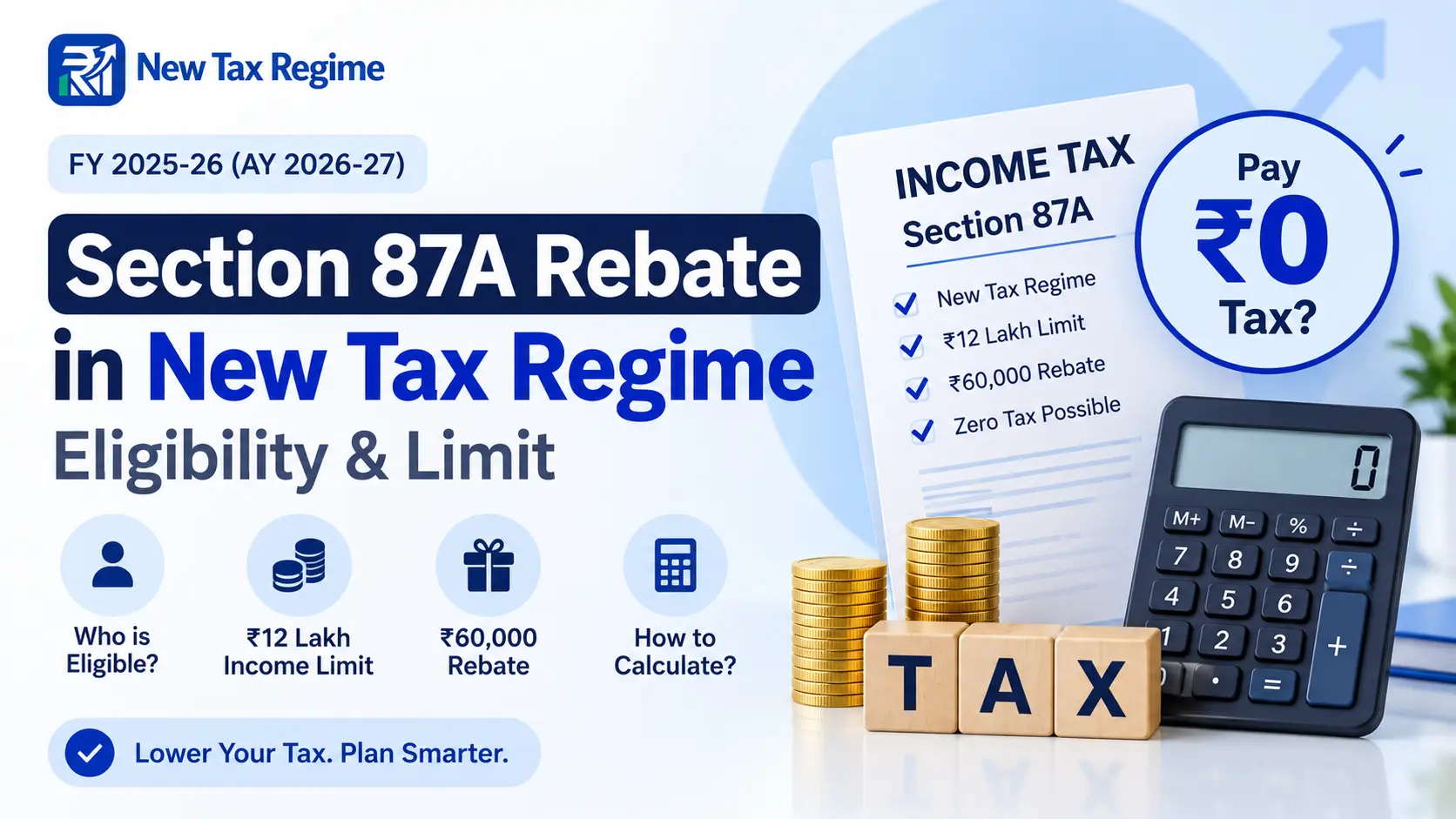
Under the new tax regime for FY 2025-26, the Section 87A rebate allows resident individuals with a total income up to ₹12 lakh to reduce their tax liability to zero. The maximum rebate available is ₹60,000.
This means that for the financial year 2025-26 (Assessment Year 2026-27), if your income is from normal sources like salary, pension, or interest, you may not have to pay any income tax.
This article explains everything you need to know about the 87A rebate in the new tax regime, including eligibility, the rebate amount, how it’s calculated, and how marginal relief works if your income is slightly above ₹12 lakh.
You May Also Like To Read These Posts 👇
Complete List of Deductions & Exemptions Allowed in New Tax Regime
NPS Deduction (80CCD(2)) Under New Tax Regime – Full Guide for FY 2025-26
Standard Deduction in New Tax Regime – Amount & Rules
HRA Exemption in New Tax Regime – Can You Still Claim It?
What is the Section 87A Rebate?
Section 87A is a provision in the Income Tax Act that provides a tax rebate to eligible individual taxpayers. It’s important to understand that a rebate is different from a deduction.
- A deduction (like Section 80C) reduces your total income. You subtract it from your gross income before calculating tax.
- A rebate (like Section 87A) reduces your final tax liability. It is applied after the tax on your income has been calculated.
The purpose of Section 87A is to provide relief to taxpayers with modest incomes, ensuring that their final tax payable is significantly reduced or even brought down to zero.
Section 87A Rebate Eligibility & Limit
For FY 2025-26 under the new tax regime, here are the key eligibility rules and limits:
| Particular | FY 2025-26 (AY 2026-27) – New Tax Regime |
|---|---|
| Eligibility | Resident individuals only |
| Income Threshold | Total income ≤ ₹12,00,000 |
| Maximum Rebate | ₹60,000 |
| Applicable Tax Slabs | 0% up to ₹4L, 5% from ₹4L-₹8L, 10% from ₹8L-₹12L, 15% from ₹12L-₹16L, 20% from ₹16L-₹20L, 25% from ₹20L-₹24L, 30% above ₹24L |
| Standard Deduction | ₹75,000 for eligible salaried/pension taxpayers |
| Health & Education Cess | 4% |
Who Can Claim?
- Resident Individuals: The rebate is only available to individuals who are residents of India for tax purposes. NRIs, HUFs, and companies are not eligible.
- Age: The rebate is available to all resident individuals, regardless of age.
- Income: Your total income must be ₹12 lakh or less. This is the income after applying eligible deductions like the standard deduction.
What is Total Income for Rebate Eligibility?
When checking eligibility for the Section 87A rebate under the new regime, only normal income is considered.
Special-rate incomes like capital gains, lottery winnings, and income from Virtual Digital Assets are excluded from this calculation.
For example, if you have a salary of ₹11 lakh and a long-term capital gain of ₹2 lakh, your total income (for rebate eligibility) is ₹11 lakh, not ₹13 lakh. You are therefore eligible for the rebate on your salary income.
How is the Section 87A Rebate Calculated?
The rebate amount is the lower of:
- The tax payable on your normal income.
- The maximum rebate of ₹60,000.
In effect, if your tax on normal income is ₹60,000 or less, the rebate reduces it to zero. The rebate is applied before adding the 4% Health and Education Cess.
Example 1: Income Below ₹12 Lakh (Salaried)
Mr. Sharma earns a gross salary of ₹12,75,000.
- Standard Deduction: ₹75,000
- Total Income: ₹12,00,000
Tax Calculation:
- Up to ₹4,00,000: ₹0
- ₹4,00,001 – ₹8,00,000: 5% of ₹4,00,000 = ₹20,000
- ₹8,00,001 – ₹12,00,000: 10% of ₹4,00,000 = ₹40,000
- Total Tax: ₹60,000
- Section 87A Rebate: ₹60,000 (100% of tax liability)
- Tax after Rebate: ₹0
- Cess @ 4%: ₹0
- Final Tax Liability: ₹0
Marginal Relief When Income Slightly Exceeds ₹12 Lakh
If your total income is just above the ₹12 lakh threshold, you don’t suddenly face a huge tax bill.
The government provides marginal relief to ensure you don’t pay more tax than the amount by which your income exceeds ₹12 lakh.
How it works: The tax you pay is capped at the amount of income that exceeds ₹12 lakh.
Example 2: Income Slightly Above ₹12 Lakh
Mr. Patel has a total income of ₹12,25,000.
- Tax as per slabs: ₹63,750
- Excess income: ₹25,000 (₹12,25,000 – ₹12,00,000)
- Tax after marginal relief: ₹25,000 (This is the cap)
- Cess @ 4%: ₹1,000
- Final Tax Liability: ₹26,000
This is significantly lower than the ₹63,750 tax that would otherwise be payable.
You May Also Like To Read These Posts 👇
80TTA & 80TTB Deduction – Are They Allowed in New Tax Regime?
Meal Card, Food Coupons & Conveyance Allowance in New Tax Regime
LTA (Leave Travel Allowance) in New Tax Regime – Rules Explained
Marginal Relief in New Tax Regime – Explained With Examples
Special-Rate Income: Capital Gains, Lottery, and More
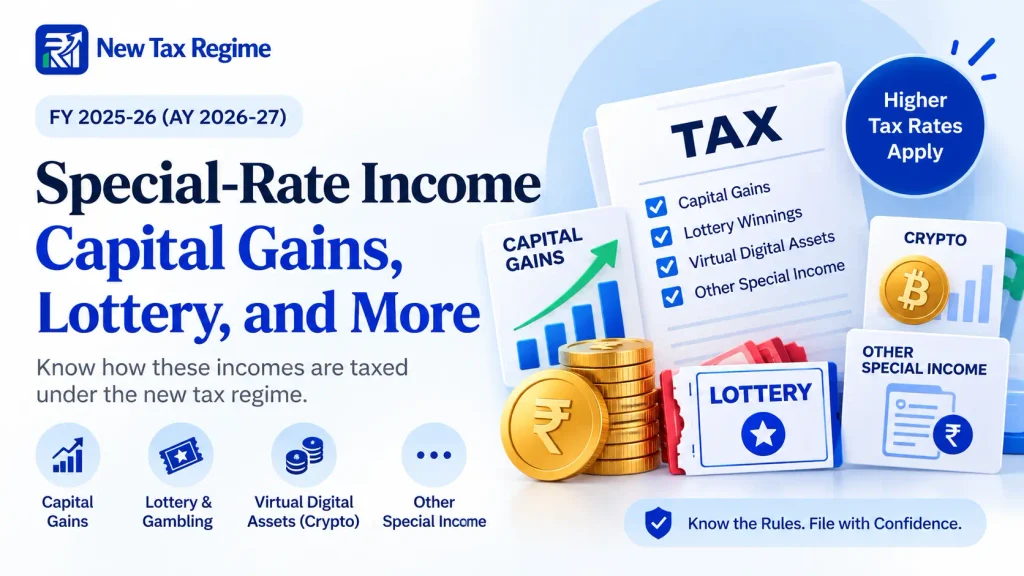
It is important to understand that the Section 87A rebate cannot be used to reduce tax on special-rate income. This type of income is taxed at the rates specified in the law.
Examples of such income include:
- Long-Term Capital Gains (LTCG) on listed equity: Taxed at 12.5% on gains exceeding ₹1,25,000.
- Short-Term Capital Gains (STCG) on listed equity: Taxed at 20%.
- Lottery, gambling, race winnings: Taxed at 30%.
- Virtual Digital Assets (e.g., Cryptocurrency): Taxed at 30%.
Example 3: Salary + Special-Rate Income
Ms. Reddy has the following income:
- Salary: ₹9,00,000
- LTCG on shares: ₹3,00,000
- Standard Deduction: ₹75,000
- Normal Income: ₹8,25,000 (Eligible for rebate)
- Special-Rate Income: ₹3,00,000
Tax Calculation:
1. Tax on Normal Income:
- Up to ₹4L: ₹0
- ₹4L-₹8L: 5% of ₹4L = ₹20,000
- ₹8L-₹8.25L: 10% of ₹25,000 = ₹2,500
- Tax on Normal Income = ₹22,500
- Section 87A Rebate = ₹22,500 (Tax becomes ₹0)
2. Tax on Special-Rate Income (LTCG):
- Total LTCG = ₹3,00,000
- LTCG Exemption = ₹1,25,000
- Taxable LTCG = ₹1,75,000
- Tax @ 12.5% = ₹21,875
- Rebate does NOT apply
3. Total Tax: ₹21,875
4. Cess @ 4%: ₹875
- Final Tax Liability: ₹22,750
This example demonstrates that taxpayers with special-rate income may still have a tax liability even if their total income is below ₹12 lakh.
You May Also Like To Read These Posts 👇
Home Loan in New Tax Regime: Deduction & Interest Benefit for FY 2025-26
Surcharge in New Tax Regime: Rates, Calculation & Marginal Relief for FY 2025-26
Gratuity & Leave Encashment Exemption in New Tax Regime
80G Deduction (Donations) in New Tax Regime – Is It Allowed?
Key Takeaways
- Under the new tax regime for FY 2025-26, resident individuals with a total income of up to ₹12 lakh can pay zero tax due to the Section 87A rebate.
- The maximum rebate available is ₹60,000, which is enough to cover the tax on income up to ₹12 lakh.
- For salaried individuals, the effective zero-tax limit is roughly ₹12.75 lakh gross salary due to the ₹75,000 standard deduction.
- If your income slightly exceeds ₹12 lakh, marginal relief limits your tax to the excess income amount.
- The Section 87A rebate does not apply to special-rate income like capital gains, lottery winnings, or income from crypto assets.
Frequently Asked Questions
1. What is the Section 87A rebate limit under the new tax regime?
The maximum Section 87A rebate under the new tax regime for FY 2025-26 is ₹60,000. This is available if your total income does not exceed ₹12 lakh.
2. Who can claim the Section 87A rebate?
Only resident individuals can claim this rebate. Non-residents, Hindu Undivided Families (HUFs), and companies are not eligible.
3. Can tax be zero on income up to ₹12 lakh?
Yes, if your income is from normal sources (salary, pension, business, interest, etc.) and your total income is ₹12 lakh or less, the Section 87A rebate will reduce your tax liability to zero.
4. What happens if my income is ₹12.1 lakh? Do I have to pay tax on the whole amount?
No. You will get the benefit of marginal relief. Your tax liability will be capped at the excess amount over ₹12 lakh (in this case, ₹10,000), plus cess.
5. Does the rebate apply to capital gains?
No. The Section 87A rebate does not apply to any income that is taxed at special rates. This includes Short-Term and Long-Term Capital Gains (STCG/LTCG), which are taxed at their own specific rates.
Disclaimer: This article provides general information for educational purposes and should not be considered professional tax or financial advice.
Tax laws are complex and subject to change. You should consult a qualified tax professional for advice specific to your situation.

7 Comments
Pingback: New Tax Regime Deductions & Exemptions FY 2025-26
Pingback: NPS Deduction in New Tax Regime: 80CCD(2) Guide
Pingback: Meal Card & Conveyance in New Tax Regime
Pingback: No LTA Exemption in New Tax Regime FY 2026-27
Pingback: No HRA Exemption in New Tax Regime FY 2026-27
Pingback: Surcharge in New Tax Regime: Rates & Rules FY 2026-27
Pingback: Leave Encashment Exemption in New Regime FY 2026-27