

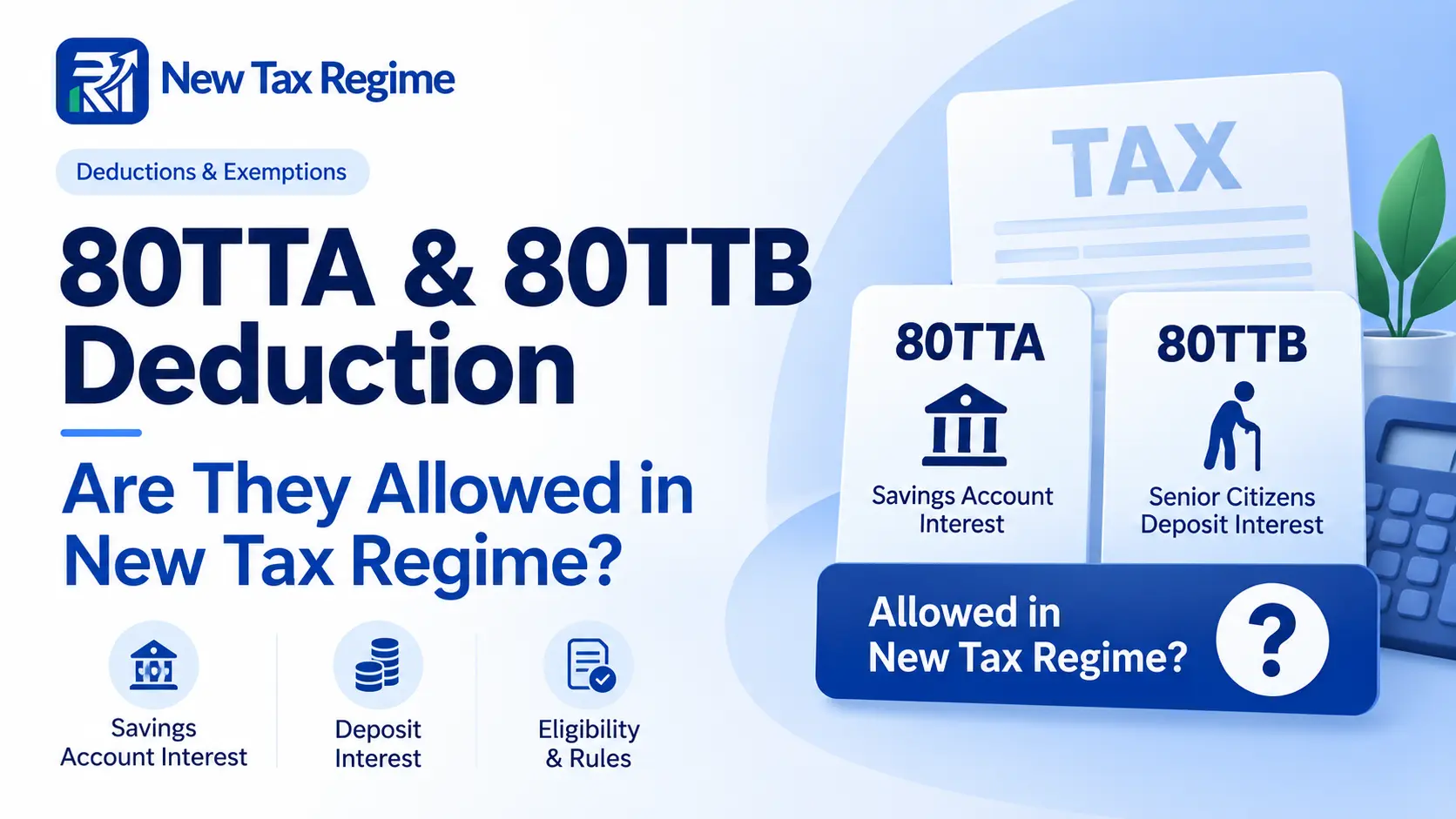
Section 80TTA is not available under the New Tax Regime for FY 2025-26 (AY 2026-27). Section 80TTB is also not available under the New Tax Regime.
Taxpayers who opt for the New Regime cannot reduce their taxable income using these deductions on eligible savings-account or deposit interest.
The two sections are frequently confused because both offer interest-income deductions under the Old Tax Regime, yet they apply to different taxpayer categories and different types of interest.
This guide explains how each section works, what happens to interest income when these deductions cannot be claimed, and why the distinction matters when comparing the two regimes.
Discover More About:👇
What Is Section 80TTA?
Section 80TTA provides a deduction for qualifying interest earned from savings accounts.
Under the Old Tax Regime, an eligible individual or HUF can claim up to ₹10,000 on qualifying savings-account interest, subject to the conditions of the section.
The deduction is limited to interest from savings accounts with eligible banks, co-operative banks and post offices.
It does not generally cover interest from fixed deposits (FDs), recurring deposits (RDs), bonds or similar investments.
Suppose an eligible taxpayer earns ₹8,000 in savings-account interest during the year. Under the Old Tax Regime, that taxpayer may be able to claim a deduction for the qualifying amount, subject to the applicable conditions.
The deduction does not stop the bank from reporting the interest as income. Instead, it reduces the amount included in taxable income after the income is considered under the applicable rules.
You May Also Like To Read These Posts 👇
Complete List of Deductions & Exemptions Allowed in New Tax Regime
NPS Deduction (80CCD(2)) Under New Tax Regime – Full Guide for FY 2025-26
Section 87A Rebate in New Tax Regime – Eligibility & Limit FY 2025-26
Standard Deduction in New Tax Regime – Amount & Rules
Is 80TTA Applicable in New Tax Regime?
No. Section 80TTA cannot be claimed under the New Tax Regime for FY 2025-26.
The New Tax Regime under Section 115BAC permits only specified deductions and exemptions. Section 80TTA is not among the deductions allowed under this regime.
The Income Tax Department’s guidance for AY 2026-27 separately lists the deductions permitted under the New Regime.
This leads to an important distinction: not being able to claim a deduction does not make the underlying income exempt.
If a taxpayer earns savings-account interest under the New Regime, that interest remains part of the taxpayer’s income. The taxpayer simply cannot subtract the 80TTA deduction from it.
Three separate concepts are at work here:
- Income: The savings-account interest is included in the taxpayer’s income.
- Deduction: 80TTA can reduce qualifying income under the Old Regime, but it is not available under the New Regime.
- Rebate: A taxpayer may still qualify for a tax rebate based on total income and other applicable conditions. A rebate is not the same as a deduction.
The absence of 80TTA therefore does not automatically mean tax is payable on every rupee of savings interest.
80TTA Deduction in New Tax Regime: What Happens to Savings Interest?
When an individual chooses the New Tax Regime, the 80TTA deduction in new tax regime is not available.
Qualifying savings-account interest therefore remains in the taxpayer’s income without an 80TTA reduction.
Consider a simple example:
| Particulars | Old Tax Regime | New Tax Regime |
|---|---|---|
| Savings-account interest | ₹12,000 | ₹12,000 |
| Maximum 80TTA deduction available | ₹10,000* | ₹0 |
| Interest remaining after deduction | ₹2,000* | ₹12,000 |
*Subject to the eligibility and conditions applicable to Section 80TTA.
Under the New Regime, the full ₹12,000 is considered part of total income. That does not mean the taxpayer necessarily pays tax on ₹12,000 separately.
Income tax is calculated on the taxpayer’s overall taxable income using the applicable provisions.
This distinction matters most for taxpayers whose total income falls within the range where the Section 87A rebate can eliminate the final tax liability.
A deduction and a rebate operate differently and should not be treated as interchangeable benefits.
What Is Section 80TTB?
Section 80TTB is designed for resident senior citizens and provides a deduction for qualifying interest income from deposits.
Unlike 80TTA, which is restricted to savings-account interest, 80TTB has a broader scope. Subject to the applicable conditions, qualifying interest from deposits with banks, co-operative banks and post offices can be considered for the deduction.
The maximum deduction under Section 80TTB is ₹50,000. This is a ceiling, not an automatic tax benefit of ₹50,000 for every senior citizen.
If an eligible senior citizen has ₹35,000 of qualifying interest income, the deduction cannot exceed the qualifying interest amount. If the qualifying interest is ₹60,000, the deduction is subject to the statutory maximum.
The section is particularly relevant when comparing the tax position of senior citizens who earn interest from fixed deposits and other qualifying deposits.
A senior citizen should also distinguish between qualifying interest income and other types of investment income. Not every return earned from an investment automatically falls within Section 80TTB.
Is 80TTB Applicable in New Tax Regime?
No. Section 80TTB is not available under the New Tax Regime for FY 2025-26.
An eligible senior citizen who chooses the New Regime cannot claim the Section 80TTB deduction against qualifying deposit interest.
The interest itself does not become exempt; it continues to form part of the taxpayer’s income under the applicable tax provisions.
This can make the regime comparison more significant for senior citizens than for taxpayers with only a small amount of savings-account interest.
Consider a senior citizen with ₹40,000 of qualifying deposit interest. Under the Old Tax Regime, the taxpayer may be able to claim a deduction for the qualifying amount, subject to Section 80TTB conditions.
Under the New Regime, that deduction is not available, so the ₹40,000 remains part of taxable income.
The final choice should not be based on this one deduction alone. The senior citizen should compare the complete tax calculation under both regimes.
You May Also Like To Read These Posts 👇
HRA Exemption in New Tax Regime – Can You Still Claim It?
Meal Card, Food Coupons & Conveyance Allowance in New Tax Regime
LTA (Leave Travel Allowance) in New Tax Regime – Rules Explained
Marginal Relief in New Tax Regime – Explained With Examples
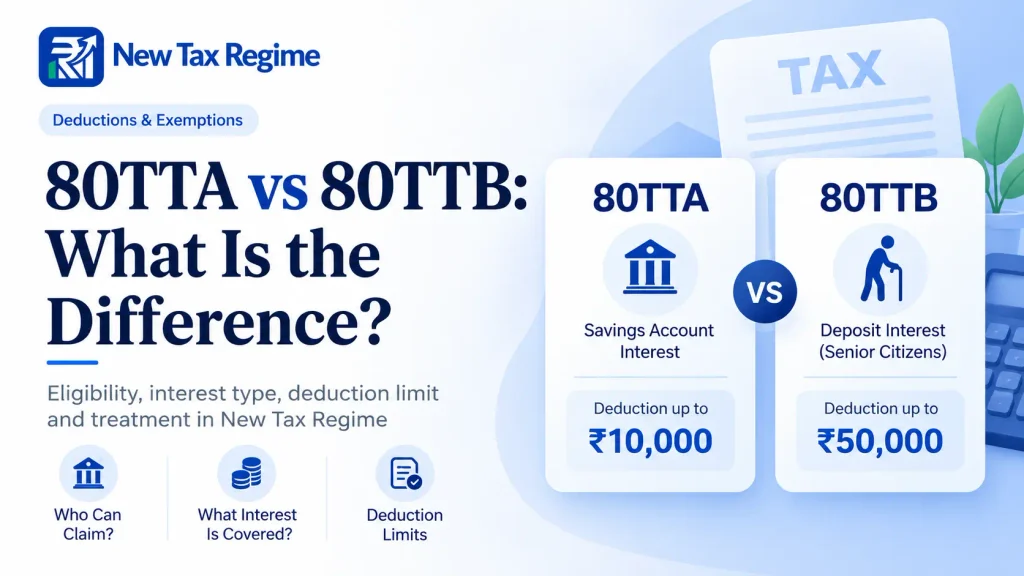
80TTA vs 80TTB: What Is the Difference?
The two provisions serve different taxpayer groups and cover different types of interest.
| Feature | Section 80TTA | Section 80TTB |
|---|---|---|
| Main taxpayer category | Eligible individuals and HUFs other than senior citizens | Resident senior citizens |
| Main interest covered | Qualifying savings-account interest | Qualifying interest from deposits |
| Maximum deduction | ₹10,000 | ₹50,000 |
| Fixed-deposit interest | Generally not covered | Can qualify, subject to conditions |
| New Tax Regime | Not available | Not available |
| Main relevance | Savings-account interest | Broader deposit interest for senior citizens |
The biggest practical difference is the type of interest covered. A taxpayer cannot assume that the ₹10,000 80TTA limit applies to FD interest.
Similarly, the ₹50,000 80TTB provision is specifically linked to eligible senior citizens and qualifying interest.
Another important point is that neither deduction can simply be carried into the New Regime because the taxpayer has qualifying interest. The tax regime determines whether the deduction is available in the first place.
How to Treat Interest Income Under the New Tax Regime
The easiest way to understand the treatment is to follow the income through the calculation.
Step 1: Start with salary income
Suppose a salaried individual earns ₹9,00,000 during FY 2025-26.
Under the New Tax Regime, an eligible salaried taxpayer can claim the applicable ₹75,000 standard deduction from salary income. That leaves ₹8,25,000 after the standard deduction, before considering other income.
Step 2: Add savings-account interest
Assume the same taxpayer earns ₹15,000 in savings-account interest. Because 80TTA is unavailable under the New Regime, there is no ₹10,000 deduction to subtract from this interest.
The income considered for the calculation therefore becomes:
₹8,25,000 + ₹15,000 = ₹8,40,000
Step 3: Apply the New Regime provisions
For AY 2026-27, the New Tax Regime has slabs beginning with a Nil rate up to ₹4 lakh, followed by 5%, 10%, 15%, 20%, 25% and 30% slabs as income rises.
The taxpayer’s ₹8.40 lakh income therefore falls within the New Regime slab structure. The applicable Section 87A rebate should then be considered when determining the final tax liability for an eligible resident individual.
The important point is that the ₹15,000 interest is included in the income calculation even though 80TTA cannot be claimed. This example also shows why the loss of a deduction does not automatically make the New Regime more expensive.
The final result depends on the taxpayer’s complete income, applicable slabs, rebate eligibility and other deductions that may be available under either regime.
What Should You Check Before Choosing the Tax Regime?
The fact that 80TTA or 80TTB is unavailable under the New Regime does not by itself mean the Old Regime will produce lower tax.
A taxpayer should compare the overall taxable income and final tax liability under both regimes.
The comparison can include salary, pension, savings interest, FD interest and other taxable income, along with the deductions actually available to the taxpayer.
For a taxpayer with only ₹5,000–₹10,000 of savings-account interest, the value of 80TTA may be relatively small compared with the effect of the broader New Regime tax structure.
For a senior citizen with substantial qualifying deposit interest, the ₹50,000 maximum 80TTB deduction can have a more noticeable effect under the Old Regime.
Even then, the correct decision depends on the taxpayer’s entire financial position rather than the deduction in isolation.
The safest approach is to calculate taxable income under both regimes using the same income figures and then compare the final tax payable.
You May Also Like To Read These Posts 👇
Home Loan in New Tax Regime: Deduction & Interest Benefit for FY 2025-26
Surcharge in New Tax Regime: Rates, Calculation & Marginal Relief for FY 2025-26
Gratuity & Leave Encashment Exemption in New Tax Regime
80G Deduction (Donations) in New Tax Regime – Is It Allowed?
Key Takeaways
- Section 80TTA is not available under the New Tax Regime for FY 2025-26.
- Under the Old Regime, eligible taxpayers can claim up to ₹10,000 against qualifying savings-account interest, subject to the section’s conditions.
- Section 80TTB is also not available under the New Tax Regime.
- Section 80TTB is meant for eligible resident senior citizens and provides a maximum deduction of ₹50,000 against qualifying interest income.
- The inability to claim 80TTA or 80TTB does not make the underlying interest income exempt.
- Tax regime selection should be based on the taxpayer’s overall tax calculation, not on one deduction alone.
Frequently Asked Questions
Is 80TTA allowed in the New Tax Regime for FY 2025-26?
No. Section 80TTA is not available under the New Tax Regime for FY 2025-26 (AY 2026-27). A taxpayer choosing the New Regime cannot claim the 80TTA deduction against qualifying savings-account interest.
The interest remains part of total income, while the final tax depends on the taxpayer’s complete income and applicable rebates.
Can I claim 80TTA on savings-account interest under the New Tax Regime?
No. 80TTA cannot be claimed under the New Tax Regime. The deduction is available under the Old Tax Regime subject to its eligibility conditions.
Under the New Regime, qualifying savings-account interest continues to be included in income without an 80TTA deduction.
Is 80TTB available in the New Tax Regime?
No. Section 80TTB is not available under the New Tax Regime for FY 2025-26.
Eligible resident senior citizens who choose the New Regime cannot claim the maximum ₹50,000 deduction under 80TTB against qualifying interest income.
What is the difference between 80TTA and 80TTB?
Section 80TTA primarily covers qualifying savings-account interest for eligible individuals and HUFs other than senior citizens, with a maximum deduction of ₹10,000.
Section 80TTB applies to eligible resident senior citizens and covers qualifying interest from deposits, with a maximum deduction of ₹50,000. Neither deduction is available under the FY 2025-26 New Tax Regime.
Is savings-bank interest taxable if 80TTA cannot be claimed?
Yes. The fact that 80TTA cannot be claimed does not make savings-bank interest exempt. Under the New Regime, the interest is included in the taxpayer’s income.
However, the final tax payable depends on total taxable income, the applicable slab rates and any rebate or other benefit available under the tax rules.
Disclaimer
This content is provided for general informational purposes and should not be treated as professional tax, legal, or financial advice. Individual tax treatment may vary based on income, taxpayer status and applicable rules.

6 Comments
Pingback: New Tax Regime Deductions & Exemptions FY 2025-26
Pingback: Marginal Relief in New Tax Regime: Examples & Calculation
Pingback: Home Loan in New Tax Regime: Deduction & Interest Benefit
Pingback: Leave Encashment Exemption in New Tax Regime
Pingback: Food Coupons & Meal Card Tax Exemption in New Tax Regime FY 2025-26
Pingback: No LTA Exemption in New Tax Regime FY 2026-27