

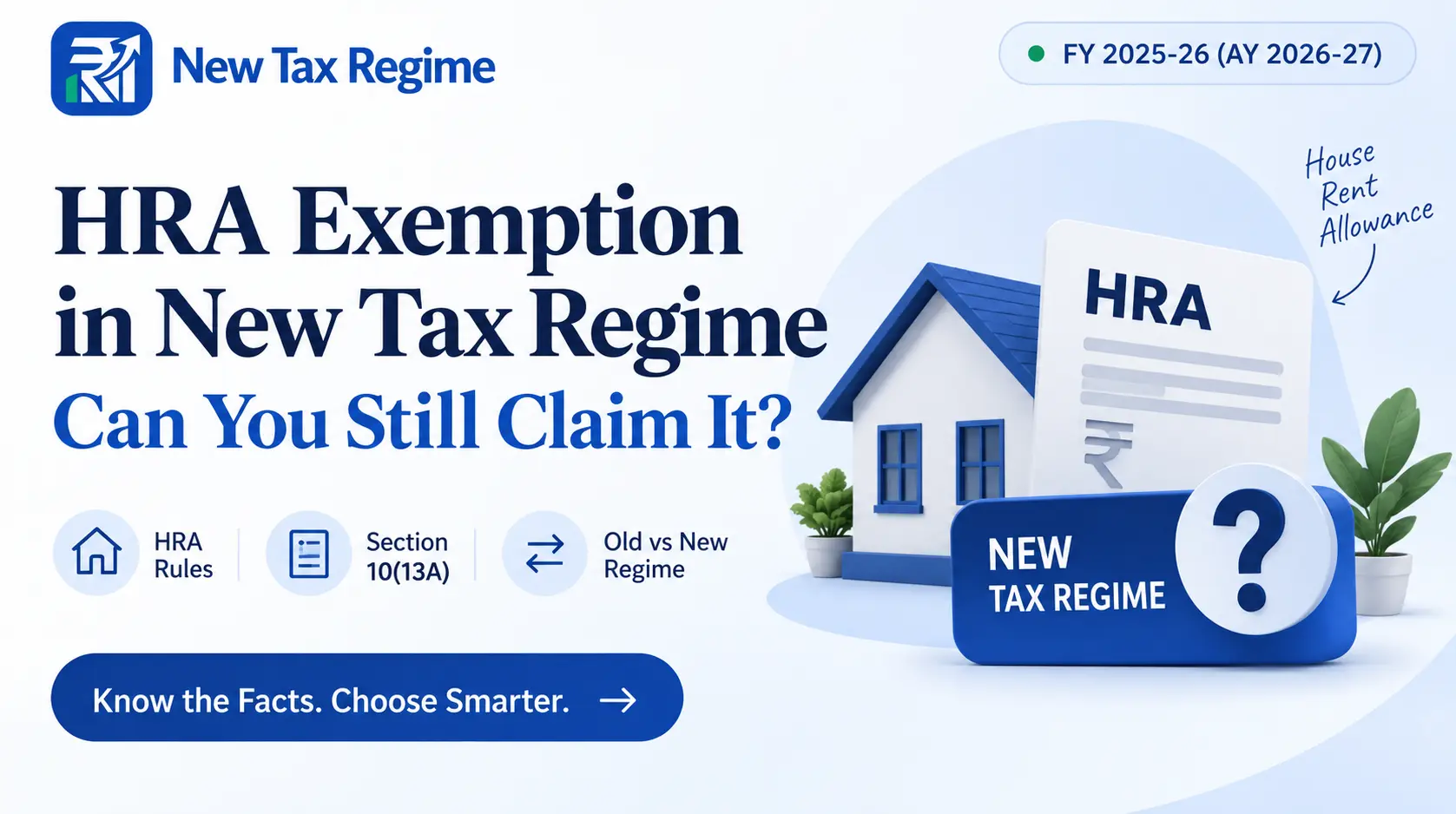
No, HRA exemption is generally not available under the new tax regime for FY 2025-26 (AY 2026-27).
Last updated: October 2026.
While an employer can still include House Rent Allowance (HRA) in your salary package, you generally cannot claim the tax exemption available under Section 10(13A).
This distinction is crucial: an HRA line appearing on your salary slip does not automatically make that amount tax-free.
This article explains how HRA is treated under the new regime, how the exemption works under the old regime, and what paying rent means for someone choosing the new tax regime.
Discover More About:👇
HRA in New Tax Regime: What Happens to Your House Rent Allowance?
House Rent Allowance is a salary component commonly provided by employers to employees who receive a structured salary package.
It may appear separately from basic salary, special allowance and other components on the payslip.
Under the old tax regime, HRA can qualify for an exemption under Section 10(13A) if the prescribed conditions are satisfied. The amount of exemption is calculated using specific limits based on HRA received, rent paid and salary.
The treatment changes when an employee opts for the new tax regime. The HRA exemption under Section 10(13A) is generally not available, so the HRA received from the employer is ordinarily included in taxable salary.
This means salary structure and tax treatment are two different things. An employer does not necessarily need to remove the HRA component merely because an employee chooses the new regime.
For example, you may continue to see ₹20,000 as HRA on your monthly payslip. Under the new regime, that ₹20,000 does not become tax-free simply because it is labelled “HRA”.
You May Also Like To Read These Posts 👇
Complete List of Deductions & Exemptions Allowed in New Tax Regime
NPS Deduction (80CCD(2)) Under New Tax Regime – Full Guide for FY 2025-26
Section 87A Rebate in New Tax Regime – Eligibility & Limit FY 2025-26
Standard Deduction in New Tax Regime – Amount & Rules
Can We Claim HRA in New Tax Regime?
No. HRA exemption under Section 10(13A) is generally not available under the new tax regime.
You can still receive HRA from your employer, but the tax exemption attached to that allowance is not available after choosing the new regime.
Paying rent, having a rent agreement or submitting rent receipts does not by itself restore the exemption.
This is different from saying that HRA cannot exist in a salary package. The employer can continue to pay and report HRA as part of salary; the issue is whether you can exclude that amount while calculating taxable income.
The new regime is designed around lower slab rates and fewer exemptions and deductions.
Therefore, you need to look at the overall tax calculation rather than assuming that a particular salary component will remain tax-free.
For a taxpayer with substantial deductions and exemptions, the old regime may sometimes produce a lower tax liability.
For another taxpayer with fewer deductions, the new regime may remain more beneficial even without the HRA exemption.
Is HRA Allowed in New Tax Regime for Salaried Employees?
The answer depends on what “allowed” means.
HRA can still be paid by an employer and appear in the salary structure. However, the HRA exemption under Section 10(13A) is generally not available under the new regime.
HRA Shown in Your Salary Slip
Your salary slip can contain an HRA component even when you use the new regime.
For example, a salary structure might contain basic salary of ₹50,000 per month and HRA of ₹20,000 per month. The employer can continue to show both components separately for payroll purposes.
The presence of HRA on the payslip does not determine whether it is exempt from income tax. The applicable tax regime and relevant income-tax provisions determine the tax treatment.
HRA Exemption Is a Separate Tax Benefit
Under the old regime, HRA exemption depends on prescribed conditions and a specific calculation. Rent paid is one part of that calculation, but the exemption is not simply equal to the rent paid.
Under the new regime, the Section 10(13A) exemption is generally unavailable.
Therefore, even if you actually pay monthly rent, you cannot normally claim the HRA exemption merely by providing rent receipts to your employer.
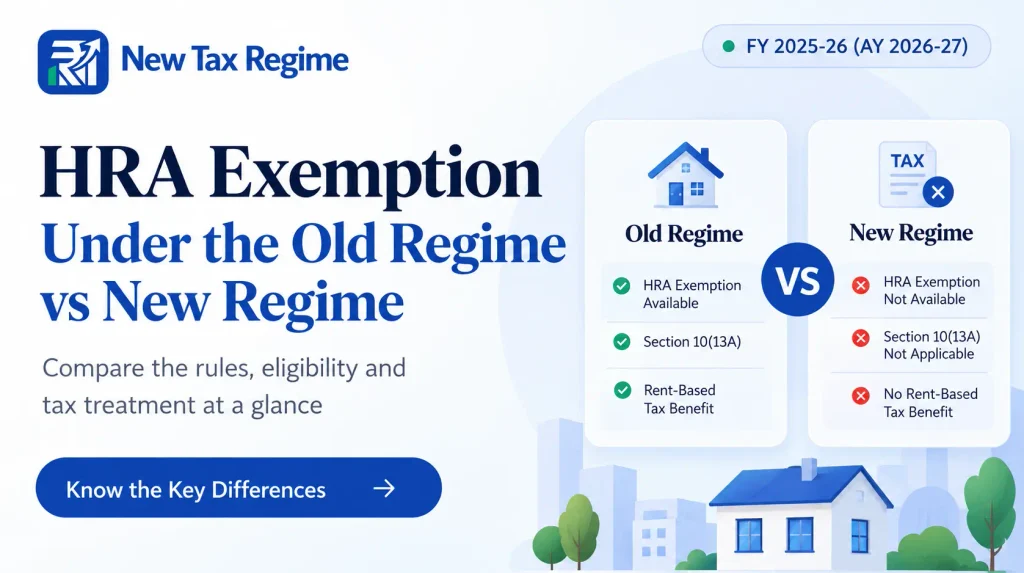
HRA Exemption Under the Old Regime vs New Regime
The HRA treatment can be summarized as follows:
| HRA Treatment | Old Tax Regime | New Tax Regime |
|---|---|---|
| HRA can form part of salary | Yes | Yes |
| Section 10(13A) HRA exemption | Generally available, subject to conditions | Generally not available |
| Rent receipts can support an HRA exemption claim | Yes, where applicable | Do not create an HRA exemption |
| HRA shown separately in salary slip | Possible | Possible |
| HRA exemption reduces taxable salary | Yes, where eligible | No |
The key difference is therefore not whether an employer can pay HRA. It is whether you can claim the associated tax exemption.
How HRA Exemption Is Normally Calculated Under the Old Regime
HRA exemption under the old regime is generally based on the lowest of three amounts:
- Actual HRA received from the employer.
- Rent paid minus 10% of salary.
- 50% of salary for specified metropolitan cities (Delhi, Mumbai, Kolkata, Chennai) or 40% of salary for other locations.
For this calculation, “salary” has a specific meaning. It generally includes basic salary, eligible dearness allowance that forms part of retirement benefits, and commission where it is based on a fixed percentage of turnover. It is not the same as total CTC.
You May Also Like To Read These Posts 👇
80TTA & 80TTB Deduction – Are They Allowed in New Tax Regime?
Meal Card, Food Coupons & Conveyance Allowance in New Tax Regime
LTA (Leave Travel Allowance) in New Tax Regime – Rules Explained
Marginal Relief in New Tax Regime – Explained With Examples
Worked HRA Example
Consider an employee living in Bengaluru with:
- Basic salary: ₹50,000 per month
- Annual basic salary: ₹6,00,000
- HRA received: ₹20,000 per month
- Annual HRA: ₹2,40,000
- Rent paid: ₹25,000 per month
- Annual rent: ₹3,00,000
Bengaluru falls into the non-metro category for this calculation, so the relevant percentage is 40% of salary.
The three amounts are:
- Actual HRA received = ₹2,40,000
- Rent paid − 10% of salary = ₹3,00,000 − ₹60,000 = ₹2,40,000
- 40% of salary = ₹2,40,000
The lowest amount is ₹2,40,000, so that would be the HRA exemption under the old-regime calculation, assuming the other applicable conditions are satisfied.
This example is provided only to explain the old-regime calculation. The same ₹2,40,000 exemption cannot generally be claimed when you choose the new tax regime.
What Happens to HRA If You Choose the New Tax Regime?
When the new tax regime is selected, the HRA exemption under Section 10(13A) is generally unavailable.
Suppose you receive ₹2,40,000 as HRA during the year and also pay ₹20,000 in monthly rent. The rent payment does not allow you to subtract ₹2,40,000 from salary as an HRA exemption under the new regime.
The practical effect is that the HRA amount is generally included in taxable salary rather than being reduced by the Section 10(13A) exemption.
This is why using the salary breakup alone to estimate taxable income can produce the wrong result. You should not simply remove the HRA component from salary because it is labelled “HRA”.
There is therefore no HRA exemption deduction under the new regime equivalent to the Section 10(13A) benefit available under the old regime.
Can Rent Paid Still Give You a Tax Benefit Under the New Regime?
Paying rent does not automatically make part of salary tax-free under the new regime.
Under the old regime, rent can be relevant to an HRA exemption calculation when you receive HRA and satisfy the applicable conditions. Under the new regime, that particular HRA exemption is generally unavailable.
Employees sometimes confuse HRA with Section 80GG, which relates to a deduction for certain taxpayers paying rent without receiving HRA.
Section 80GG has separate eligibility requirements and limits, and it should not be treated as another form of HRA exemption.
More importantly, deductions that are not permitted under the new regime cannot be claimed simply because the underlying expense was actually paid. Therefore, if you pay ₹25,000 rent every month, you should not assume that the annual rent of ₹3,00,000 automatically creates a tax deduction under the new regime.
Practical Example — HRA in Salary but No HRA Exemption
Consider this annual salary structure:
- Basic salary: ₹6,00,000
- HRA: ₹2,40,000
- Other salary components: ₹2,00,000
- Gross salary: ₹10,40,000
You pay rent of ₹20,000 per month and choose the new tax regime.
The HRA of ₹2,40,000 remains part of the salary received from the employer. You cannot claim the Section 10(13A) HRA exemption simply because rent is being paid.
If you were eligible to claim HRA exemption under the old regime, the calculation would depend on the prescribed three-limit formula. The result could therefore be different between the two regimes.
This example highlights the main issue: an HRA component in a salary breakup does not automatically mean that the same amount can be excluded from taxable income.
You should also remember that taxable salary is not always identical to CTC. Other salary components, exempt allowances, employer contributions and permitted deductions can affect the final tax calculation.
Should You Choose the Old Regime Just to Claim HRA?
HRA can be an important factor in a tax-regime comparison, but it should not be the only factor.
The new regime provides revised slab rates and, for eligible salaried taxpayers, a ₹75,000 standard deduction.
Budget 2025 also increased the Section 87A rebate threshold for eligible resident individuals, making normal income up to ₹12 lakh eligible for a rebate of up to ₹60,000, subject to the applicable conditions.
Salaried taxpayers can also benefit from the standard deduction while determining taxable income.
The old regime, on the other hand, can allow HRA exemption along with various other deductions and exemptions where you satisfy the relevant conditions.
If you pay high rent and also have substantial eligible deductions, the old regime may deserve comparison.
Someone with relatively few deductions may find that the lower rates and benefits of the new regime outweigh the loss of HRA exemption.
There is no universal income level at which the old regime or new regime is always better. The better choice depends on your salary, HRA, rent, eligible deductions, other income and applicable tax benefits.
A sensible comparison should therefore calculate the tax liability under both regimes instead of deciding solely on the basis of HRA.
You May Also Like To Read These Posts 👇
Home Loan in New Tax Regime: Deduction & Interest Benefit for FY 2025-26
Surcharge in New Tax Regime: Rates, Calculation & Marginal Relief for FY 2025-26
Gratuity & Leave Encashment Exemption in New Tax Regime
80G Deduction (Donations) in New Tax Regime – Is It Allowed?
Key Takeaways
- HRA exemption under Section 10(13A) is generally not available under the new tax regime for FY 2025-26.
- An employer can still include HRA in the salary structure even when you choose the new regime.
- Receiving HRA and claiming HRA exemption are two different things.
- Under the old regime, HRA exemption is generally based on the lowest of actual HRA, rent paid minus 10% of salary, and the applicable percentage of salary.
- Paying rent does not automatically make HRA tax-free under the new regime.
- Choosing a tax regime should depend on the overall tax calculation, not HRA alone.
Frequently Asked Questions
Can I claim HRA exemption under the new tax regime?
Generally, no. The exemption available under Section 10(13A) is not available when you opt for the new tax regime. HRA can still be received from the employer, but the corresponding exemption cannot generally be claimed.
Is HRA taxable in the new tax regime?
Generally, the HRA received from the employer forms part of taxable salary because the Section 10(13A) exemption is unavailable under the new regime.
The final tax liability is still determined after considering the complete salary and other applicable provisions.
Can I claim HRA exemption if I pay rent but choose the new regime?
Generally, no. Paying rent is relevant to the HRA exemption calculation under the old regime, but rent payment alone does not create an HRA exemption under the new regime.
Is HRA allowed in the new tax regime if it appears in my salary slip?
Yes, an employer can continue to show HRA as a salary component. However, its appearance on the payslip does not mean you can claim the Section 10(13A) exemption under the new regime.
Is the old tax regime better if I receive HRA?
Not necessarily. The old regime may be beneficial when HRA exemption and other eligible deductions are substantial, while the new regime may be more suitable when deductions are limited.
The comparison should be based on your complete income and eligible tax benefits.
Disclaimer: This content is provided for general informational purposes and should not be treated as professional tax or financial advice. Individual tax outcomes can vary based on income, salary structure, regime selection and applicable rules.

7 Comments
Pingback: New Tax Regime Deductions & Exemptions FY 2025-26
Pingback: 87A Rebate in New Tax Regime: Limit & Eligibility
Pingback: 80TTA in New Tax Regime: Is It Allowed in FY 2025-26?
Pingback: Leave Encashment Exemption in New Tax Regime
Pingback: Food Coupons & Meal Card Tax Exemption in New Tax Regime FY 2025-26
Pingback: No LTA Exemption in New Tax Regime FY 2026-27
Pingback: Surcharge in New Tax Regime: Rates & Rules FY 2026-27