

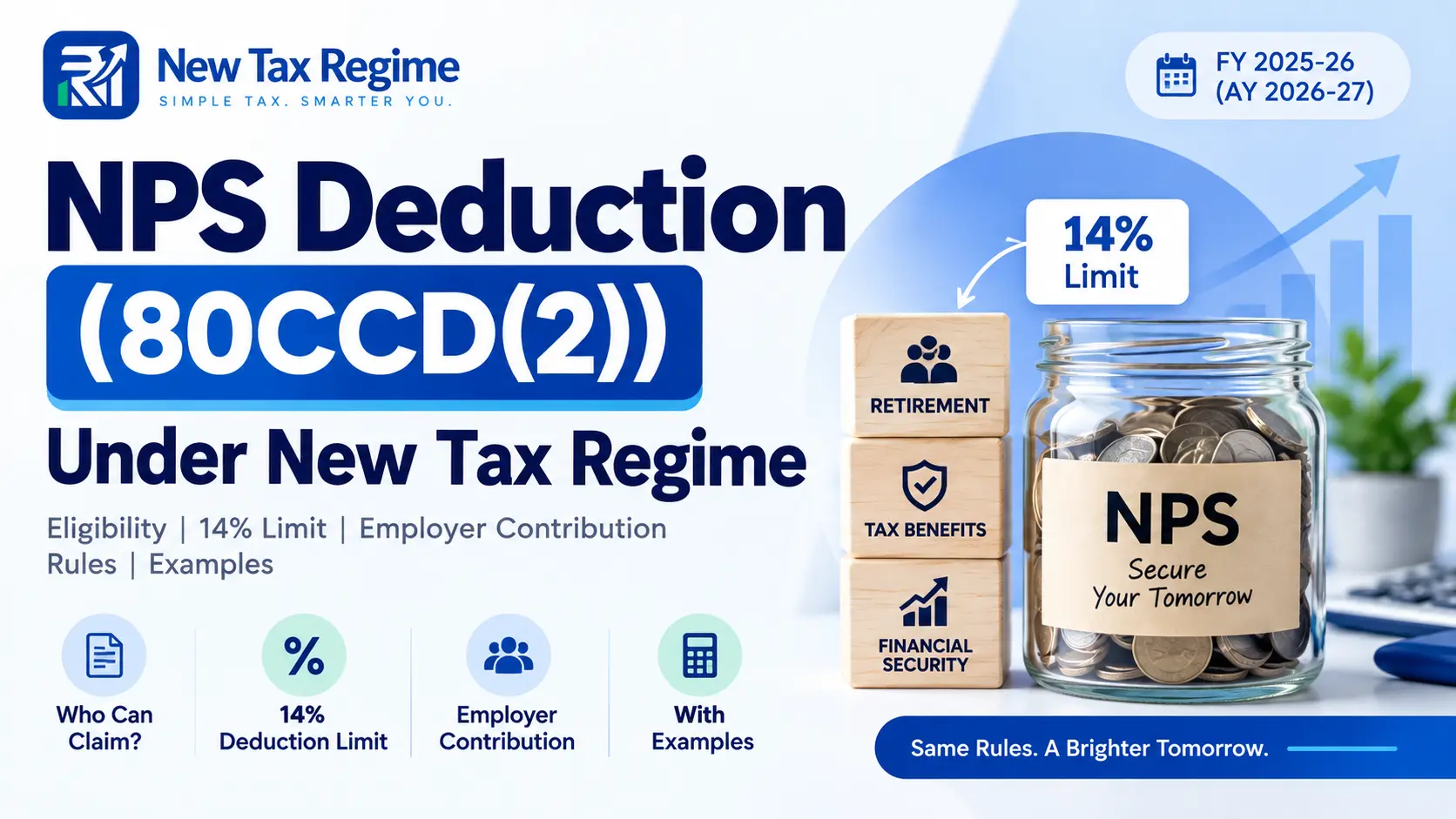
Can you claim NPS deduction under the new tax regime? Yes,but only for your employer’s contribution.
Your own NPS contribution (whether under Section 80CCD(1) or the additional ₹50,000 under Section 80CCD(1B)) does not qualify for any tax deduction if you opt for the new tax regime.
The employer’s contribution under Section 80CCD(2) remains available and, for private-sector employees, the limit has increased to 14% of your salary.
This guide explains exactly how the NPS deduction works under the new tax regime for FY 2025-26 (AY 2026-27), who can claim it, how it’s calculated, and what limits apply.
Can You Claim NPS Deduction Under the New Tax Regime?
The answer depends on who makes the NPS contribution:
| Contribution Type | Section | Available Under New Regime? |
|---|---|---|
| Employee’s own NPS contribution | 80CCD(1) | ❌ No |
| Additional employee contribution | 80CCD(1B) | ❌ No |
| Employer’s NPS contribution | 80CCD(2) | ✅ Yes |
This is one of the few tax deductions that remains available under the new tax regime.
What Is Section 80CCD(2) in the New Tax Regime?
Section 80CCD(2) allows a deduction for the employer’s contribution to an employee’s NPS account. Under the Corporate NPS model, the employer contributes a percentage of the employee’s salary to their Tier-I NPS account.
Key point: This deduction is available under both the old and new tax regimes. Unlike your personal NPS contributions, which lose their tax benefit in the new regime, the employer’s contribution continues to reduce your taxable income.
Who Can Claim Section 80CCD(2)?
- Government employees (Central and State) — eligible under both regimes
- Private-sector employees — eligible only if the employer has adopted the Corporate NPS model
- Self-employed individuals — not eligible, as there is no employer to make a contribution
What Counts as “Salary” for This Deduction?
For the purpose of Section 80CCD(2), “salary” means Basic Salary + Dearness Allowance (DA), provided DA forms part of retirement benefits.
What is NOT included:
- HRA
- Special allowance
- Bonus
- Commission
- Any other allowances
Do not calculate the deduction against your total CTC or gross salary — that would be incorrect.
What Is the NPS Deduction Limit Under the New Regime?
The deduction limit depends on your employer type and the tax regime you choose:
| Employee Category | Old Tax Regime | New Tax Regime |
|---|---|---|
| Central/State Government | 14% of salary (Basic+DA) | 14% of salary (Basic+DA) |
| Private Sector / PSU / Corporate | 10% of salary (Basic+DA) | 14% of salary (Basic+DA) |
Important: Under the new tax regime for FY 2025-26, the limit for private-sector employees has been increased from 10% to 14%, aligning it with government employees.
How to Calculate the 80CCD(2) Deduction
Step 1: Calculate your annual salary for this purpose = Basic Salary + DA (where DA forms part of retirement benefits).
Step 2: Determine the applicable percentage based on your employer category and tax regime.
Step 3: Calculate the limit = Percentage × Salary.
Step 4: The eligible deduction = Lower of (Actual employer NPS contribution, Calculated limit).
Example 1: Employer Contribution Within the Limit
Profile: Private-sector employee, FY 2025-26, New Tax Regime.
- Basic Salary: ₹10,00,000
- DA: ₹2,00,000 (forms part of retirement benefits)
- Salary for 80CCD(2) = ₹12,00,000
- Employer NPS contribution: ₹1,68,000 (14% of salary)
Calculation:
- Limit: 14% × ₹12,00,000 = ₹1,68,000
- Actual employer contribution: ₹1,68,000
- Eligible deduction: ₹1,68,000 (full amount qualifies)
Example 2: Employer Contribution Above the Limit
Profile: Private-sector employee, FY 2025-26, New Tax Regime.
- Basic Salary: ₹10,00,000
- DA: ₹2,00,000
- Salary for 80CCD(2) = ₹12,00,000
- Employer NPS contribution: ₹2,00,000
Calculation:
- Limit: 14% × ₹12,00,000 = ₹1,68,000
- Actual employer contribution: ₹2,00,000
- Eligible deduction: ₹1,68,000 (the excess ₹32,000 is NOT deductible)
The excess employer contribution is not deductible under Section 80CCD(2).
Employee NPS Contribution vs Employer Contribution
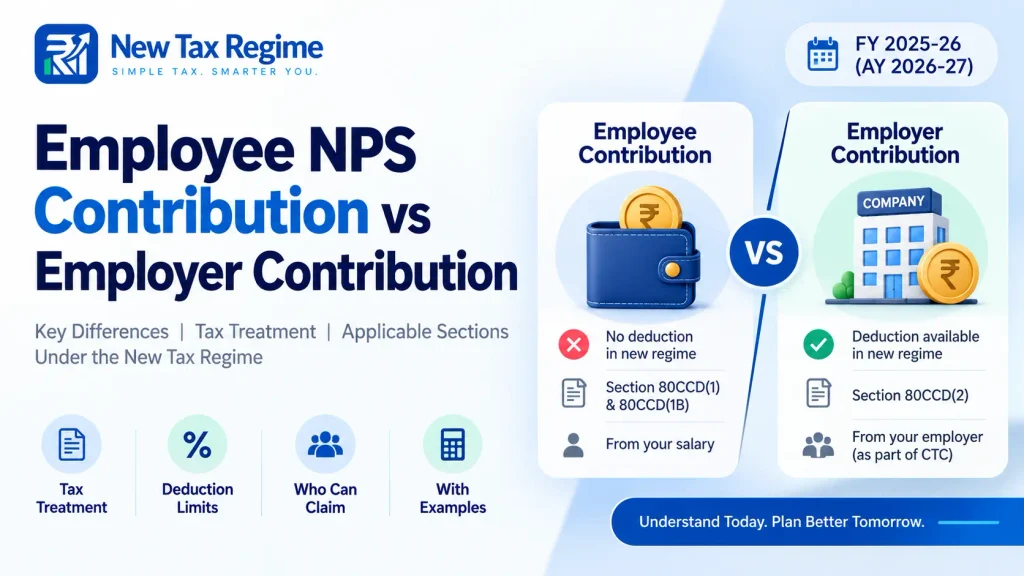
This is the most common source of confusion. Here’s a clear comparison:
| Employee’s Own Contribution | Employer’s NPS Contribution | |
|---|---|---|
| Who contributes? | You (from your salary) | Your employer (as part of CTC) |
| Section | 80CCD(1) and 80CCD(1B) | 80CCD(2) |
| Available under new regime? | ❌ No | ✅ Yes |
| Limit under new regime | Not applicable | 14% of Basic+DA (private) |
| Subject to 80C limit? | Yes (₹1.5 lakh) | No |
Remember: If you choose the new tax regime, your own NPS contribution gives you no tax benefit. Only what your employer contributes is deductible.
NPS Tax Benefit in New Tax Regime: What Else Should You Know?
How the Deduction Works — The Statutory Sequence
The employer’s NPS contribution is first included in your salary under Section 17(1)(viii) of the Income-tax Act. Then, it becomes eligible for deduction under Section 80CCD(2).
This is why your Form 16 and ITR utility will show the employer NPS contribution added to salary first, then deducted. This is not double taxation — it’s the statutory sequence.
What About Withdrawal?
- 60% lump-sum withdrawal at retirement: Exempt under Section 10(12A)
- Partial withdrawal (up to certain limits): Exempt under Section 10(12B)
- Annuity income from NPS: Fully taxable at slab rates
NPS is not completely tax-free — annuity income is taxable.
What Happens If Employer Contributions Cross ₹7.5 Lakh?
The ₹7.5 lakh limit under Section 17(2)(vii) is a separate rule — do not confuse it with the 80CCD(2) deduction limit.
What it means: If the aggregate employer contributions to NPS + EPF + Superannuation Fund exceed ₹7.5 lakh in a financial year, the excess amount is taxable as a perquisite in the employee’s hands.
Important: This does not affect your 80CCD(2) deduction. The 14% limit for 80CCD(2) and the ₹7.5 lakh perquisite threshold are two different provisions serving different purposes.
Common Mistakes When Claiming NPS Benefits
1. Assuming all NPS contributions are deductible under the new regime — Only the employer’s contribution under Section 80CCD(2) qualifies. Your own contribution does not.
2. Confusing 80CCD(1) with 80CCD(2) — 80CCD(1) is for employee contribution (not available under new regime). 80CCD(2) is for employer contribution (available).
3. Calculating the deduction against total CTC — The limit applies only to Basic Salary + DA, not your full compensation.
4. Assuming the entire employer contribution is always deductible — The deduction is capped at the applicable percentage of salary. Any excess is not deductible.
5. Confusing the ₹7.5 lakh perquisite limit with the 80CCD(2) deduction — These are separate provisions.
6. Thinking self-employed individuals can claim 80CCD(2) — This provision requires an employer. Self-employed individuals cannot claim it.
7. Assuming all NPS withdrawals are tax-free — While 60% of the lump sum is exempt, annuity income is fully taxable.
Key Takeaways
- Only employer NPS contributions are deductible under the new tax regime — your own contributions give no tax benefit.
- Private-sector employees can claim up to 14% of salary (Basic+DA) under the new regime (up from 10% in the old regime).
- Government employees can claim up to 14% under both regimes.
- The deduction is claimed under Section 80CCD(2) — separate from the employee contribution provisions.
- Salary for this purpose means Basic + DA only — not CTC or gross salary.
- The ₹7.5 lakh perquisite limit on employer contributions to retirement funds is a separate rule, not the same as the 80CCD(2) limit.
- Annuity income from NPS is fully taxable — NPS is not completely tax-free.
Frequently Asked Questions
1. Can I claim NPS deduction under the new tax regime?
Yes — but only for the employer’s contribution under Section 80CCD(2). Your own NPS contribution does not qualify for deduction under the new regime.
2. What is the NPS deduction limit under the new regime?
For private-sector employees, the limit is 14% of salary (Basic + DA). For government employees, it is 14% under both regimes.
3. Is employer NPS contribution taxable under the new regime?
It is first included in salary under Section 17(1)(viii), then deducted under Section 80CCD(2). This is a statutory sequence, not double taxation.
4. Can I claim both 80CCD(1) and 80CCD(2) under the new regime?
No — 80CCD(1) (employee contribution) is not available under the new regime. Only 80CCD(2) (employer contribution) is available.
5. How is salary calculated for Section 80CCD(2)?
“Salary” means Basic Salary + Dearness Allowance (DA), provided DA forms part of retirement benefits. Other allowances (HRA, bonus, commission) are not included.
Disclaimer: This article provides general information for educational purposes only and does not constitute professional tax, financial, or legal advice.
Tax laws are subject to change. Readers should consult a qualified tax professional for advice specific to their situation.
