

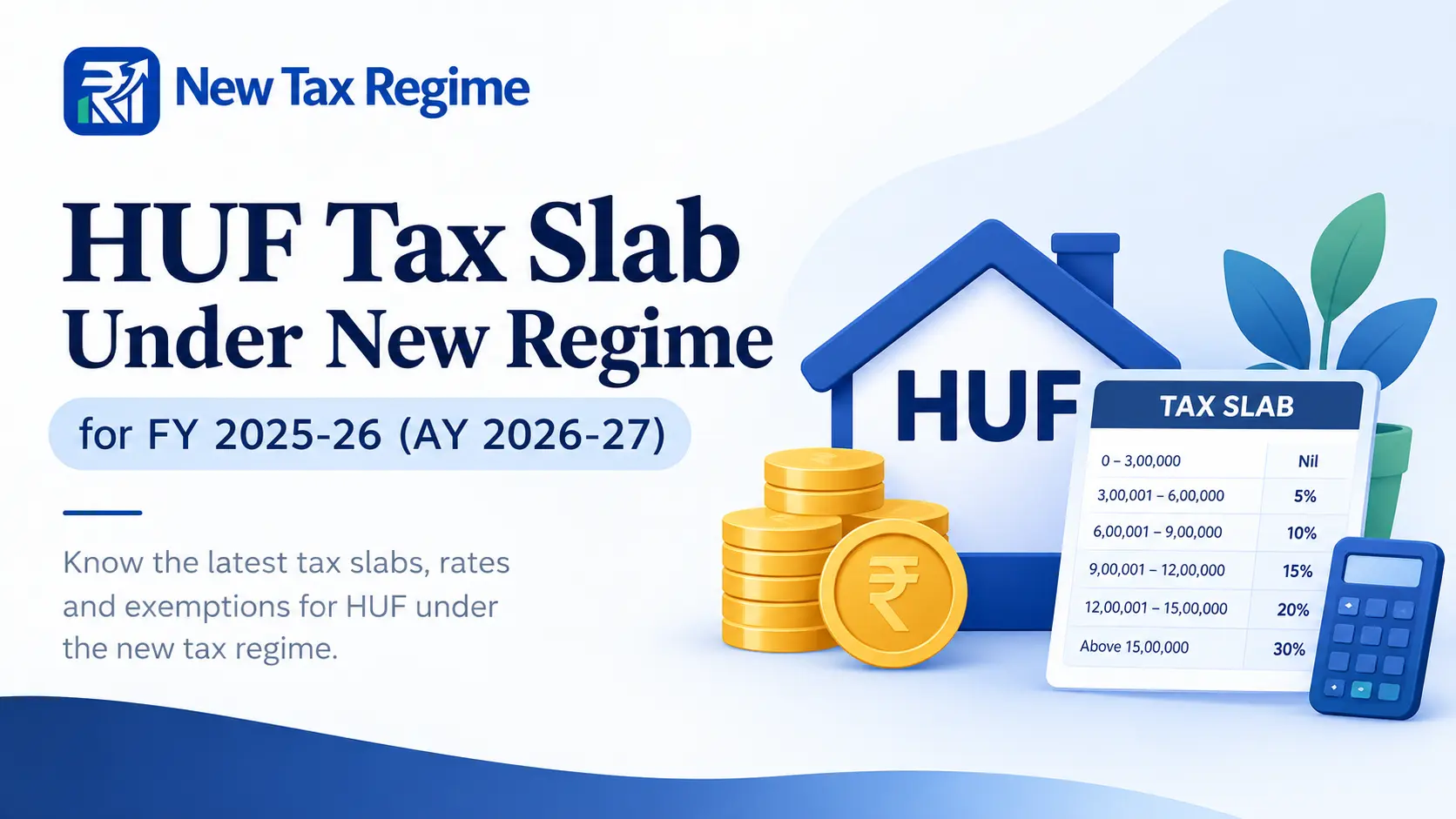
For FY 2025-26 (AY 2026-27), an HUF is taxed under the new-regime slab structure with nil tax up to ₹4 lakh, followed by rates of 5%, 10%, 15%, 20%, 25% and 30% as income rises.
However, an HUF cannot claim the Section 87A rebate available to eligible resident individuals, so the Budget 2025 provision that can result in zero tax for an individual with taxable income up to ₹12 lakh does not create the same outcome for an HUF.
The distinction matters when calculating HUF tax. An HUF with ₹12 lakh of taxable income from normal slab-rate sources would have ₹60,000 of income tax before cess and ₹62,400 after 4% Health and Education Cess, assuming no surcharge or special-rate income.
This guide explains the applicable slabs, calculation method, deductions, Section 87A treatment and common mistakes for AY 2026-27.
Discover More About:👇
HUF New Tax Regime: Who Is Taxed and How?
A Hindu Undivided Family, or HUF, is treated as a separate taxable person for income-tax purposes. Income that belongs to the HUF is assessed in the HUF’s hands rather than being automatically added to the personal taxable income of an individual member.
The huf new tax regime is the default tax regime for HUFs under Section 115BAC.
The new regime became the default for HUFs from AY 2024-25, while eligible taxpayers can opt for the old regime subject to the applicable conditions and filing requirements.
For an HUF, the tax calculation therefore starts with income belonging to the HUF.
The nature of that income also matters because some income may be taxed at normal slab rates while other income can be subject to a separate tax rate.
You May Also Like To Read These Posts 👇
What Is a New Tax Regime? Complete Beginner’s Guide 2025-26
How to Save Tax in New Tax Regime – Legal Ways & Practical Tips
Tax on Rs 12 Lakh / Rs 15 Lakh / Rs 20 Lakh Income Under New Regime
HUF New Regime Tax Slab for AY 2026-27
The huf new regime tax slab for FY 2025-26 is as follows:
| Taxable Income | New-Regime Tax Rate |
|---|---|
| Up to ₹4,00,000 | Nil |
| ₹4,00,001–₹8,00,000 | 5% |
| ₹8,00,001–₹12,00,000 | 10% |
| ₹12,00,001–₹16,00,000 | 15% |
| ₹16,00,001–₹20,00,000 | 20% |
| ₹20,00,001–₹24,00,000 | 25% |
| Above ₹24,00,000 | 30% |
These are progressive slabs. For example, if an HUF has ₹10 lakh of taxable income subject entirely to normal slab rates, the entire ₹10 lakh is not taxed at 10%.
The first ₹4 lakh falls in the nil slab, the next ₹4 lakh is taxed at 5%, and only the remaining ₹2 lakh is taxed at 10%.
The slab structure above applies to HUFs, including both resident and non-resident HUFs, for AY 2026-27.
HUF Tax Calculation Under the New Regime
Calculating HUF tax involves more than simply applying the slab table to total receipts. The nature of each income source should be identified before the final tax is calculated.
A practical calculation generally follows these steps:
- Calculate the HUF’s gross total income. Include income belonging to the HUF from its different sources.
- Separate normal-rate income from special-rate income. Some capital gains and other specified income can have their own tax rates.
- Identify deductions permitted under the selected regime. The new regime restricts many deductions available under the old regime.
- Determine taxable income. Apply the deductions that are actually available to the HUF.
- Apply the new-regime slabs to income taxable at normal rates.
- Calculate tax on special-rate income separately, where applicable.
- Apply surcharge, if the HUF’s income reaches the relevant threshold.
- Add 4% Health and Education Cess to the income tax and applicable surcharge.
Health and Education Cess is charged at 4% on income tax plus surcharge, where applicable.
Worked Example: HUF Tax on ₹10 Lakh
Assume an HUF has ₹10,00,000 of taxable income, all of which is subject to normal slab rates. Assume there is no special-rate income, surcharge or eligible deduction affecting the calculation.
Step 1: Apply the slabs
- First ₹4,00,000: Nil
- Next ₹4,00,000 at 5% = ₹20,000
- Remaining ₹2,00,000 at 10% = ₹20,000
Income tax before cess = ₹40,000
Step 2: Add Health and Education Cess
4% of ₹40,000 = ₹1,600
Total tax = ₹41,600
No Section 87A rebate is deducted because that rebate is available to eligible resident individuals, not HUFs.
Does Section 87A Rebate Apply to an HUF?
No. Section 87A is not available to an HUF. The rebate is available to resident individuals, and an HUF cannot claim it.
For the new regime, the rebate can be up to ₹60,000 where the taxable income of an eligible resident individual does not exceed ₹12 lakh.
This is why an eligible individual can potentially have zero income tax at that income level. The provision does not extend the same benefit to an HUF.
This creates an important difference between the ₹4 lakh basic nil-rate slab and the ₹12 lakh individual nil-tax outcome. The first is part of the slab structure. The second results from applying Section 87A to an eligible resident individual.
For example, an HUF with ₹12 lakh of taxable income from normal slab-rate sources would calculate:
- First ₹4 lakh: Nil
- Next ₹4 lakh at 5%: ₹20,000
- Next ₹4 lakh at 10%: ₹40,000
- Tax before cess: ₹60,000
- 4% cess: ₹2,400
- Total: ₹62,400
This example assumes there is no surcharge, special-rate income or other adjustment.
Deductions and Exemptions Available to HUF Under the New Regime
The new regime generally provides lower slab rates in exchange for restricting many deductions and exemptions that can be claimed under the old regime.
An HUF should therefore not assume that a deduction available under the old regime automatically remains available after choosing the new regime.
For example, commonly used deductions such as Section 80C and Section 80D should not be treated as generally available under the new regime.
The eligibility of any particular deduction should be checked against the specific provision and the HUF’s circumstances.
House-property income also requires careful treatment.
For a self-occupied house property, the deduction for interest on borrowed capital is restricted under the new regime, and a resulting house-property loss cannot generally be set off against income under another head under the new-regime rules.
Some deductions can continue where the law specifically permits them and the relevant conditions are satisfied.
These should be checked individually rather than assuming that all Chapter VI-A deductions are available or unavailable as one group.
Because an HUF can have business income, property income, investment income or other sources, the correct deduction treatment can depend on the composition of its income.
A regime comparison is therefore more useful when based on the HUF’s actual figures rather than only on the headline slab rates.
HUF Tax Slab New Regime Calculator: How to Estimate Tax
An huf tax slab new regime calculator can make the calculation easier, but the inputs need to be classified correctly.
The basic information required generally includes:
- HUF income from normal slab-rate sources
- Income taxable at special rates
- Eligible deductions under the selected regime
- Total taxable income
- Applicable surcharge, if any
- Health and Education Cess
The calculation can then be performed in this order:
Gross income → eligible deductions → taxable income → normal slab-rate tax → special-rate tax → surcharge, if applicable → 4% cess → final tax liability
For example, an HUF with ₹10 lakh entirely taxable at normal slab rates produces ₹40,000 of tax before cess under the AY 2026-27 slabs. After 4% cess, the liability becomes ₹41,600, assuming no other adjustments.
A calculator should not automatically apply the normal slab table to every type of income.
Certain capital gains and other specified income can have separate tax treatment, so the underlying income classification remains important.
Common HUF New-Regime Tax Mistakes
1. Applying Section 87A to the HUF
The Section 87A rebate is available to eligible resident individuals. An HUF cannot claim the rebate merely because its taxable income is below ₹12 lakh.
2. Treating ₹12 lakh as the HUF’s basic exemption limit
The HUF’s nil-rate slab extends only up to ₹4 lakh under the AY 2026-27 new regime. The ₹12 lakh zero-tax outcome is connected to the individual Section 87A rebate and should not be treated as an HUF exemption.
3. Applying one tax rate to the entire income
The slabs are progressive. An HUF with ₹10 lakh of normal taxable income does not pay 10% on the entire ₹10 lakh.
4. Applying slab rates to special-rate income
Some income, including specified capital gains, is taxed under separate provisions. Such income should be calculated separately rather than automatically placed into the normal slab table.
5. Assuming old-regime deductions continue
Deductions such as Section 80C and Section 80D are generally not available under the new regime. The deduction rules should be checked before calculating taxable income.
6. Forgetting cess
After calculating income tax and applicable surcharge, 4% Health and Education Cess is added. For example, ₹40,000 of tax produces ₹1,600 of cess, resulting in ₹41,600 before any other adjustment.
7. Ignoring surcharge on high income
Surcharge can apply once total income crosses the prescribed thresholds. The applicable rate and marginal-relief provisions should be considered for high-income HUFs.
New-regime surcharge rates of 10%, 15% and 25% apply at the relevant income ranges.
HUF vs Individual: Key Tax Feature Comparison
| Tax Feature | HUF | Eligible Resident Individual |
|---|---|---|
| Separate taxable person | Yes | Yes |
| New-regime slabs for AY 2026-27 | Applicable | Applicable |
| Nil-rate slab | Up to ₹4 lakh | Up to ₹4 lakh |
| Section 87A rebate | Not available | Available if eligible |
| ₹12 lakh nil-tax outcome | Not applicable through Section 87A | Available if eligible under the rebate rules |
| Special-rate income | Depends on income type | Depends on income type |
| 4% Health and Education Cess | Applicable | Applicable |
The key difference for this article is Section 87A. The slab structure can look similar, but the rebate rules produce different outcomes for an HUF and an eligible resident individual.
You May Also Like To Read These Posts 👇
Hidden Costs & Disadvantages of New Tax Regime Nobody Tells You
Can You Switch Between Old and New Tax Regime Every Year?
New Tax Regime for Senior Citizens – Rules & Benefits
Key Takeaways
- The huf tax slab new regime for AY 2026-27 starts with a nil-rate slab up to ₹4 lakh, followed by 5%, 10%, 15%, 20%, 25% and 30%.
- An HUF cannot claim the Section 87A rebate, which is available to eligible resident individuals.
- The ₹12 lakh zero-tax outcome under Budget 2025 should not be treated as an HUF exemption because it depends on the individual Section 87A rebate.
- Normal slab-rate income and income taxable at special rates should be calculated separately.
- Most commonly used old-regime deductions are restricted under the new regime, so the deduction position should be checked before calculating HUF taxable income.
- 4% Health and Education Cess is added to income tax and applicable surcharge.
Frequently Asked Questions
What is the HUF tax slab under the new regime for AY 2026-27?
For FY 2025-26, the new-regime HUF slabs are nil up to ₹4 lakh, 5% from ₹4 lakh to ₹8 lakh, 10% from ₹8 lakh to ₹12 lakh, 15% from ₹12 lakh to ₹16 lakh, 20% from ₹16 lakh to ₹20 lakh, 25% from ₹20 lakh to ₹24 lakh, and 30% above ₹24 lakh.
Does an HUF get the Section 87A rebate under the new tax regime?
No. Section 87A is available to eligible resident individuals and is not available to an HUF.
Therefore, an HUF cannot use the ₹60,000 new-regime rebate to eliminate tax on taxable income up to ₹12 lakh.
Is HUF income up to ₹12 lakh tax-free under the new regime?
No. An HUF has a ₹4 lakh nil-rate slab under the new regime.
The ₹12 lakh zero-tax outcome introduced for eligible individuals comes from Section 87A and does not apply to HUFs.
How can HUF tax be calculated under the new regime?
First determine the HUF’s taxable income and separate normal slab-rate income from income subject to special tax rates.
Apply the relevant deductions, calculate slab-rate tax, add any applicable special-rate tax and surcharge, and then add 4% Health and Education Cess.
Which deductions are available to an HUF under the new tax regime?
The new regime restricts many deductions available under the old regime, including commonly used deductions such as Section 80C and Section 80D.
The availability of any particular deduction should be checked against its specific statutory conditions rather than assuming that it applies to every HUF.
