

Introduction
The new tax regime is an alternative income-tax system with revised slab rates and fewer deductions and exemptions than the old regime.
Last updated: October 2026.
For FY 2025-26 (AY 2026-27), Budget 2025 substantially changed its slabs and increased the Section 87A rebate, allowing eligible resident individuals with qualifying normal taxable income up to ₹12 lakh to have zero tax after rebate.
For salaried taxpayers, the ₹75,000 standard deduction can make gross salary of up to ₹12.75 lakh effectively tax-free when the taxpayer otherwise qualifies for the full rebate.
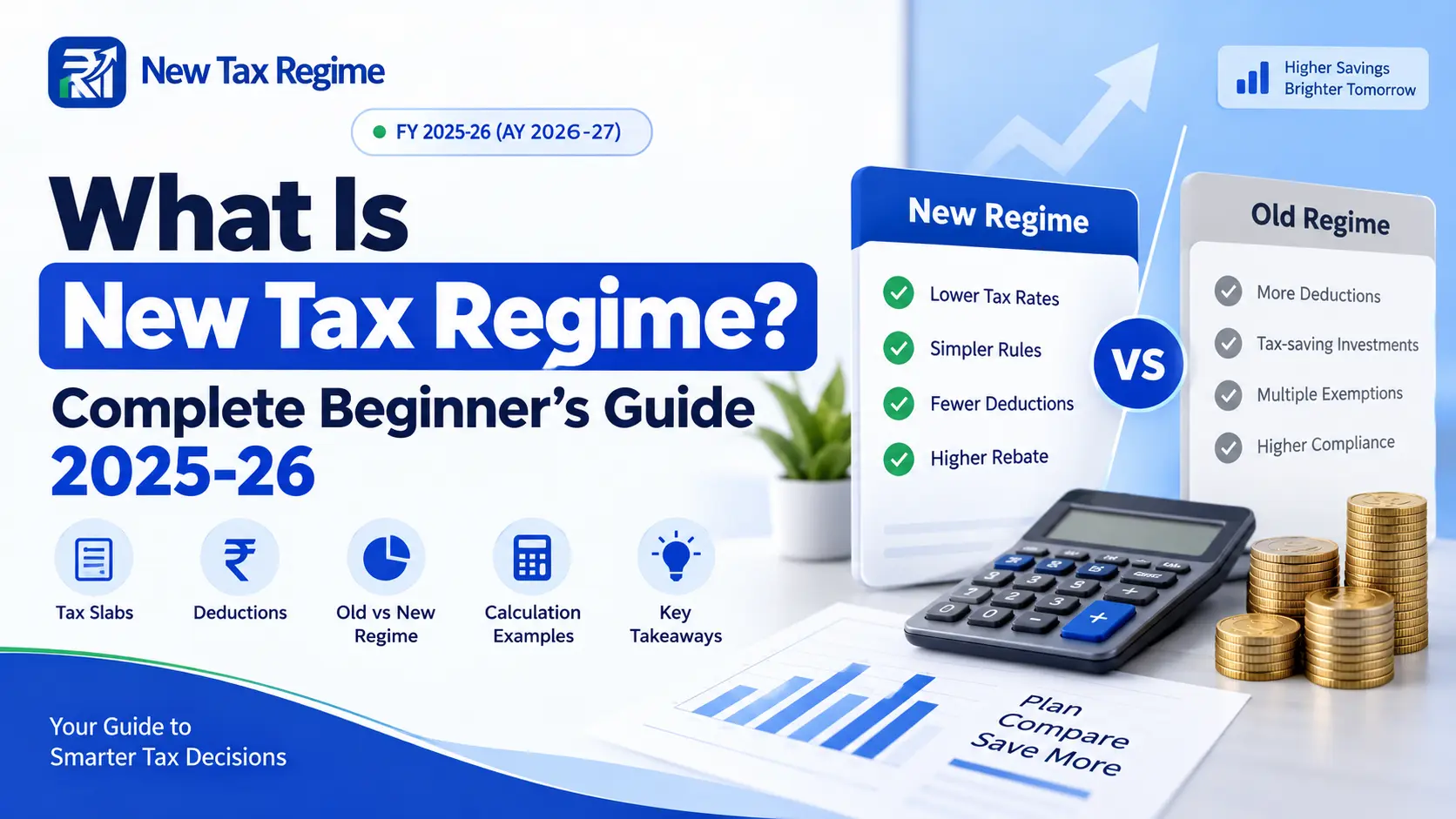
This guide explains what the regime means, its FY 2025-26 slabs, Section 87A, available deductions, calculation method and the key differences between the new and old regimes.
Discover More About:👇
What Is the New Tax Regime?
The new tax regime is a personal income-tax framework designed around lower and wider tax slabs with fewer deductions and exemptions.
It gives taxpayers an alternative to the traditional tax system, where a larger number of deductions and exemptions can reduce taxable income.
The regime is generally available to individual taxpayers and Hindu Undivided Families (HUFs), subject to the applicable income-tax rules.
For FY 2025-26, the new regime is the default tax regime, but eligible taxpayers can generally choose the old regime when permitted.
The biggest conceptual difference is simple: the new regime places greater emphasis on its revised slab rates and fewer tax-saving deductions, while the old regime allows a wider range of deductions and exemptions in exchange for its higher slab structure.
You May Also Like To Read These Posts 👇
How to Save Tax in New Tax Regime – Legal Ways & Practical Tips
Tax on Rs 12 Lakh / Rs 15 Lakh / Rs 20 Lakh Income Under New Regime
Hidden Costs & Disadvantages of New Tax Regime Nobody Tells You
Gross income vs taxable income
A taxpayer’s gross income and taxable income are not necessarily the same.
For example, suppose a salaried individual earns ₹15 lakh during the year.
If the taxpayer is eligible for the ₹75,000 standard deduction under the new regime, the taxable income would be ₹14.25 lakh, assuming there are no other relevant adjustments.
The tax slabs are then applied to the taxable income rather than simply applying one rate to the entire gross salary.
New Tax Regime Slabs for FY 2025-26
Budget 2025 introduced the revised slab structure applicable to FY 2025-26 (AY 2026-27).
| Taxable Income | Tax Rate |
|---|---|
| Up to ₹4,00,000 | Nil |
| ₹4,00,001–₹8,00,000 | 5% |
| ₹8,00,001–₹12,00,000 | 10% |
| ₹12,00,001–₹16,00,000 | 15% |
| ₹16,00,001–₹20,00,000 | 20% |
| ₹20,00,001–₹24,00,000 | 25% |
| Above ₹24,00,000 | 30% |
These are marginal slabs. A taxpayer entering a higher slab does not pay that higher rate on the entire taxable income.
How marginal taxation works
Suppose taxable income is ₹20 lakh.
The calculation before rebate and cess would work as follows:
- First ₹4,00,000: Nil tax
- Next ₹4,00,000: 5% = ₹20,000
- Next ₹4,00,000: 10% = ₹40,000
- Next ₹4,00,000: 15% = ₹60,000
- Remaining ₹4,00,000: 20% = ₹80,000
Total income tax before applicable rebate and cess = ₹2,00,000.
This is why a taxpayer with ₹20 lakh of taxable income does not simply multiply ₹20 lakh by 20%.
A 4% Health and Education Cess is generally added to the income tax after applicable rebate and other relevant calculations.
What Is New Tax Regime 2025 After Budget 2025 Changes?
The Budget 2025 changes made the new regime substantially more favourable for many middle-income taxpayers.
The major changes for FY 2025-26 include:
- Revised tax slabs: The slab structure was widened and tax rates were adjusted across income levels.
- Higher Section 87A rebate eligibility: The relevant taxable-income limit for the enhanced rebate was increased to ₹12 lakh.
- Higher maximum rebate: The maximum rebate under the new regime was increased to ₹60,000 for eligible taxpayers.
- ₹75,000 standard deduction: Salaried taxpayers can generally claim the standard deduction applicable under the new regime.
- Default regime: The new regime is the default system for FY 2025-26, although eligible taxpayers may generally choose the old regime where permitted.
The ₹12 lakh figure should not be interpreted as a blanket exemption covering every kind of income.
The benefit primarily operates through the Section 87A rebate and depends on eligibility and the nature of income.
What does “new tax regime 2026” mean?
Searches for what is new tax regime 2026 can cause confusion because India uses separate financial-year and assessment-year labels.
Income earned during FY 2025-26 is generally assessed in AY 2026-27. Therefore, a search referring to the “2026” tax regime may actually be referring to the assessment year beginning in 2026 rather than a separate financial year.
How Section 87A Rebate Works Under the New Regime
Section 87A provides a tax rebate to eligible individual taxpayers. A rebate is different from a deduction: a deduction reduces taxable income, while a rebate reduces the tax calculated on that income.
For FY 2025-26, the new-regime Section 87A provision provides a maximum rebate of ₹60,000 for eligible resident individuals whose qualifying total income does not exceed ₹12 lakh, subject to the applicable rules.
| Feature | FY 2025-26 New Regime |
|---|---|
| Relevant income threshold | ₹12 lakh |
| Maximum rebate | ₹60,000 |
| Broad eligibility | Eligible resident individuals with qualifying income |
The calculation follows a straightforward sequence:
- Determine taxable income.
- Calculate tax using the applicable slab rates.
- Determine whether Section 87A applies.
- Reduce eligible tax through the rebate, subject to the prescribed limits.
- Add applicable cess to the remaining tax.
Why special-rate income matters
The Section 87A rebate should not be treated as a universal cancellation of tax on every type of income.
Certain income is taxed under special provisions and rates rather than ordinary slab rates. Examples can include specified capital gains and lottery or similar winnings.
The treatment of such income needs to be considered separately when determining the final tax liability.
Salaried taxpayers and the ₹12.75 lakh figure
A salaried taxpayer can have an effective gross-salary threshold of ₹12.75 lakh where the ₹75,000 standard deduction brings taxable income down to ₹12 lakh and the taxpayer otherwise qualifies for the rebate.
For example:
- Gross salary: ₹12.50 lakh
- Standard deduction: ₹75,000
- Taxable income: ₹11.75 lakh
- Tax calculated under slabs: ₹52,500
- Eligible Section 87A rebate: ₹52,500
- Tax after rebate: Nil
This example assumes qualifying normal income and no other income or adjustment affecting the calculation.
What Deductions Are Available Under the New Tax Regime?
The new regime does not provide the same broad collection of deductions and exemptions associated with the old regime.
The ₹75,000 standard deduction is an important benefit for salaried taxpayers and eligible pensioners under the applicable rules.
Other specified benefits may remain available in particular circumstances. These can include eligible employer contributions to the National Pension System under Section 80CCD(2).
Certain treatment of employer-related retirement contributions and specified provisions concerning house-property income.The availability and limits of these benefits depend on the relevant conditions.
Common deductions generally unavailable
Many deductions familiar to taxpayers under the old regime are generally not available under the new regime, including:
- Section 80C deductions for investments such as PPF, ELSS and eligible life-insurance premiums
- Section 80D deduction for qualifying health-insurance premiums
- Section 80G deduction for qualifying charitable donations
- HRA exemption under the applicable salary provisions
- LTA/LTC-related exemption where the old-regime conditions apply
- Certain savings-interest deductions under Sections 80TTA/80TTB
This difference is central to regime selection. A taxpayer who has few deductions may value the lower slab structure.
While someone with substantial eligible deductions should compare both calculations before making a choice.
What Is New Tax Regime and Old Tax Regime?
The question of what is new tax regime and old tax regime is ultimately a comparison of two different methods of calculating individual income tax.
| Feature | New Tax Regime | Old Tax Regime |
|---|---|---|
| Basic exemption level | ₹4 lakh under FY 2025-26 slabs | Generally ₹2.5 lakh for individuals below the applicable senior-citizen categories |
| Standard deduction for salary | ₹75,000 | ₹50,000 |
| Slab structure | Wider revised slabs | Higher rates at comparatively lower income levels |
| Section 87A | Enhanced rebate under applicable conditions | Separate rebate rules with a lower income threshold |
| Common deductions | More limited | Wider range of deductions |
| 80C | Generally unavailable | Generally available subject to conditions |
| 80D | Generally unavailable | Generally available subject to conditions |
| HRA exemption | Generally unavailable | Available subject to conditions |
| Default status for FY 2025-26 | Yes | No |
The correct comparison is not simply “lower slab rate versus higher slab rate.”
A taxpayer should calculate the final liability under both systems after considering the deductions, exemptions, rebate provisions and cess that actually apply.
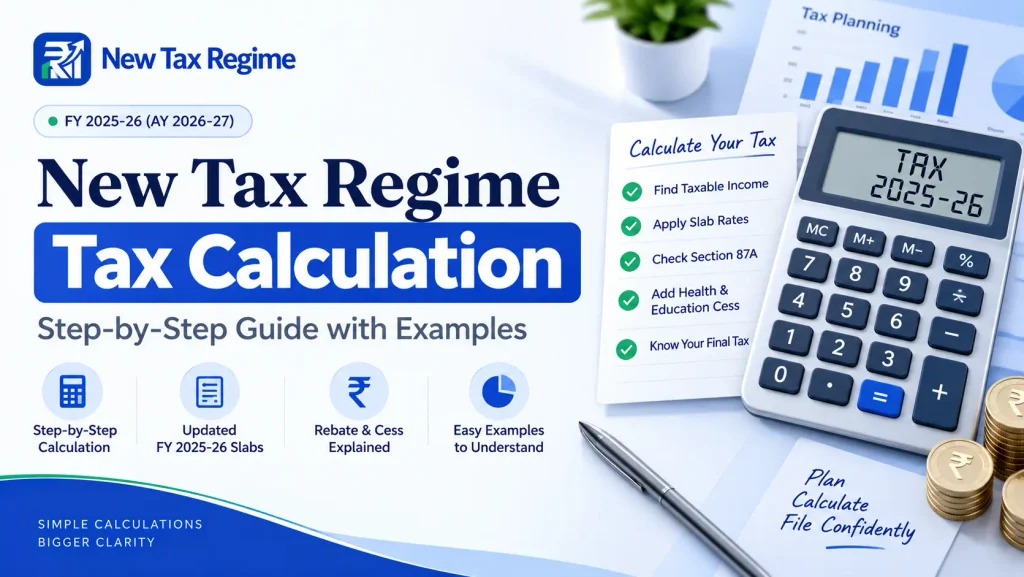
New Tax Regime Tax Calculation Example
Consider a salaried individual with ₹20 lakh gross annual salary and no other income.
Step 1: Determine taxable income
| Particulars | Amount |
|---|---|
| Gross salary | ₹20,00,000 |
| Less: Standard deduction | ₹75,000 |
| Taxable income | ₹19,25,000 |
Step 2: Apply the new-regime slabs
| Income portion | Rate | Tax |
|---|---|---|
| Up to ₹4,00,000 | 0% | ₹0 |
| ₹4,00,001–₹8,00,000 | 5% | ₹20,000 |
| ₹8,00,001–₹12,00,000 | 10% | ₹40,000 |
| ₹12,00,001–₹16,00,000 | 15% | ₹60,000 |
| ₹16,00,001–₹19,25,000 | 20% | ₹65,000 |
| Total | ₹1,85,000 |
Step 3: Check Section 87A
The taxable income is ₹19.25 lakh, which is above the relevant ₹12 lakh threshold. Therefore, the taxpayer in this illustration does not qualify for the Section 87A rebate.
Step 4: Add cess
A 4% Health and Education Cess on ₹1,85,000 is ₹7,400.
Illustrative total tax liability:
₹1,85,000 + ₹7,400 = ₹1,92,400
This example assumes only salary income and the standard deduction, with no surcharge, special-rate income or other adjustment affecting the calculation.
Who May Benefit From the New Tax Regime?
The new regime may be attractive to taxpayers who have relatively few deductions or exemptions.
For example, a taxpayer who does not claim substantial 80C, 80D, HRA or similar benefits may find that the revised slab rates produce a lower final liability.
It can also appeal to taxpayers who prefer a simpler tax calculation and do not want their tax choice to depend heavily on investment deductions.
However, a taxpayer with significant eligible deductions should not assume that the new regime is automatically cheaper.
The best option depends on the taxpayer’s income, eligible deductions, exemptions, type of income and applicable rebate provisions.
There is no universal deduction amount at which the old regime becomes better for everyone.
How to Choose Between the Two Tax Regimes
A practical comparison can be completed in five steps.
Step 1: Calculate taxable income under the new regime
Start with the relevant income and subtract deductions that are actually permitted under the new regime, including the applicable standard deduction for eligible salary income.
Step 2: Calculate taxable income under the old regime
Recalculate income using deductions and exemptions that are available under the old regime and that the taxpayer actually qualifies to claim.
Step 3: Calculate tax under both systems
Apply the relevant slab rates separately. Do not compare only the highest marginal rate.
Step 4: Apply rebates and cess
Check Section 87A eligibility under each regime and then calculate applicable cess on the resulting tax.
Step 5: Compare the final amounts
The regime with the lower final tax liability may be financially preferable, provided the comparison reflects the taxpayer’s actual circumstances.
For salaried employees, the regime selected for employer TDS calculations and the regime ultimately selected in the income-tax return can involve different practical considerations.
Taxpayers should ensure that their final ITR selection reflects the applicable rules.
Taxpayers earning business or professional income should pay particular attention to the separate rules governing regime selection and switching.
The rules are not identical to those applicable to taxpayers who do not have such income.
You May Also Like To Read These Posts 👇
Can You Switch Between Old and New Tax Regime Every Year?
New Tax Regime for Senior Citizens – Rules & Benefits
HUF Tax Slab Under New Regime for FY 2025-26 (AY 2026-27)
Key Takeaways
- The new regime is the default tax regime for FY 2025-26, but eligible taxpayers may generally choose the old regime where permitted.
- FY 2025-26 uses revised slabs beginning with Nil tax up to ₹4 lakh and reaching 30% above ₹24 lakh.
- Eligible resident individuals with qualifying normal income up to ₹12 lakh can potentially have their tax reduced to zero through the Section 87A rebate, subject to the applicable rules.
- Salaried taxpayers can generally claim a ₹75,000 standard deduction, which can make ₹12.75 lakh gross salary effectively tax-free when all rebate conditions are satisfied.
- Many popular deductions, including 80C, 80D and HRA, are generally unavailable under the new regime.
- The right regime should be determined by comparing final tax liability, not by looking at slab rates alone.
Frequently Asked Questions
What is the new tax regime in simple words?
The new tax regime is an income-tax system with revised slab rates and fewer deductions and exemptions than the old regime.
For FY 2025-26, its revised slabs and enhanced Section 87A rebate can significantly reduce tax for eligible taxpayers, particularly those with limited deductions.
Is the new tax regime better than the old tax regime?
There is no single answer for every taxpayer. The new regime may work well for someone with few deductions, while the old regime can remain useful for someone who qualifies for substantial deductions and exemptions.
Comparing the final tax payable under both systems gives a more reliable result.
What is the new tax regime for FY 2025-26?
For FY 2025-26, the new regime has slabs from Nil up to ₹4 lakh to 30% above ₹24 lakh.
Budget 2025 also increased the Section 87A rebate to a maximum of ₹60,000 for eligible resident individuals with qualifying income up to ₹12 lakh.
What is the income limit for zero tax under the new regime?
Eligible resident individuals with qualifying normal taxable income up to ₹12 lakh can potentially have their slab-tax liability reduced to zero through Section 87A.
For an eligible salaried taxpayer, the ₹75,000 standard deduction can result in an effective gross-salary level of ₹12.75 lakh. Special-rate income can require separate treatment.
Can I switch between the old and new tax regimes?
The rules depend on the taxpayer’s income profile. Taxpayers without business or professional income generally have greater flexibility to choose between the regimes from year to year.
Taxpayers with business or professional income are subject to additional conditions concerning regime selection and switching.
Disclaimer: This article is intended for general informational purposes and does not constitute professional tax, legal or financial advice. Tax liability can vary based on individual facts and applicable rules.

6 Comments
Pingback: How to Save Tax in New Tax Regime – FY 2025-26
Pingback: Tax on ₹15 Lakh Income in New Regime FY 2025-26
Pingback: Hidden Costs of New Tax Regime: Key Disadvantages
Pingback: Switch Old & New Tax Regime Every Year? FY 2025-26
Pingback: New Tax Regime for Senior Citizens: Rules & Benefits
Pingback: HUF Tax Slab Under New Tax Regime FY 2025-26