

A home loan in the new tax regime does not offer the same tax benefits as the old regime. For a self-occupied property, you cannot claim the interest deduction under Section 24(b) or the principal repayment deduction under Section 80C.
However, for a let-out property, you can still deduct eligible home-loan interest from your rental income. The treatment of any resulting house-property loss is also restricted.
This guide explains the rules for FY 2025-26 (AY 2026-27).
It clarifies the crucial differences between principal and interest, and between self-occupied and let-out properties, so you can understand exactly what applies to your situation.
Discover More About:👇
Home Loan Deduction in New Tax Regime: What Actually Applies?
The new tax regime under Section 115BAC offers lower slab rates but allows very few deductions.
This makes it essential to understand how your home loan is treated. There are two main components to a housing-loan repayment, and their tax treatments are different.
Principal Repayment
Under the old regime, the principal portion of your home loan EMI could be claimed as a deduction under Section 80C, subject to the overall limit of ₹1.5 lakh. This was a popular way to reduce taxable income.
However, the new regime does not allow this benefit.
The Income Tax Department’s guidance for AY 2026-27 confirms that Section 80C deductions are not available under the new regime, except for specific provisions. Therefore, your principal repayment does not reduce your taxable income.
For example, if your EMI includes ₹30,000 as principal, that amount cannot be claimed as a deduction.
Home-Loan Interest
Interest is treated differently because Section 24(b) operates under the head “Income from House Property,” not as a general deduction like Section 80C.
The treatment of this interest under the new regime depends entirely on whether the property is self-occupied or let out. This distinction is the most important rule for any borrower comparing the two tax regimes.
Home Loan Interest for a Self-Occupied House
A self-occupied property is one where you live, and it does not generate rental income.
Under the old regime, you could claim a deduction for interest paid on a home loan for a self-occupied property, generally up to ₹2 lakh per year, subject to conditions.
This could create a “loss” from house property that could be set off against your other income, such as salary.
The new regime changes this completely. The Income Tax Department’s AY 2026-27 guidance clearly states that interest on borrowed capital for a self-occupied property is not allowed as a deduction from income from house property.
This means a taxpayer choosing the new regime generally cannot use self-occupied home-loan interest to:
- Reduce salary income
- Create a house-property loss
- Claim the old-regime Section 24(b) benefit
For instance, if you pay ₹2.5 lakh in home-loan interest on a self-occupied house, that amount does not reduce your taxable salary or other income.
Interest on Home Loan for a Let-Out Property
The position is different when the property is let out. Rental income is taxable under “Income from House Property,” and you can deduct certain expenses from it.
For a let-out property, eligible interest on the home loan can be deducted from the rental income.
The Income Tax Department’s guidance for AY 2026-27 confirms that the deduction for a let-out property can be the actual interest amount without any upper monetary cap.
The calculation generally involves:
- Determining the property’s annual value.
- Deducting eligible municipal taxes actually paid.
- Applying the 30% standard deduction on the net annual value.
- Deducting eligible home-loan interest.
Example of a Let-Out Property
Assume you earn an annual rent of ₹3,00,000 and pay ₹2,50,000 in eligible home-loan interest. Assume there are no municipal taxes.
| Calculation | Amount |
|---|---|
| Annual rental value | ₹3,00,000 |
| Less: 30% standard deduction | ₹90,000 |
| Income after standard deduction | ₹2,10,000 |
| Less: Home-loan interest | ₹2,50,000 |
| House-property result | ₹40,000 loss |
Under the new regime, this ₹40,000 loss cannot be set off against salary or other heads of income.
It also cannot be carried forward to future years. Therefore, while the interest is deducted within the house-property calculation, its benefit is limited to the rental income itself.
Home Loan Benefit: Old Regime vs New Regime
The major differences can be summarized in this table:
| Home Loan Item | Old Tax Regime | New Tax Regime |
|---|---|---|
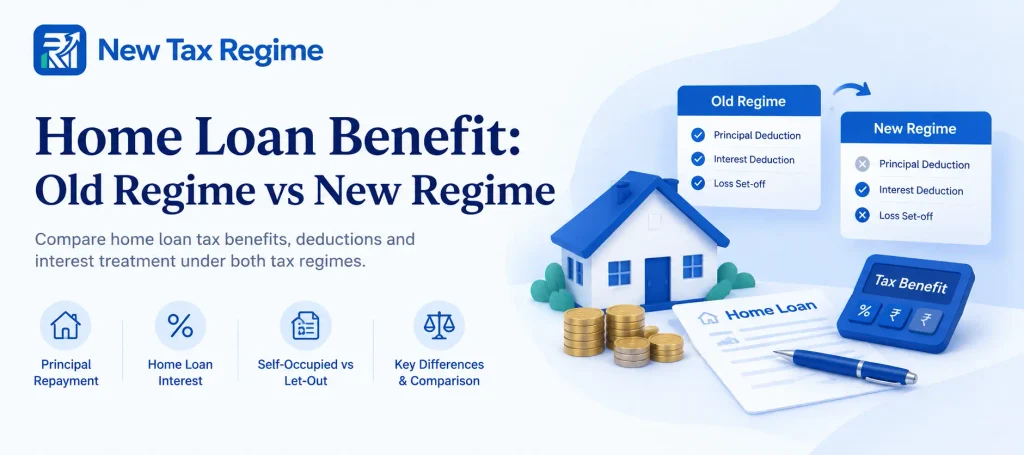
| Principal Repayment | Deductible under Section 80C, within the overall ₹1.5 lakh limit. | Not available as a deduction. |
| Interest on Self-Occupied Property | Deductible under Section 24(b), generally up to ₹2 lakh, subject to conditions. | Not allowed. |
| Interest on Let-Out Property | Deductible under Section 24(b) against rental income. | Deductible under Section 24(b) against rental income, with no cap. |
| House-Property Loss Treatment | Can be set off against other income up to ₹2 lakh; excess can be carried forward. | Cannot be set off against other income and cannot be carried forward. |
Is There a Home Loan Rebate in New Tax Regime?
No, there is no separate home-loan rebate under the new tax regime. The terms “deduction” and “rebate” are often confused but mean different things.
A deduction reduces your taxable income before tax is calculated. Section 24(b) is a deduction provision.
A rebate reduces the final tax amount after it has been computed. Section 87A is a rebate that can make your tax liability nil if your total income is up to a certain limit.
For AY 2026-27, the new regime offers a rebate of up to ₹60,000 for eligible taxpayers with total income up to ₹12 lakh.
This Section 87A benefit is based on your total income, not on whether you have a home loan. Having a home loan does not automatically qualify you for this rebate.
Worked Example: How Home Loan Interest Affects Tax Under the New Regime
Consider a salaried taxpayer with these details for FY 2025-26:
- Salary Income: ₹15,00,000
- Home-Loan Interest: ₹2,50,000
- Property Status: Self-occupied
- Tax Regime: New Regime
The standard deduction for a salaried taxpayer under the new regime is ₹75,000. This brings the taxable salary to ₹14,25,000.
Because the property is self-occupied, the ₹2.5 lakh home-loan interest cannot be deducted.
It does not reduce the taxable income, and you cannot create a house-property loss. The tax is calculated on the full ₹14,25,000.
This example shows that the size of your home loan alone does not determine a tax benefit. The property’s status and your chosen tax regime are the deciding factors.
When a Home Loan Can Still Matter for Tax Planning
Even with limited benefits, a home loan can still be relevant for your tax planning.
- Let-Out Property: The most significant benefit remains for a let-out property, where interest can be deducted from rental income.
- Regime Comparison: The lower tax rates in the new regime can outweigh the lost home-loan deductions for many taxpayers.
- For others, especially those with large loans and other investments, the old regime might still result in a lower total tax liability. The right approach is to compare your total tax liability under both regimes.
- Salary Structure: For salaried individuals, the new regime offers a higher standard deduction (₹75,000). This, combined with the Section 87A rebate, can make the new regime very attractive.
- A salary of up to ₹12.75 lakh can result in zero tax after the standard deduction, as the total income of ₹12 lakh is covered by the rebate.
The decision should always be based on a complete comparison, not just the home-loan interest.
How to Check Your Home Loan Tax Treatment Before Filing
Before you file your return, work through this checklist:
- Identify Property Status: Is your property self-occupied or let out?
- Separate Principal and Interest: Get the annual statement from your lender that breaks down the two components.
- Confirm Your Tax Regime: The new regime is the default. If you want old-regime benefits, you must opt out explicitly.
- Review Section 24(b): For a self-occupied property under the new regime, the interest deduction is not available. For a let-out property, it is.
- Check Loss Treatment: Remember that a house-property loss cannot be set off against salary under the new regime.
- Compare Overall Liability: Use the Income Tax Department’s calculator to compare your total tax liability under both regimes.
Key Takeaways
- Principal Repayment: Not deductible under the new tax regime.
- Self-Occupied Property: Interest is not deductible under the new regime.
- Let-Out Property: Interest can be deducted against rental income, but any loss cannot be set off against other income.
- Home-Loan Rebate: There is no such thing. Section 87A is a general rebate based on total income, not a home-loan benefit.
- Tax Planning: Always compare your total tax liability under both the old and new regimes before making a choice.
Frequently Asked Questions
Can I claim home loan interest deduction under the new tax regime?
For a self-occupied property, no. The interest deduction under Section 24(b) is not allowed.
For a let-out property, yes, you can deduct eligible interest from your rental income while calculating income from house property.
Is home loan principal repayment deductible under the new tax regime?
Generally, no. The principal repayment was a deduction under Section 80C of the old regime. The new regime does not allow this deduction.
Can I claim Section 24(b) interest deduction under the new tax regime?
It depends on the property. For a self-occupied property, the deduction is not available. For a let-out property, it is available against rental income.
Does a home loan give any rebate under the new tax regime?
No, there is no home-loan-specific rebate. The rebate under Section 87A is based on your total income and is not linked to having a home loan.
Is home loan interest for a rented property treated differently under the new tax regime?
Yes. Interest on a let-out property can be deducted from rental income. However, if this creates a loss, that loss cannot be set off against salary or other income, nor can it be carried forward.
