

Introduction: What Are the Hidden Costs of the New Tax Regime?
The hidden costs of the new tax regime are primarily the deductions and exemptions a taxpayer gives up by choosing it. These are not extra government charges or penalties.
They are foregone tax benefits that could have reduced taxable income under the old regime.
For FY 2025-26, the new regime offers a ₹4 lakh basic exemption limit, a ₹75,000 standard deduction for eligible salaried taxpayers and pensioners, and a Section 87A rebate of up to ₹60,000 for eligible resident individuals with total income up to ₹12 lakh.
For a salaried taxpayer, the standard deduction can make salary income up to ₹12.75 lakh effectively tax-free in eligible cases.
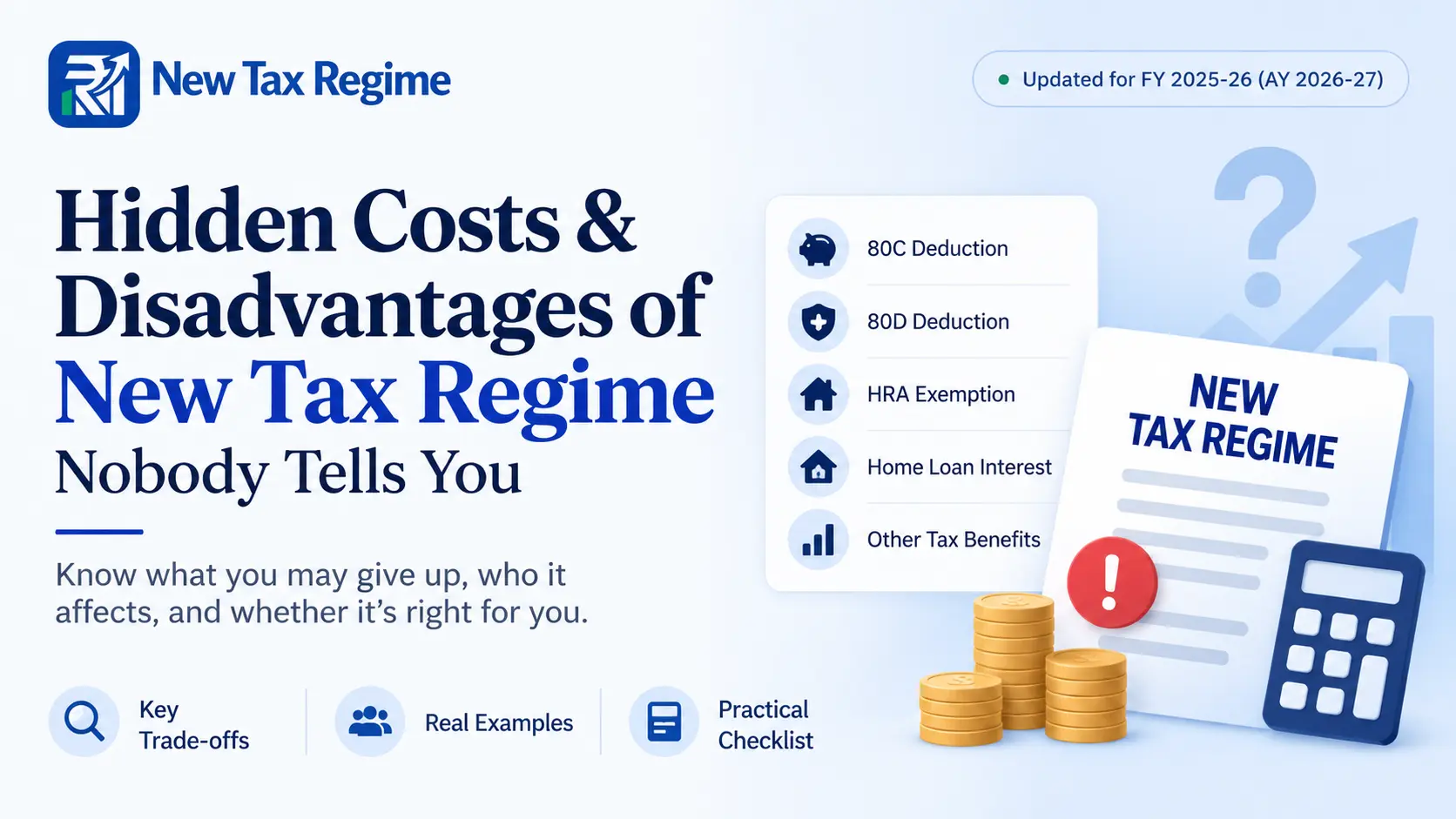
The trade-off is that benefits such as Section 80C, Section 80D, HRA exemption and self-occupied home-loan interest are generally unavailable under the new regime.
The real question is whether the tax saved through lower rates and rebates exceeds the value of the benefits given up. This article examines those trade-offs objectively and explains who is most likely to feel them.
Discover More About:👇
Hidden costs of the new tax regime
Why the New Tax Regime Can Look Cheaper but Still Cost You Benefits
A tax deduction reduces taxable income. A rebate reduces tax payable after the tax has been calculated.
Lower slab rates reduce tax directly. These mechanisms work differently, so comparing only headline rates gives an incomplete picture.
An eligible taxpayer with ₹12 lakh of total income can receive a Section 87A rebate of up to ₹60,000 under the new regime, subject to applicable conditions. That can eliminate the tax liability on eligible normal income.
However, the same taxpayer may have claimed deductions under the old regime for investments, health insurance, eligible NPS contributions or other expenses.
Those deductions do not convert into cash when the taxpayer switches regimes; their tax-saving value is generally lost.
The right comparison is therefore final tax payable under each regime, not simply “low rates versus high rates.”
Lost Deductions Under the New Tax Regime
Under the new regime, most traditional deductions commonly used under the old regime are unavailable. The Income Tax Department specifically identifies Section 80CCD(2) as one of the deductions that remains available, along with certain other specified benefits.
| Tax benefit | Old regime | New regime |
|---|---|---|
| Section 80C | Available subject to conditions | Generally unavailable |
| Section 80D | Available subject to conditions | Generally unavailable |
| Employee’s own NPS contribution under 80CCD(1B) | Available subject to conditions | Generally unavailable |
| Employer NPS contribution under 80CCD(2) | Available subject to applicable limit | Available up to 14% of salary, subject to conditions |
| HRA exemption | Available subject to conditions | Generally unavailable |
| Self-occupied home-loan interest under Section 24(b) | Available up to ₹2 lakh, subject to conditions | Not available |
The ₹75,000 standard deduction remains available under the new regime. Employer contributions to NPS under Section 80CCD(2) also remain eligible, with the new-regime limit extending to 14% of salary.
A taxpayer should not treat every tax benefit as lost merely because the new regime is selected.
HRA and Other Salary Exemptions You May Give Up
House Rent Allowance (HRA) is a common area where salaried taxpayers can lose a tax benefit by choosing the new regime.
Under the old regime, eligible employees can claim HRA exemption subject to conditions relating to salary, HRA received, rent paid and applicable city rules.
Under the new regime, the HRA exemption under Section 10(13A) is generally unavailable. A taxpayer who previously reduced taxable salary through HRA may therefore see a significant difference when comparing the two regimes.
The amount of HRA exemption should not be estimated simply from the rent paid. The exemption is determined using the prescribed calculation, including factors such as basic salary, eligible DA, HRA received and rent paid.
For example, someone receiving HRA and paying rent may have a larger old-regime benefit than an employee with the same salary who does not receive HRA.
The exact difference needs to be calculated rather than assumed.The same principle applies to other salary-related exemptions.
Some specified allowances and deductions continue to receive treatment under the new regime, so taxpayers should check the particular allowance rather than assuming every salary benefit disappears.
Home Loan Interest and Property-Related Trade-Offs
Home-loan interest is another area where the two regimes can produce different results.
Self-Occupied Property
Under the new regime, interest on borrowed capital for a self-occupied property is not allowed as a deduction from income from house property.
The Income Tax Department confirms that taxpayers seeking the ₹2 lakh self-occupied property interest deduction need to opt for the old regime, subject to applicable conditions.
For a homeowner paying substantial interest, this can reduce the value of old-regime benefits that would otherwise be available.
Let-Out Property
The treatment is different for a let-out property. Under the new regime, eligible interest under Section 24(b) can be deducted from rental income without the usual monetary ceiling applicable to a self-occupied property.
However, a resulting loss from house property cannot be set off against other heads of income under the new regime.
The interest deduction may still reduce taxable property income, but the resulting house-property loss cannot be used to reduce salary income or other taxable income.

The Investment Trade-Off: When Tax-Saving Investments No Longer Save Tax
A taxpayer may continue investing in products such as PPF, ELSS or eligible insurance policies after choosing the new regime.
The important difference is that the investment itself does not automatically create the same income-tax deduction available under the old regime.
This is the difference between financial value and tax value.
Someone may invest in PPF because of long-term financial goals, safety or other product features. The absence of a Section 80C deduction under the new regime does not automatically make the investment unsuitable.
The same applies to ELSS. An investor may choose an ELSS fund for its investment characteristics, but the Section 80C deduction generally cannot be claimed under the new regime.
The hidden cost is therefore not necessarily the investment itself. It is the loss of the tax deduction associated with that investment.
Health insurance follows a similar principle. Section 80D can provide a deduction under the old regime subject to prescribed conditions, but that deduction is generally unavailable under the new regime.
The insurance cover itself remains a financial-protection decision and should not be treated as unnecessary merely because the deduction is unavailable.
NPS, Health Insurance and Benefits That Need a Closer Look
NPS is particularly important because the tax treatment differs between an employee’s own contribution and an employer’s contribution.
An employee’s own contribution under Section 80CCD(1B) is generally not deductible under the new regime.
However, an employer’s contribution under Section 80CCD(2) remains available, subject to applicable rules. For the new regime, the deduction limit is 14% of salary.
An employee should not simply conclude that “NPS deduction is unavailable” after switching regimes. The source of the contribution matters.
The same caution applies to other deductions. Section 80C, Section 80D and several other traditional deductions are generally associated with the old regime, while specific benefits continue under the new regime.
The practical approach is to separate employee-paid deductions, employer-provided benefits and tax exemptions before comparing the two systems.
Worked Example: How a Hidden Cost Can Affect Your Tax Outcome
Consider a salaried employee with ₹15 lakh of salary income.
Assume the employee has eligible Section 80C investments and health-insurance premiums but does not receive an HRA exemption that can be reliably calculated without knowing the required salary components.
Under the new regime, the employee can claim the ₹75,000 standard deduction, leaving taxable salary of ₹14.25 lakh, assuming no other income or adjustment.
The basic tax calculation before cess would be:
- ₹0 to ₹4 lakh: Nil
- ₹4 lakh to ₹8 lakh at 5%: ₹20,000
- ₹8 lakh to ₹12 lakh at 10%: ₹40,000
- ₹12 lakh to ₹14.25 lakh at 15%: ₹33,750
- Total income tax before cess: ₹93,750
The old regime may allow additional deductions such as eligible Section 80C and Section 80D benefits.
However, the final tax cannot be compared accurately without knowing the taxpayer’s complete salary structure, HRA details, other income, eligible deductions and other applicable facts.
This illustrates the main point: losing a deduction does not automatically mean the old regime will produce a lower tax bill.
The new regime can still result in lower tax because its slab rates and rebate structure may outweigh the value of deductions for some taxpayers.
Who Is Most Likely to Feel These Hidden Costs?
The impact is usually more noticeable for taxpayers who have several substantial deductions under the old regime.
Taxpayers with large Section 80C claims may feel the difference because investments and payments that previously reduced taxable income generally do not provide the same deduction under the new regime.
Taxpayers with eligible Section 80D claims may also see higher taxable income under the new regime because the health-insurance deduction is generally unavailable.
Salaried employees receiving HRA should calculate the actual exemption available under the old regime rather than assuming the rent paid is itself deductible.
Homeowners with self-occupied properties can also see a meaningful difference if they pay substantial home-loan interest, because the old regime provides a deduction subject to the applicable limit while the new regime does not.
On the other hand, taxpayers with few deductions may find the new regime more attractive.
Employees receiving eligible employer NPS contributions can also retain an important tax benefit under the new system.
How to Check Whether the New Regime Is Actually Better for You
A practical comparison can be done in these steps:
- Calculate total income for FY 2025-26, including salary and other taxable income.
- Apply the relevant standard deduction based on the regime and taxpayer eligibility.
- List old-regime deductions such as eligible Section 80C, Section 80D, NPS and home-loan benefits.
- Calculate the HRA exemption separately if applicable instead of treating the entire HRA as exempt.
- Check employer NPS separately, because Section 80CCD(2) remains available under the new regime subject to conditions.
- Calculate tax under both regimes using the applicable FY 2025-26 rules.
- Compare final tax payable, including the effect of applicable rebates and cess.
- Review investments separately from tax deductions. A product should not be considered unsuitable merely because its tax deduction is unavailable.
The best regime is therefore the one that produces the more suitable overall result for the taxpayer’s actual income, deductions and financial circumstances.
Key Takeaways
- The “hidden cost” of the new tax regime is generally a foregone tax benefit, not an additional government charge.
- Section 80C, Section 80D, HRA exemption and self-occupied home-loan interest are important benefits that are generally unavailable under the new regime.
- Employer NPS contribution under Section 80CCD(2) remains available under the new regime, subject to applicable conditions and limits.
- A taxpayer can lose deductions under the new regime and still end up paying less tax overall because of its slab structure and rebate.
- A zero tax liability under the new regime does not mean traditional deductions suddenly become available.
- The actual impact depends on the taxpayer’s income, deductions, exemptions, salary structure and other applicable circumstances.
Frequently Asked Questions
1. What are the hidden costs of the new tax regime?
The main hidden costs are foregone deductions and exemptions, rather than additional taxes.
Common examples include Section 80C, Section 80D, HRA exemption and the deduction for interest on a self-occupied home loan.
2. What deductions are lost in the new tax regime?
Many traditional deductions under Chapter VI-A are generally unavailable, including Section 80C, Section 80D and employee’s own NPS contribution under Section 80CCD(1B).
However, certain benefits, including employer NPS contribution under Section 80CCD(2), remain available subject to conditions.
3. Is the new tax regime bad for people with investments?
Not necessarily. Investments such as PPF, ELSS or insurance can still be made under the new regime, but the associated tax deduction may not be available.
The investment decision should therefore be based on its financial purpose as well as its tax treatment.
4. Can I claim HRA exemption in the new tax regime?
Generally, HRA exemption under Section 10(13A) is not available under the new regime. A taxpayer who wants to use the applicable HRA exemption generally needs to compare and choose the old regime, subject to the relevant conditions.
5. Who should carefully compare the new and old tax regimes?
Taxpayers with substantial 80C investments, eligible 80D premiums, HRA benefits or self-occupied home-loan interest should compare both regimes carefully.
Taxpayers with few deductions may find the new regime more attractive because of its lower rates and simplified deduction structure.
Disclaimer: This article is for general informational purposes only and should not be treated as professional tax, financial or investment advice.
Individual tax outcomes can vary based on income, deductions, exemptions and other applicable circumstances.
