

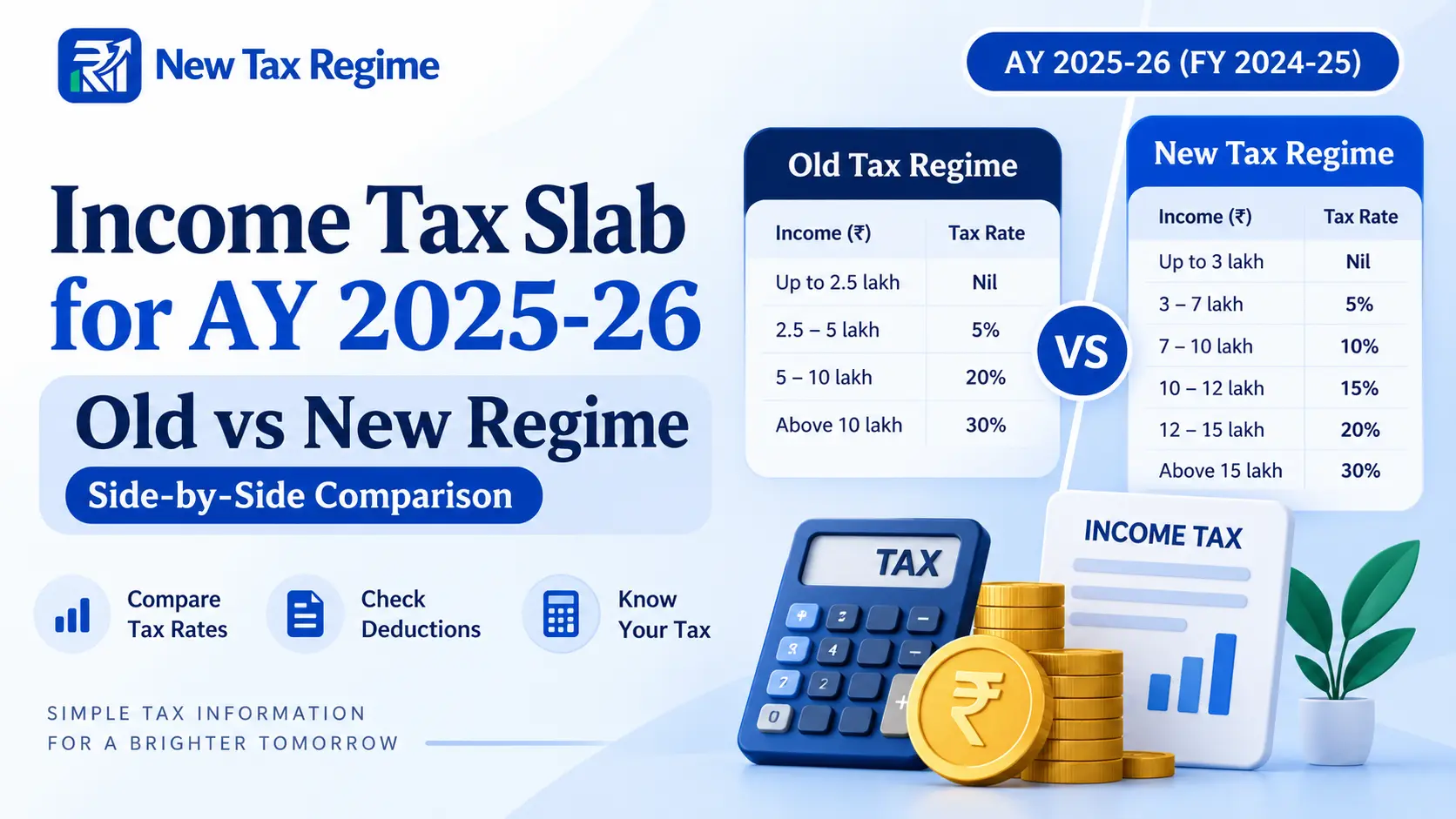
For AY 2025-26, which relates to income earned during FY 2024-25, individual taxpayers can compare the old and new tax regimes.
For an individual below 60 years, the old regime starts with a ₹2.5 lakh basic exemption limit, while the new regime starts with a ₹3 lakh nil-rate slab.
The new regime generally has lower rates across several income ranges, while the old regime allows a wider range of deductions and exemptions.
The key point is that AY 2025-26 is not the same as AY 2026-27. Budget 2025 changed the new-regime slabs for FY 2025-26, or AY 2026-27, so those newer rates should not be used when calculating tax for AY 2025-26.
Income Tax Slab for AY 2025-26: Old vs New Regime
For an individual below 60 years of age, the AY 2025-26 slab rates can be compared as follows. The new regime is the default regime, although eligible taxpayers can generally opt for the old regime subject to the applicable rules.
| Taxable Income | Old Tax Regime | New Tax Regime |
|---|---|---|
| Up to ₹2.5 lakh | Nil | Nil |
| ₹2.5 lakh–₹3 lakh | 5% | Nil |
| ₹3 lakh–₹5 lakh | 5% | 5% |
| ₹5 lakh–₹7 lakh | 20% | 5% |
| ₹7 lakh–₹10 lakh | 20% | 10% |
| ₹10 lakh–₹12 lakh | 30% | 15% |
| ₹12 lakh–₹15 lakh | 30% | 20% |
| Above ₹15 lakh | 30% | 30% |
These are slab rates, meaning the applicable rate is charged only on the portion of taxable income falling within each slab. The final liability can also be affected by rebates, deductions, surcharge and the 4% Health and Education Cess.
For AY 2025-26, the new regime provides a standard deduction for eligible salaried and pension income, while the old regime continues to allow deductions and exemptions that can reduce taxable income.
Discover More About:👇
Income Tax Slab for AY 2025-26
Tax Slab for AY 2025-26 New Regime
The tax slab for AY 2025-26 new regime has a ₹3 lakh nil-rate threshold for individuals below 60. Income above that level moves through the 5%, 10%, 15%, 20% and 30% slabs shown above.
One of the major benefits is the Section 87A rebate. For an eligible resident individual, the rebate can eliminate the tax payable where total income does not exceed ₹7 lakh, subject to the conditions of the provision.
The rebate is different from a deduction because it reduces the tax calculated after applying the slab rates.
The new regime also restricts many deductions and exemptions that are commonly available under the old regime. This is why comparing only the slab percentages does not always identify the lowest-tax option.
How New-Regime Tax Is Calculated
Consider a salaried taxpayer with gross salary of ₹12 lakh during FY 2024-25.
Assume the taxpayer is eligible for a ₹50,000 standard deduction under the applicable rules.
Step 1: Calculate taxable income
₹12,00,000 − ₹50,000 = ₹11,50,000
Step 2: Apply the new-regime slabs
- First ₹3 lakh: Nil
- Next ₹4 lakh at 5%: ₹20,000
- Remaining ₹4.5 lakh at 10%: ₹45,000
Basic income tax = ₹65,000
Because the taxpayer’s taxable income exceeds the Section 87A threshold, the full rebate available to a taxpayer with total income up to ₹7 lakh does not apply.
Step 3: Add Health and Education Cess
4% of ₹65,000 = ₹2,600
Estimated tax including cess = ₹67,600, assuming no surcharge or other special tax treatment applies.
AY 2025-26 Old Tax Regime Slabs and Deductions
The old regime has a higher tax rate at several middle-income levels, but it allows eligible taxpayers to claim deductions and exemptions that can substantially reduce taxable income.
For example, eligible taxpayers may claim deductions under provisions such as Section 80C and Section 80D, subject to their respective conditions and limits. Salaried taxpayers can also claim the applicable standard deduction.
Old-Regime Example With Section 80C
Suppose the same taxpayer earns ₹12 lakh in salary and qualifies for:
- Standard deduction: ₹50,000
- Section 80C deduction: ₹1.5 lakh
The taxable income becomes:
₹12,00,000 − ₹50,000 − ₹1,50,000 = ₹10,00,000
Tax calculation:
- Up to ₹2.5 lakh: Nil
- ₹2.5 lakh–₹5 lakh at 5%: ₹12,500
- ₹5 lakh–₹10 lakh at 20%: ₹1,00,000
Basic tax = ₹1,12,500
Health and Education Cess at 4% = ₹4,500
Estimated tax including cess = ₹1,17,000.
Under these specific assumptions, the new-regime calculation of ₹67,600 is lower by ₹49,400. This is only an illustration; changing the taxpayer’s deductions, exemptions or income composition can change the result.
Old vs New Tax Regime — Which One Gives Lower Tax?
There is no single regime that produces the lowest tax for every taxpayer. The comparison depends on how much taxable income can be reduced through deductions and exemptions under the old regime.
The new regime can be attractive when a taxpayer has relatively few deductions.
The old regime can become more competitive where the taxpayer has substantial eligible deductions or exemptions, such as Section 80C investments, health-insurance deductions, eligible home-loan interest or HRA-related benefits.
Example for a Salaried Taxpayer
Consider a taxpayer earning ₹12 lakh with the following assumed old-regime deductions:
- Standard deduction: ₹50,000
- Section 80C: ₹1.5 lakh
- Section 80CCD(1B): ₹50,000
- Section 80D: ₹25,000
Total assumed deductions = ₹2.75 lakh
Taxable income under the old regime would therefore be ₹9.25 lakh, assuming all deductions are fully eligible.
The basic old-regime tax would be:
- Up to ₹2.5 lakh: Nil
- ₹2.5 lakh–₹5 lakh: ₹12,500
- ₹5 lakh–₹9.25 lakh at 20%: ₹85,000
Basic tax = ₹97,500
After 4% cess, the estimated liability becomes ₹1,01,400, before considering any other applicable adjustments.
By comparison, the earlier new-regime example produced ₹67,600. In this particular example, the new regime remains lower, despite substantial deductions under the old regime.
The practical lesson is that taxpayers should calculate both liabilities rather than assuming that claiming deductions automatically makes the old regime better.
Income Tax Slab for AY 2026-27 New Regime After Budget 2025
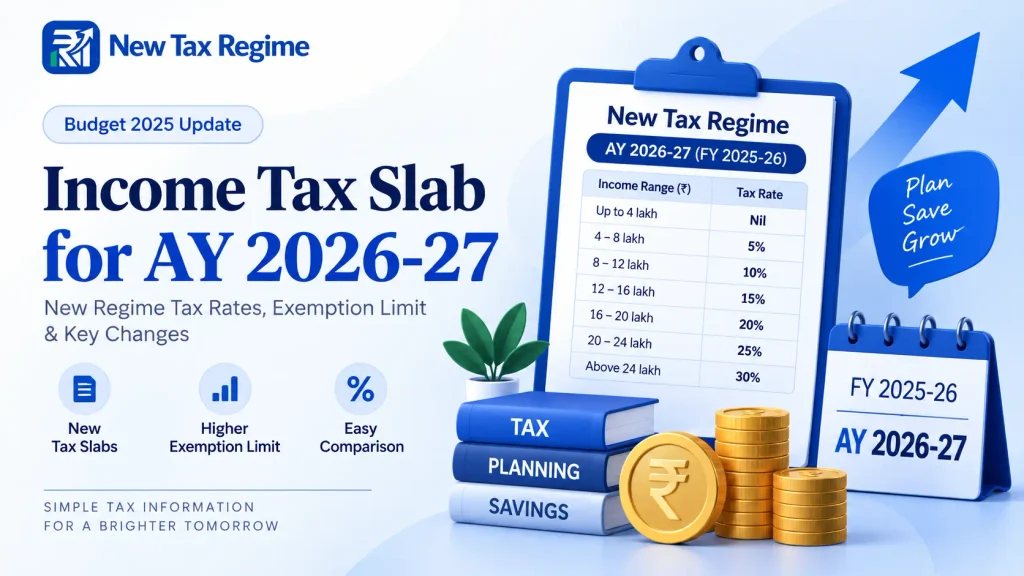
The income tax slab for AY 2026-27 new regime is different from the AY 2025-26 structure because Budget 2025 introduced a revised slab system for FY 2025-26.
| Taxable Income | New Regime Rate for AY 2026-27 |
|---|---|
| Up to ₹4 lakh | Nil |
| ₹4 lakh–₹8 lakh | 5% |
| ₹8 lakh–₹12 lakh | 10% |
| ₹12 lakh–₹16 lakh | 15% |
| ₹16 lakh–₹20 lakh | 20% |
| ₹20 lakh–₹24 lakh | 25% |
| Above ₹24 lakh | 30% |
These rates apply to AY 2026-27, not AY 2025-26. The Income Tax Department confirms the revised slab structure and the increased Section 87A rebate framework for AY 2026-27.
What Changed From AY 2025-26 to AY 2026-27?
The most significant change is the restructuring of the new-regime slabs. The nil-rate threshold moves from ₹3 lakh to ₹4 lakh, while new 5%, 10%, 15%, 20% and 25% ranges extend up to ₹24 lakh before the 30% rate applies.
Budget 2025 also increased the Section 87A rebate under the new regime. For eligible taxpayers, the rebate can apply where total income does not exceed ₹12 lakh, with a maximum rebate of ₹60,000 from AY 2026-27 onward.
For salaried taxpayers, the ₹75,000 standard deduction under the new regime can also affect the point at which total taxable income falls within the rebate threshold.
This should not be described as a Budget 2025 increase from ₹50,000 to ₹75,000 because the ₹75,000 new-regime standard deduction was already applicable for AY 2025-26.
Rebate, Cess and Other Factors That Affect Final Tax
Slab rates show the basic tax calculation, but they do not always represent the final amount payable.
Section 87A is a rebate that directly reduces income tax for eligible resident individuals who satisfy the relevant income conditions. It is different from a deduction such as Section 80C, which reduces taxable income before tax is calculated.
A 4% Health and Education Cess is generally added to income tax and applicable surcharge. The cess therefore needs to be included when comparing the final tax payable under two regimes.
Higher-income taxpayers may also face surcharge depending on their total income and the nature of the income. Certain special-rate incomes can have separate rules, so a simple slab calculation may not cover every taxpayer’s final liability.
How to Choose Between Old and New Tax Regime
A practical comparison can be done in five steps:
- Calculate total income: Include salary, business income, interest, capital gains and other taxable income as applicable.
- Identify deductions and exemptions: Determine which benefits are actually available under each regime.
- Calculate taxable income: Subtract eligible deductions from the relevant income base.
- Apply slab rates and rebates: Calculate basic tax, apply eligible Section 87A relief and then add applicable cess or surcharge.
- Compare final liabilities: The regime with the lower applicable tax may be financially preferable, subject to the taxpayer’s eligibility and filing requirements.
For a taxpayer with few deductions, the new regime may produce a lower liability because of its lower slab rates in several income ranges.
A taxpayer with significant eligible deductions should calculate the old regime separately before making the comparison.
Key Takeaways
- AY 2025-26 corresponds to FY 2024-25, while AY 2026-27 corresponds to FY 2025-26.
- For AY 2025-26, the new regime starts with a ₹3 lakh nil-rate slab, while the old regime generally starts with a ₹2.5 lakh basic exemption for individuals below 60.
- The new regime generally has lower slab rates but restricts many deductions and exemptions available under the old regime.
- Budget 2025 introduced the revised new-regime slabs applicable from FY 2025-26 / AY 2026-27, including the ₹4 lakh nil-rate threshold and slabs extending to ₹24 lakh before the 30% rate.
- The Section 87A rebate and standard deduction can materially affect the final tax calculation.
- Comparing the final tax under both regimes is more useful than comparing slab rates alone.
Frequently Asked Questions
What is the income tax slab for AY 2025-26 under the new regime?
For individuals below 60 years, the AY 2025-26 new regime has a nil-rate slab up to ₹3 lakh, followed by 5% on ₹3–7 lakh, 10% on ₹7–10 lakh, 15% on ₹10–12 lakh, 20% on ₹12–15 lakh and 30% above ₹15 lakh.
Is AY 2025-26 the same as FY 2025-26?
No. AY 2025-26 relates to FY 2024-25. Income earned during FY 2024-25 is generally assessed in AY 2025-26. Similarly, FY 2025-26 corresponds to AY 2026-27.
Which is better for AY 2025-26, old or new tax regime?
It depends on the taxpayer’s income and eligible deductions. The new regime can be advantageous when deductions are limited, while the old regime can become more competitive when substantial eligible deductions and exemptions are available.
What is the new tax regime slab for AY 2026-27 after Budget 2025?
For AY 2026-27, the new regime has a nil-rate slab up to ₹4 lakh, followed by 5%, 10%, 15%, 20%, 25% and 30% slabs, with the 30% rate applying above ₹24 lakh.
Can a taxpayer compare tax liability under both regimes?
Yes. A taxpayer can calculate the liability under both applicable regimes using the relevant income, deductions, rebates, cess and other applicable provisions.
The comparison should use the rules for the correct assessment year rather than mixing AY 2025-26 and AY 2026-27 rates.
Disclaimer: This article is intended for general educational and informational purposes and does not constitute professional tax, legal, accounting or financial advice. Individual tax liability can vary based on income type, deductions, residential status and other applicable provisions.
