

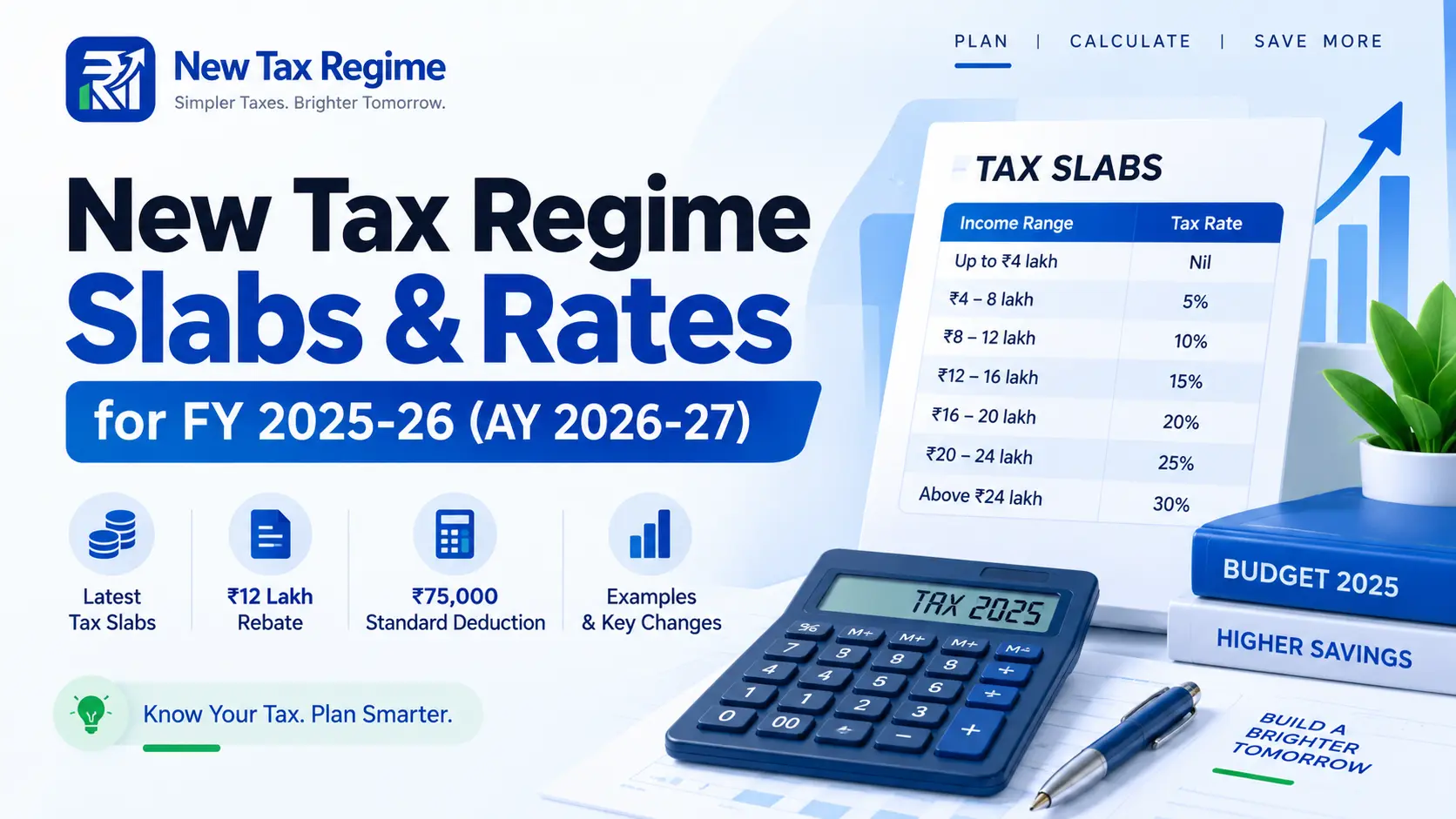
The new tax regime slabs for FY 2025-26 start with nil tax up to ₹4 lakh, followed by rates of 5%, 10%, 15%, 20%, 25% and 30% across progressively higher income bands.
Budget 2025 also increased the Section 87A rebate for eligible resident individuals, so a taxpayer with total income up to ₹12 lakh can potentially have the entire slab-based tax reduced to zero, subject to the applicable conditions.
For eligible salaried taxpayers, the ₹75,000 standard deduction can reduce ₹12.75 lakh of salary to ₹12 lakh of taxable income before the rebate is considered.
This guide explains the slab rates, Budget 2025 changes, rebate, salary calculation, examples, special-rate income and the key points to check before calculating tax.
Latest New Tax Regime Slabs for FY 2025-26
The income tax slab under the new regime for FY 2025-26 is structured as follows:
| Taxable Income | Tax Rate |
|---|---|
| Up to ₹4,00,000 | Nil |
| ₹4,00,001 – ₹8,00,000 | 5% |
| ₹8,00,001 – ₹12,00,000 | 10% |
| ₹12,00,001 – ₹16,00,000 | 15% |
| ₹16,00,001 – ₹20,00,000 | 20% |
| ₹20,00,001 – ₹24,00,000 | 25% |
| Above ₹24,00,000 | 30% |
Discover More About:👇
These slabs apply under the new regime for FY 2025-26, subject to the taxpayer’s income type and other applicable provisions.
The basic exemption level under the revised structure is ₹4 lakh. The rates are marginal, which means a higher rate applies only to the portion of taxable income falling within that particular slab.
For example, a person with taxable income of ₹15 lakh does not pay 15% on the entire ₹15 lakh. The first ₹4 lakh falls in the nil band, the next portions are taxed at 5% and 10%, and only the portion above ₹12 lakh falls into the 15% slab.
How the New Regime Changed After Budget 2025
Budget 2025 changed the new regime primarily by widening the income bands and increasing the rebate available to eligible taxpayers.
The revised structure introduced a 25% slab for ₹20 lakh to ₹24 lakh, while the 30% rate begins above ₹24 lakh. This differs substantially from the earlier structure, where the 30% rate began at a lower income level.
Another major change was the enhancement of the Section 87A rebate. Under the revised new regime, eligible resident individuals with total income within the specified ₹12 lakh threshold can receive a rebate of up to ₹60,000.
The headline that “income up to ₹12 lakh is tax-free” therefore needs context. The ₹12 lakh figure relates to total income for the rebate eligibility, rather than meaning that every form of ₹12 lakh income is automatically exempt from tax.
For salaried taxpayers, the distinction is particularly relevant because the standard deduction can reduce salary income before taxable income is determined.
Section 87A Rebate and the ₹12 Lakh Threshold
How the rebate works
Section 87A provides a tax rebate to eligible resident individual taxpayers who satisfy the applicable income conditions.
Under the FY 2025-26 new regime:
- The maximum rebate is ₹60,000.
- The relevant total-income threshold is ₹12 lakh.
- The rebate cannot exceed the tax otherwise payable.
- The calculation needs to consider whether any income is subject to separate tax treatment.
Suppose the ordinary slab calculation produces ₹50,000 of tax and the taxpayer qualifies for the full rebate. The ₹60,000 maximum does not create a cash refund of ₹10,000; the rebate is limited to the tax liability, bringing that slab-based liability down to zero.
This is why the rebate should not be confused with a deduction. A deduction reduces income used for tax calculation, while a rebate reduces the resulting tax liability.
Why ₹12.75 lakh salary can result in zero tax
For an eligible salaried taxpayer, the ₹75,000 standard deduction can reduce gross salary before arriving at taxable income.
For example:
₹12,75,000 salary − ₹75,000 standard deduction = ₹12,00,000 taxable income
If the taxpayer satisfies the Section 87A conditions and the income is otherwise eligible, the slab tax on ₹12 lakh can be offset by the rebate.
The calculation is therefore different from saying that ₹12.75 lakh of salary is itself exempt from tax.
New Regime Tax Calculation With Examples
The easiest way to understand the new tax regime income tax slabs is to calculate the tax progressively.
Example 1 — Taxable income of ₹9.50 lakh
Consider a taxpayer with ₹9.50 lakh taxable income, assuming the income is subject to the normal slab rates.
| Slab | Income Portion | Rate | Tax |
|---|---|---|---|
| Up to ₹4 lakh | ₹4,00,000 | 0% | ₹0 |
| ₹4 lakh–₹8 lakh | ₹4,00,000 | 5% | ₹20,000 |
| ₹8 lakh–₹9.50 lakh | ₹1,50,000 | 10% | ₹15,000 |
| Total | ₹35,000 |
The calculated slab tax is ₹35,000.
If the taxpayer is an eligible resident individual satisfying the Section 87A conditions, the rebate can offset this tax.
The resulting income-tax liability can therefore be zero before any other applicable considerations.
Example 2 — Taxable income of ₹15 lakh
Now consider taxable income of ₹15 lakh:
| Slab | Income Portion | Rate | Tax |
|---|---|---|---|
| Up to ₹4 lakh | ₹4,00,000 | 0% | ₹0 |
| ₹4 lakh–₹8 lakh | ₹4,00,000 | 5% | ₹20,000 |
| ₹8 lakh–₹12 lakh | ₹4,00,000 | 10% | ₹40,000 |
| ₹12 lakh–₹15 lakh | ₹3,00,000 | 15% | ₹45,000 |
| Total slab tax | ₹1,05,000 |
Because the income exceeds the ₹12 lakh threshold, the taxpayer does not receive the ordinary full ₹60,000 rebate available within the stated threshold.
Before applicable cess or other adjustments, the slab tax in this simplified example is ₹1,05,000. A 4% Health and Education Cess would then be calculated on the applicable tax and surcharge, where relevant.
The key point is that the taxpayer does not suddenly pay 15% on the entire ₹15 lakh. Each portion is taxed according to its respective slab.
Example 3 — Taxable income slightly above ₹12 lakh (marginal relief context)
Consider a taxpayer with ₹12.10 lakh taxable income.
The slab tax calculation is as follows:
| Slab | Income Portion | Rate | Tax |
|---|---|---|---|
| Up to ₹4 lakh | ₹4,00,000 | 0% | ₹0 |
| ₹4 lakh–₹8 lakh | ₹4,00,000 | 5% | ₹20,000 |
| ₹8 lakh–₹12 lakh | ₹4,00,000 | 10% | ₹40,000 |
| ₹12 lakh–₹12.10 lakh | ₹10,000 | 15% | ₹1,500 |
| Total slab tax | ₹61,500 |
Without marginal relief, the taxpayer would pay ₹61,500 on ₹12.10 lakh income. This is more than the ₹10,000 excess above ₹12 lakh, which creates a steep effective tax on the small excess.
The income-tax law provides marginal relief in such cases the additional tax payable is capped at the amount by which the income exceeds the rebate threshold.
In this case, the additional tax cannot exceed ₹10,000 (the excess income). So, the final tax liability after marginal relief would be approximately ₹10,000 (plus cess), not ₹61,500.
This is why the phrase “income up to ₹12 lakh is tax-free” needs careful qualification. A taxpayer just above ₹12 lakh does not face the full slab tax on the entire income; special provisions operate to prevent a sudden large tax burden on a small income increase.
New Tax Regime Slabs for Salaried Employees
For salaried employees, the calculation normally begins with gross salary and then accounts for the standard deduction available under the applicable rules.
Consider an eligible salaried taxpayer earning ₹12.75 lakh:
| Calculation | Amount |
|---|---|
| Gross salary | ₹12,75,000 |
| Less: Standard deduction | ₹75,000 |
| Taxable income | ₹12,00,000 |
| Slab-based tax | ₹60,000 |
| Section 87A rebate, if eligible | ₹60,000 |
| Tax before cess | ₹0 |
| Final income-tax liability | ₹0 |
The calculation demonstrates why articles about the FY 2025-26 new regime tax slab often mention ₹12.75 lakh for salaried taxpayers.
However, this should not be interpreted as a universal exemption for every person earning ₹12.75 lakh. Eligibility for the standard deduction and Section 87A rebate, the nature of income and other applicable rules still matter.
What Income Is Not Covered by Normal Slab Rates?
The ordinary slab table should not automatically be applied to every type of income.
Certain income categories can be taxed under separate provisions or special rates. Examples include:
- Short-term capital gains on specified assets (may be taxed under section 111A at a special rate)
- Long-term capital gains (may be taxed under section 112 at a different rate)
- Winnings from lotteries, horse races, or other specified sources (taxed at a special rate under section 115BB)
This matters because the tax calculation for a taxpayer with salary, capital gains and other income may require more than simply adding everything together and applying the seven ordinary slabs.
The Section 87A rebate may also have different applicability depending on the nature of the income.
For example, a taxpayer with ₹10 lakh in salary and ₹3 lakh in short-term capital gains may have total income exceeding ₹12 lakh.
Even if the total income is below ₹12 lakh, the capital-gains component may be governed by its own tax provisions. The rebate provisions, where applicable, operate within the framework prescribed for different income heads.
The treatment of special-rate income is governed by the specific provisions applicable to each income type. A detailed calculation should therefore identify the nature of each income source before applying the normal slab rates.
New Regime vs Old Regime: What Is Different?
The new and old regimes use different slab structures and deduction frameworks. The comparison below is intended only to provide context for choosing which calculation to examine.
| Factor | New Regime | Old Regime |
|---|---|---|
| Basic exemption structure | Starts at ₹4 lakh | Different limits based on applicable taxpayer category |
| Slab structure | Revised 7-band structure | Different slab structure |
| Standard deduction for eligible salaried taxpayers | ₹75,000 | ₹50,000 |
| Major deductions/exemptions | More restricted | Broader range of deductions/exemptions |
| Section 87A | Enhanced rebate under applicable new-regime rules | Separate old-regime eligibility and limit |
| Main calculation approach | Lower rates across more income bands, with fewer deductions | More deductions/exemptions but different slab rates |
There is no single answer that makes one regime better for every taxpayer.
A taxpayer with relatively few deductions may find the new regime simpler and potentially more beneficial. Someone with substantial eligible deductions and exemptions may need to compare both calculations before choosing the more suitable option.
Practical Tax-Slab Checklist for FY 2025-26
A simple calculation sequence can help avoid common errors:
- Add income from relevant sources and identify the nature of each income.
- Determine taxable income after applicable deductions and adjustments.
- Apply the FY 2025-26 new regime slab rates progressively.
- Check whether the taxpayer qualifies for the Section 87A rebate.
- Check whether any income is subject to a special tax rate.
- Add applicable Health and Education Cess and surcharge, where relevant.
- If regime selection is available, compare the new-regime result with the old-regime calculation.
The most common mistake is jumping directly from gross salary to a tax slab. Salary, taxable income and final tax liability are three different stages of the calculation.
Key Takeaways
- The FY 2025-26 new regime starts with nil tax up to ₹4 lakh and reaches 30% above ₹24 lakh.
- The revised slabs include 25% between ₹20 lakh and ₹24 lakh.
- Eligible resident individuals with total income within the applicable ₹12 lakh threshold can potentially eliminate their slab-based tax through the Section 87A rebate.
- The ₹75,000 standard deduction can bring an eligible salaried taxpayer’s ₹12.75 lakh salary down to ₹12 lakh for taxable-income purposes.
- Slab rates are marginal, so crossing a threshold does not make the entire income taxable at the higher rate.
- Income taxed under special provisions should not automatically be calculated using the ordinary new-regime slabs.
- Marginal relief provisions can significantly affect the tax calculation for taxpayers with income slightly above the ₹12 lakh threshold.
Frequently Asked Questions
1. What are the new tax regime slabs for FY 2025-26?
The slabs are nil up to ₹4 lakh, 5% from ₹4 lakh to ₹8 lakh, 10% from ₹8 lakh to ₹12 lakh, 15% from ₹12 lakh to ₹16 lakh, 20% from ₹16 lakh to ₹20 lakh, 25% from ₹20 lakh to ₹24 lakh, and 30% above ₹24 lakh.
2. Is income up to ₹12 lakh tax-free under the new tax regime?
Eligible resident individual taxpayers whose total income falls within the applicable ₹12 lakh threshold can receive a Section 87A rebate of up to ₹60,000, which can eliminate the slab-based income-tax liability.
The treatment depends on the applicable rebate conditions and nature of income.
3. Is ₹12.75 lakh salary tax-free under the new regime?
An eligible salaried taxpayer earning ₹12.75 lakh can have taxable income of ₹12 lakh after the ₹75,000 standard deduction.
If the taxpayer satisfies the Section 87A conditions and the income is otherwise eligible, the rebate can eliminate the resulting slab tax.
4. What happens when taxable income is above ₹12 lakh?
The ordinary slab calculation continues progressively, but the taxpayer may no longer qualify for the full rebate available at or below the applicable threshold.
Marginal relief, where applicable, can affect the tax calculation around the threshold, so a taxpayer slightly above ₹12 lakh should not assume that simply applying the headline slab rate gives the final liability.
The additional tax on income just above ₹12 lakh is generally capped at the excess amount, subject to applicable provisions.
5. Is the new tax regime better than the old regime?
It depends on the taxpayer’s income, deductions, exemptions and other circumstances. The new regime can be attractive for taxpayers with fewer deductions, while taxpayers with substantial eligible deductions may need a side-by-side calculation under both regimes.
Disclaimer: This article is provided for general educational information and is not professional tax, legal or financial advice. Tax treatment can vary according to individual circumstances and applicable law.
