

No, Section 80G deduction cannot be claimed under the new tax regime for FY 2025-26 (AY 2026-27).
The Income Tax Department specifically confirms that a taxpayer opting for the new tax regime under Section 115BAC cannot claim a deduction under Section 80G for eligible donations.
This means an eligible charitable donation may still be made, but it will not reduce taxable income when the return is filed under the new regime.
Taxpayers who want to claim an eligible 80G deduction generally need to choose the old tax regime and satisfy the conditions applicable to the donation.
Discover More About:👇
Deduction (Donations) in New Tax Regime
What Is Section 80G and What Does the Deduction Do?
Section 80G is an income-tax provision that allows a deduction for certain donations made to specified funds, charitable institutions and other eligible organisations, subject to prescribed conditions.
The deduction is not the same as a tax rebate. An 80G deduction reduces the income on which tax is calculated, whereas a rebate such as Section 87A reduces the tax payable after the applicable tax calculation.
Not every donation qualifies for Section 80G.
The recipient must fall within the prescribed eligibility requirements, and the nature of the donation, payment method and applicable deduction category can affect the amount that can be claimed.
Section 80G can provide either 100% or 50% deduction, depending on the eligible fund or institution. Some categories are not subject to a qualifying limit, while others are subject to a limit based on adjusted gross total income.
There is also a specific payment restriction. A donation made in cash above ₹2,000 does not qualify for a deduction under Section 80G.
Most importantly, an organisation being eligible for 80G does not by itself mean that every taxpayer can claim the deduction. The taxpayer must also be using a tax regime under which the deduction is available.
80G Deduction in New Tax Regime: Is It Allowed?
No. Section 80G deduction is not available under the new tax regime for FY 2025-26.
The Income Tax Department’s current Section 80G FAQ directly confirms that an 80G deduction cannot be claimed when the taxpayer opts for the new tax regime under Section 115BAC.
This is an important distinction because Section 80G itself continues to exist. The issue is not whether the donation is permitted.
The issue is whether the taxpayer can use that donation to claim a deduction while calculating taxable income under the chosen regime.
For AY 2026-27, the new tax regime is the default regime for eligible individual taxpayers, although eligible taxpayers can opt out and choose the old regime.
The new regime provides lower slab rates and a Section 87A rebate of up to ₹60,000 for eligible resident individuals.
whose taxable income does not exceed ₹12 lakh, subject to the condition that the income is not subject to special rates such as those applicable to capital gains.
It also provides a ₹75,000 standard deduction for eligible salary or pension income.
Because Section 80G is not available in the new regime, donating ₹50,000 or ₹1,00,000 to an eligible organisation does not reduce taxable income merely because the taxpayer has received an 80G-related donation document.
Is 80G Applicable in New Tax Regime Compared With the Old Regime?
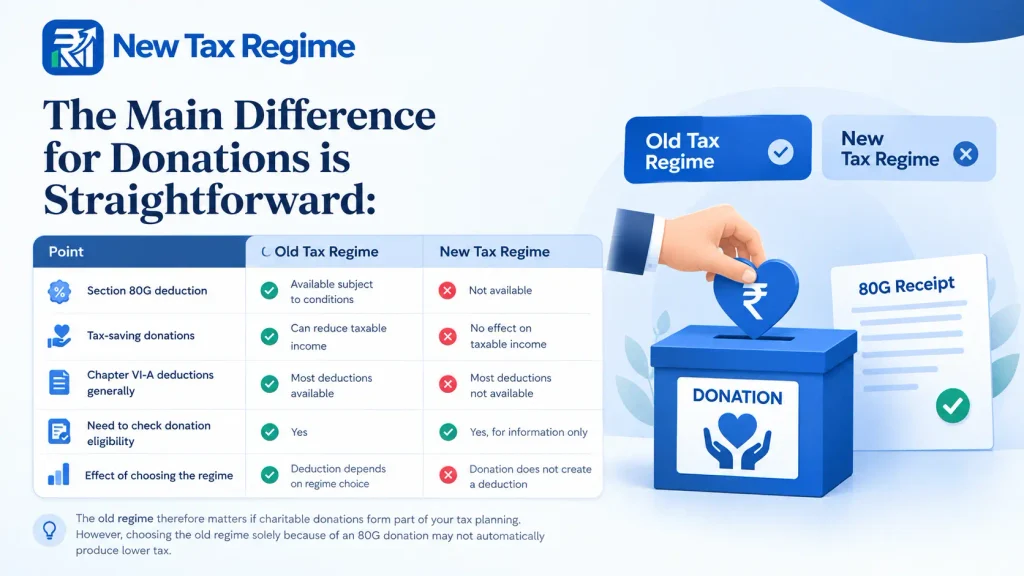
The main difference for donations is straightforward:
| Point | Old Tax Regime | New Tax Regime |
|---|---|---|
| Section 80G deduction | Available subject to conditions | Not available |
| Eligible charitable donation | May qualify for deduction | Donation can still be made, but no 80G deduction |
| 80G deduction percentage | Generally 50% or 100%, depending on category | Not claimable |
| ₹2,000 cash restriction | Applies to Section 80G claims | No 80G claim is available |
| Effect of donation on taxable income | Can reduce taxable income if eligible | Does not reduce taxable income under 80G |
| Regime choice | Required for claiming 80G | 80G cannot be claimed |
The old regime therefore matters if charitable donations form part of a taxpayer’s overall tax planning.
However, choosing the old regime solely because of an 80G donation may not automatically produce lower tax.
The correct comparison is between the tax payable under both regimes after considering all deductions and exemptions available to the taxpayer.
Donation Under 80G in New Tax Regime: What Taxpayers Should Check
Even though a donation does not produce an 80G deduction under the new regime, understanding the Section 80G conditions remains useful when comparing tax regimes.
The four-step eligibility chain
A common misunderstanding is to treat all four of these as the same thing. They are not:
- Donation eligibility: Is the payment a donation at all? Gifts in kind, such as clothes or food, are generally not eligible.
- Section 80G eligibility: Is the recipient an approved institution or fund, and does the donation fall within a category that qualifies for 80G?
- Deduction availability under the chosen regime: Even if steps 1 and 2 are satisfied, the deduction can only be claimed if the taxpayer has opted for a regime where Section 80G is allowed.
- Actual tax benefit: The final benefit depends on the applicable deduction percentage (50% or 100%), any qualifying limit, and the taxpayer’s slab rate.
An 80G receipt addresses only step 2. It does not confirm steps 3 or 4.
Is the recipient organisation eligible?
The organisation or fund receiving the donation must satisfy the conditions applicable to Section 80G.
Taxpayers should not assume that every NGO, trust, charitable organisation or fundraising campaign automatically qualifies.
The recipient’s eligibility and the applicable category of donation should be checked before treating a payment as an 80G-eligible donation.
The Income Tax Department also uses donor information reported by eligible donees to verify claims.
Its current Section 80G FAQ explains that certain donees are required to file Form 10BD, containing donor and donation details, and the donor’s 80G claim should match the information reported by the donee.
Is the donation itself eligible?
The deduction depends on the category into which the donation falls.
Broadly, Section 80G covers donations eligible for 100% or 50% deduction, with some categories having no qualifying limit and others being subject to a qualifying limit.
Therefore, taxpayers should check the specific status of the recipient and the nature of the contribution instead of assuming that the entire donation amount will always be deductible.
Is the payment method acceptable?
For Section 80G purposes, a cash donation exceeding ₹2,000 does not qualify for deduction.
Taxpayers claiming the deduction under the old regime should therefore retain clear evidence of the payment and donation details. The supporting records should correspond with the information reported by the eligible donee.
Keep the donation documents
An 80G claim should be supported by appropriate donation documentation.
The eligible donee may issue a Form 10BE certificate to the donor. This certificate, along with the donation receipt and payment evidence, should be retained for records.
The Income Tax Department’s current guidance highlights the importance of matching the deduction claimed in the ITR with donor information submitted by the donee through the prescribed reporting process.
Keeping the donation receipt, payment evidence and relevant donor information together can make the return-filing process easier and help resolve discrepancies if the claim is questioned.
80G Under New Tax Regime: Practical Examples
The following examples are for illustration only. They show the effect of the tax regime and do not replace the specific eligibility conditions applicable to a particular donation.
Example 1: Taxpayer chooses the new regime
Suppose a taxpayer has taxable income of ₹15 lakh after applicable deductions under the new regime and makes an eligible donation of ₹50,000.
The taxpayer cannot subtract that ₹50,000 donation from taxable income under Section 80G because the new regime does not permit the 80G deduction.
The donation can still be made. The tax benefit under Section 80G, however, is nil under the new regime.
Example 2: Taxpayer chooses the old regime
Suppose the same taxpayer instead opts for the old regime and makes a ₹50,000 donation to an organisation for which the applicable Section 80G deduction is 50% without a qualifying limit.
If all other conditions are satisfied, the eligible deduction would be ₹25,000.
The example demonstrates why the same donation can have different tax consequences depending on the tax regime and the specific 80G category applicable to the recipient.
Example 3: The taxpayer has an 80G document but uses the new regime
Suppose a taxpayer donates ₹1,00,000 to an eligible organisation and receives the relevant donation documentation.
If the taxpayer files the return under the new tax regime, the documentation does not create an 80G deduction. The tax regime restriction applies even though the donation itself may be eligible under Section 80G.
This is why an 80G receipt should not be treated as an automatic guarantee of tax savings.
Common Mistakes When Claiming 80G Donation Deduction
Assuming every charitable donation qualifies: Section 80G applies only to eligible donations meeting the prescribed conditions.
Assuming an 80G document guarantees a deduction: The taxpayer’s chosen tax regime also matters. Under the new regime, Section 80G cannot be claimed.
Comparing regimes based only on the donation: An 80G deduction is only one part of a tax calculation. Other deductions, exemptions, income sources and the applicable slab rates can change the result.
Ignoring the donation category: A donation qualifying for 50% deduction cannot automatically be treated as a 100% deduction.
Ignoring the ₹2,000 cash restriction: Cash donations above ₹2,000 do not qualify for Section 80G deduction.
Failing to retain supporting records: Donation details should be consistent with the information reported by the donee where applicable.
Confusing deduction with rebate: An 80G deduction reduces taxable income, while a tax rebate such as Section 87A operates against tax payable.
What Should You Do Before Claiming an 80G Deduction?
Before including a donation in an income-tax return, use this checklist:
- Identify the tax regime. If the return is filed under the new regime, Section 80G cannot be claimed.
- Check the recipient’s eligibility. Confirm that the fund or institution qualifies under Section 80G.
- Identify the applicable deduction category. Check whether the donation qualifies for 50% or 100% deduction and whether a qualifying limit applies.
- Check the payment method. Cash donations above ₹2,000 do not qualify for the Section 80G deduction.
- Keep supporting documents. Retain the donation receipt, Form 10BE if issued, payment evidence and relevant donor details.
- Compare both tax regimes. If the 80G benefit is significant, calculate the overall tax under the old regime rather than assuming that switching regimes will automatically save money.
- Report the claim accurately. If the old regime is selected and the donation qualifies, enter the applicable 80G details correctly in the ITR.
For FY 2025-26, the key point is simple: Section 80G cannot be claimed under the new tax regime.
If a taxpayer wants to use an eligible donation as an 80G deduction, the old regime must be considered, along with all other applicable tax benefits and restrictions.
Key Takeaways
- 80G deduction is not available under the new tax regime for FY 2025-26.
- An eligible donation can still be made under the new regime, but it does not reduce taxable income through Section 80G.
- Under the old regime, eligible donations can generally qualify for 50% or 100% deduction, depending on the applicable category.
- Cash donations above ₹2,000 do not qualify for Section 80G deduction.
- An 80G receipt or donation document does not override the tax-regime restriction.
- Taxpayers should compare the overall tax liability under both regimes before choosing a regime solely because of charitable donations.
Frequently Asked Questions
Is 80G deduction available in the new tax regime for FY 2025-26?
No. Section 80G deduction cannot be claimed under the new tax regime for FY 2025-26 (AY 2026-27).
The Income Tax Department’s Section 80G FAQ expressly confirms that the deduction cannot be claimed when the taxpayer opts for the new regime under Section 115BAC.
Can I claim 80G deduction if I choose the new tax regime?
No. Choosing the new tax regime means that a taxpayer cannot claim the Section 80G deduction.
The donation itself is not prohibited, but it does not reduce taxable income through Section 80G.
Is donation under 80G allowed in the new tax regime?
The donation can still be made, but the Section 80G tax deduction is not available under the new regime.
The important distinction is between making a charitable contribution and claiming a tax deduction for that contribution.
Can I claim an 80G deduction under the old tax regime?
Yes, an eligible taxpayer can generally claim Section 80G under the old regime if the donation, recipient, payment method and other applicable conditions are satisfied.
The deduction can be 50% or 100%, depending on the relevant category and qualifying limits.
Does an 80G donation receipt guarantee a tax deduction?
No. A donation receipt or related document does not by itself guarantee a tax deduction.
The taxpayer must also be using a regime under which 80G is available, and the donation must satisfy the applicable Section 80G conditions.
