

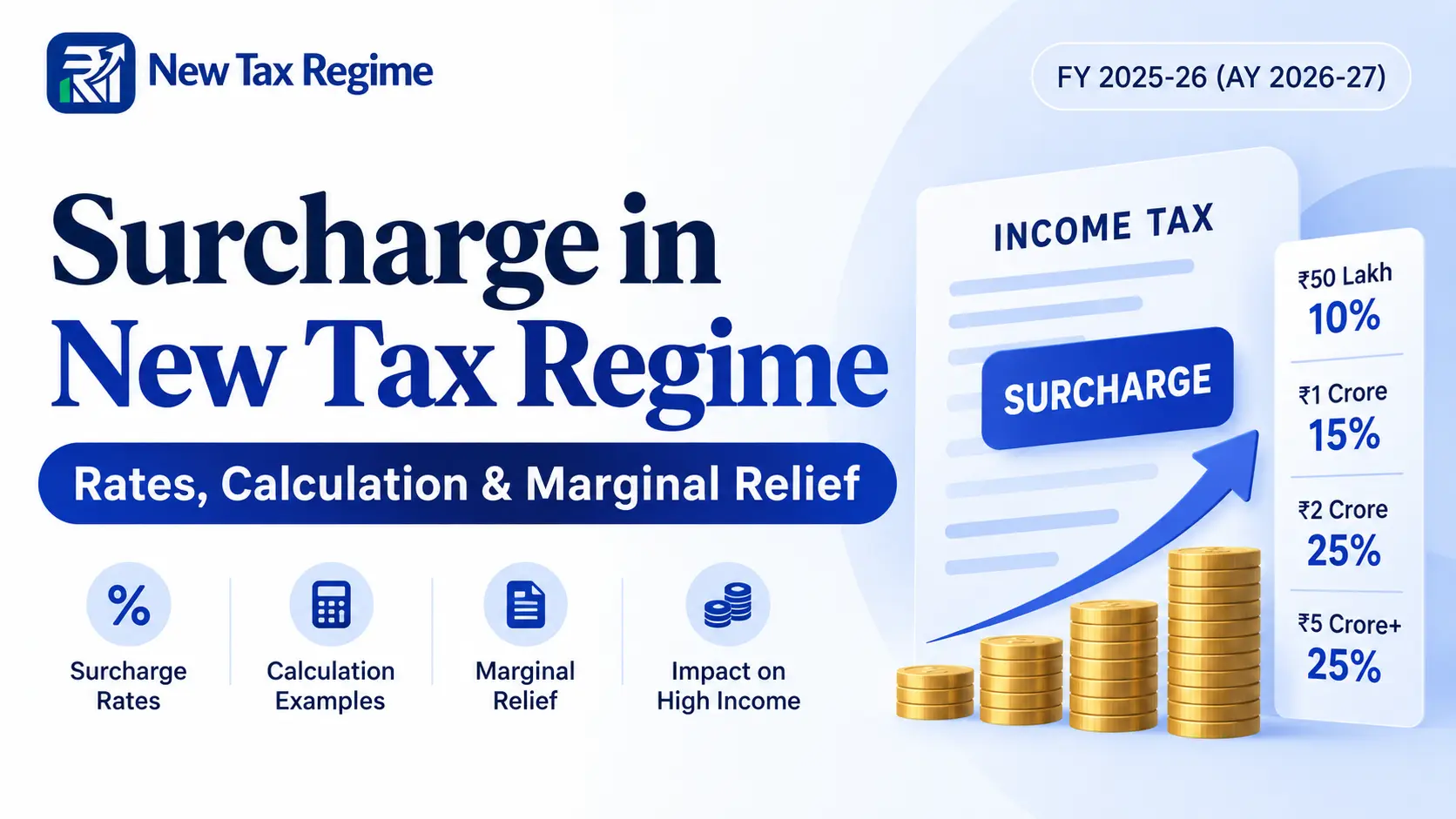
Yes, surcharge applies under the new tax regime. It is an additional charge calculated on your income-tax liability once total income crosses the prescribed thresholds.
For FY 2025-26 (AY 2026-27), surcharge starts at 10% above ₹50 lakh, rises to 15% above ₹1 crore and 25% above ₹2 crore.
The new regime caps the maximum surcharge at 25%, even for income above ₹5 crore, unlike the old regime where it can reach 37%.
The surcharge is calculated on the income tax amount, not directly on your total income. The final liability also includes 4% Health and Education Cess, applied after adding the applicable surcharge.
Special-rate income such as certain capital gains and dividend income has separate surcharge treatment, so high-income taxpayers with mixed income sources need a more detailed calculation.
Discover More About:👇
What Is Surcharge in the New Tax Regime?
Surcharge is an additional charge imposed on the income-tax amount when total income crosses specified limits. It is different from the basic income tax calculated using the applicable tax slabs.
For example, if your calculated income tax is ₹10 lakh and a 10% surcharge applies, the surcharge is ₹1 lakh. It is not 10% of your entire income.
The calculation follows three stages:
Income Tax + Applicable Surcharge = Tax before Cess
Tax before Cess + 4% Health and Education Cess = Final Tax Liability
The 4% cess is payable on income tax plus surcharge, where applicable . Surcharge does not replace the new-regime slab rates. It is an additional layer applied after the basic income-tax calculation.
When Does Surcharge Apply Under the New Tax Regime?
Under the FY 2025-26 new tax regime, surcharge starts when total income exceeds ₹50 lakh. The applicable rate depends on the income band in which the taxpayer falls.
The important thresholds are:
- Above ₹50 lakh: 10% surcharge
- Above ₹1 crore: 15% surcharge
- Above ₹2 crore: 25% surcharge
- Above ₹5 crore: 25% surcharge under the new regime
The surcharge is imposed on the applicable income-tax liability, not directly on the amount exceeding the threshold.
For example, a taxpayer with ₹60 lakh taxable income does not pay 10% surcharge only on the ₹10 lakh above ₹50 lakh. The 10% rate applies to the relevant income-tax liability, subject to marginal relief where applicable.
New Tax Regime Surcharge Rates for FY 2025-26
The new tax regime surcharge rates follow a graduated structure. The first three rates are also seen under the old regime, but the new regime does not impose the old regime’s 37% surcharge above ₹5 crore .
| Total Income | Surcharge Under New Tax Regime |
|---|---|
| Up to ₹50 lakh | Nil |
| Above ₹50 lakh to ₹1 crore | 10% |
| Above ₹1 crore to ₹2 crore | 15% |
| Above ₹2 crore to ₹5 crore | 25% |
| Above ₹5 crore | 25% |
Income Above ₹50 Lakh
The first surcharge band begins once total income exceeds ₹50 lakh. The surcharge rate is 10% of the applicable income-tax liability. Marginal relief can become relevant when income has only slightly crossed the ₹50 lakh threshold .
Income Above ₹1 Crore
When total income exceeds ₹1 crore, the applicable surcharge rate moves to 15%. The higher rate does not mean that 15% is charged only on the income above ₹1 crore.
It is a surcharge on the applicable income-tax liability, subject to marginal relief rules .
Income Above ₹2 Crore
Once total income exceeds ₹2 crore, the new-regime surcharge rate becomes 25%. This is the highest surcharge rate under the new regime and remains at 25% even when income moves above ₹5 crore .
Income Above ₹5 Crore
The new regime continues to apply a 25% surcharge above ₹5 crore. This differs from the old regime, where the surcharge can reach 37% for income above ₹5 crore .
The cap reduces the maximum effective tax rate significantly for very high earners.
How to Calculate Surcharge on Income Tax
The calculation begins with the normal income-tax computation under the applicable new-regime slabs. The simplified sequence is:
- Calculate taxable income.
- Calculate income tax using applicable new-regime rates.
- Identify the surcharge band based on total income.
- Calculate surcharge on the applicable income-tax amount.
- Add 4% Health and Education Cess to income tax plus surcharge.
- Arrive at the final tax liability.
Example: Taxable Income of ₹60 Lakh
Suppose an individual has taxable income of ₹60 lakh for FY 2025-26 and the new regime applies. The applicable new-regime slab calculation is:
| Taxable Income Portion | Rate | Tax |
|---|---|---|
| Up to ₹4 lakh | Nil | ₹0 |
| ₹4 lakh–₹8 lakh | 5% | ₹20,000 |
| ₹8 lakh–₹12 lakh | 10% | ₹40,000 |
| ₹12 lakh–₹16 lakh | 15% | ₹60,000 |
| ₹16 lakh–₹20 lakh | 20% | ₹80,000 |
| ₹20 lakh–₹24 lakh | 25% | ₹1,00,000 |
| Above ₹24 lakh (₹36 lakh) | 30% | ₹10,80,000 |
| Total Income Tax | ₹13,80,000 |
Because taxable income is ₹60 lakh, the applicable surcharge rate is 10%.
Surcharge = ₹13,80,000 × 10% = ₹1,38,000
Health & Education Cess = 4% × (₹13,80,000 + ₹1,38,000)
Cess = ₹60,720
Final tax liability = ₹13,80,000 + ₹1,38,000 + ₹60,720
Final tax = ₹15,78,720
This example illustrates why a taxpayer crossing ₹50 lakh needs to consider more than the slab-based income tax. The surcharge and cess increase the final amount payable .
Marginal Relief When Income Crosses a Surcharge Threshold
Marginal relief is designed to reduce the sharp increase in tax that can occur when income moves just above a surcharge threshold.
For example, if income is only slightly above ₹50 lakh, applying the surcharge could otherwise produce an additional tax burden greater than the additional income earned above ₹50 lakh.
Marginal relief limits this effect according to the prescribed calculation .
For the new tax regime, the relevant surcharge thresholds for marginal relief are ₹50 lakh, ₹1 crore and ₹2 crore. The official AY 2026-27 guidance does not list a ₹5 crore marginal-relief threshold for the new regime; that additional threshold applies to the old regime .
How Marginal Relief Works
The basic principle is to compare the tax and surcharge on income above a threshold with the tax payable at the threshold itself.
At the ₹50 lakh threshold, the tax and surcharge payable after crossing ₹50 lakh should not exceed the tax payable on ₹50 lakh by more than the amount of income exceeding ₹50 lakh.
Consider a taxpayer with income of ₹51 lakh. Without marginal relief, the surcharge at 10% would increase the tax burden by more than ₹1.4 lakh compared to ₹50 lakh income.
This is disproportionate to the extra ₹1 lakh earned. Marginal relief ensures the additional tax does not exceed the additional income, effectively reducing the final liability .
Marginal relief does not eliminate surcharge. It is a limited adjustment intended to prevent a disproportionate tax increase immediately after a threshold is crossed.
The calculation depends on the taxpayer’s total income and applicable tax components, so high-income taxpayers should calculate marginal relief separately rather than assuming the headline surcharge rate is their final effective rate .
Surcharge on Capital Gains and Other Special-Rate Income
The general surcharge rates do not apply identically to every category of income. The enhanced 25% surcharge rate is not levied on income chargeable under Sections 111A, 112 and 112A, and on dividend income. The maximum surcharge on such income is generally 15% in the relevant cases .
Capital Gains
Certain capital gains covered by Sections 111A, 112 and 112A receive special surcharge treatment.
For example, a taxpayer whose overall income places them in the 25% surcharge band does not automatically pay 25% surcharge on tax attributable to qualifying income under these sections.
The applicable surcharge on such income is generally capped at 15%, subject to statutory exceptions .
This distinction matters when a high-income taxpayer has both ordinary income and substantial investment gains.
Dividend Income
Dividend income also receives separate surcharge treatment under the applicable rules. The enhanced 25% surcharge is not imposed on dividend income in the manner applicable to ordinary income, subject to specified exceptions.
A taxpayer with a combination of salary, business income, dividends and capital gains cannot always calculate the final surcharge by applying one percentage to the entire tax bill .
Lottery and Similar Winnings
Certain winnings, including lottery and similar income covered by special-rate provisions, are taxed differently from ordinary slab-rate income. For such income, the special tax rate is calculated separately and the applicable surcharge rules must then be considered.
A taxpayer should not assume that the surcharge treatment of qualifying capital gains automatically applies to lottery or other special-rate winnings.
25% Surcharge Cap Under the New Tax Regime
The 25% surcharge cap is particularly relevant for very high-income taxpayers. Under the old regime, the surcharge can reach 37% when income exceeds ₹5 crore. Under the new regime, the surcharge remains at 25% even above that level .
The difference can materially affect the tax calculation for someone with very high taxable income.
However, the comparison should be made on the actual composition of income because special-rate income may have its own surcharge restrictions.
The cap also does not remove the 4% Health and Education Cess, which continues to be calculated on income tax plus applicable surcharge.
For this reason, the 25% figure should be understood as a surcharge rate, not as the taxpayer’s maximum overall tax rate. The effective marginal rate can still be higher after accounting for the base slab rate and cess.
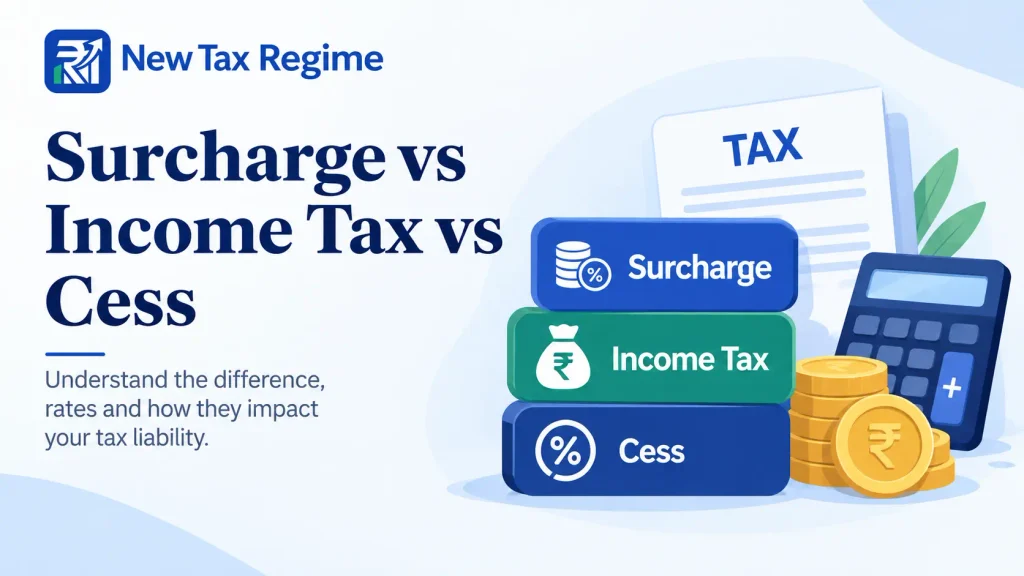
Surcharge vs Income Tax vs Cess
These three components perform different functions in the tax calculation.
| Component | What It Means |
|---|---|
| Income Tax | Tax calculated on taxable income using the applicable tax rates |
| Surcharge | Additional charge calculated on applicable income tax when specified income thresholds are crossed |
| Health & Education Cess | 4% charge calculated on income tax plus applicable surcharge |
The order matters. First, income tax is calculated. Where applicable, surcharge is added to that tax. The 4% cess is then calculated on the combined income-tax and surcharge amount .
Key Takeaways
- Surcharge under the new regime starts when total income exceeds ₹50 lakh.
- The applicable rates are 10%, 15% and 25% as income crosses the relevant thresholds.
- The new regime has a maximum surcharge rate of 25%, including for income above ₹5 crore.
- Marginal relief under the new regime is relevant at the ₹50 lakh, ₹1 crore and ₹2 crore surcharge thresholds.
- Certain capital gains and dividend income have separate surcharge treatment, with a general 15% maximum for specified categories.
- 4% Health and Education Cess is calculated after adding applicable surcharge to income tax.
Frequently Asked Questions
Is there a surcharge in the new tax regime?
Yes. Surcharge applies when total income crosses the prescribed threshold.
Under the FY 2025-26 new regime, it starts above ₹50 lakh at 10%, rises to 15% above ₹1 crore and 25% above ₹2 crore. The rate remains capped at 25% above ₹5 crore.
What is the surcharge rate under the new tax regime?
The new-regime surcharge rates are 10% for income above ₹50 lakh up to ₹1 crore, 15% above ₹1 crore up to ₹2 crore, and 25% above ₹2 crore.
Income above ₹5 crore also remains subject to the 25% rate under the new regime.
